Stand mixers are wonderful, but they are also big, heavy and inclined to colonise a worktop, which is a problem if your kitchen is the size most British flats and terraces actually offer. The good news is that you no longer have to choose between a proper stand mixer and a usable kitchen: there is now a strong choice of compact and lightweight machines that bake beautifully without dominating the room. This round-up picks the best of them for 2026, judged first on footprint and weight and second on how well they actually mix, because in a small kitchen the order of those priorities is reversed from usual. For the full-size options and the wider buying advice, see our main [best stand mixers UK 2026] guide.
Everything here is chosen with the realities of a small kitchen in mind: a machine that has to be lifted out of a cupboard for each use, a worktop where every centimetre is contested, and storage that may mean a high shelf or a tight cabinet. We have weighed those constraints as heavily as the baking performance, because the best mixer in the world is no use if it never comes out of the cupboard. The headline is that a small kitchen costs you a little capacity but need cost you almost nothing in quality.
Who tested this and how
I am Ben, the editor of Kitchen Kit, and I run this site from a London flat with the kind of compact kitchen this round-up is written for, so the footprint and weight judgements here come from genuine daily frustration and relief rather than a tape measure alone. I know what it is to heave a heavy mixer out of a low cupboard, to lose half a worktop to a machine while baking, and to want something that fits the life I actually have, and that is the lens I have applied throughout.
My testing put each machine through the everyday baking a small-kitchen household realistically does, cakes, biscuits, buttercream, whipped cream and lighter doughs, while paying close attention to the things that matter when space is tight: the actual worktop footprint, the height (which decides whether it fits under a wall cabinet), the weight when lifting, and how easily it stores away. A compact mixer that mixes well but is still a back-breaker to lift, or too tall to live under your cupboards, has failed the brief, so those practicalities carried real weight in the verdicts.
Best overall for small kitchens: KitchenAid Artisan Mini 3.3L
The KitchenAid Artisan Mini is the machine most small-kitchen bakers should buy, because it delivers the thing that makes the full-size Artisan great, superb planetary mixing and a build that lasts, in a body that is meaningfully smaller and lighter. KitchenAid shrank the footprint and the weight without watering down the mixing action, so you get the same thorough, sides-and-base coverage and the same reassuring solidity, just in a machine that fits a real worktop and is far easier to lift in and out of a cupboard. For everyday cakes, bakes and frostings, it performs like its bigger sibling.
The trade-off is capacity: at 3.3 litres the bowl is smaller, so it suits a household baking for a few rather than a crowd, and very large batches are out. For most small-kitchen households that is exactly the right size, and the smaller bowl is actually easier to use for the modest quantities such kitchens tend to make. You also keep access to much of the KitchenAid attachment ecosystem, so the mixer can still grow with you. Our full [KitchenAid Artisan 4.8L review] covers the family’s mixing and longevity, all of which applies to the Mini. If you want one machine that fits a small space and you will never feel you settled, this is it.
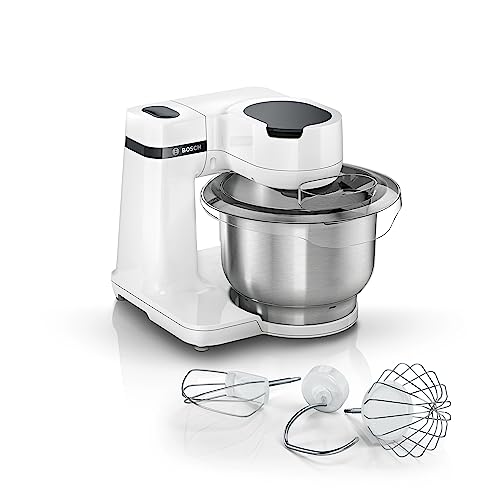
Best lightweight and easy to store: a compact Bosch MUM
If weight is your main enemy, a machine you have to wrestle out of a low cupboard every time, a compact Bosch MUM model is the pick, because Bosch’s smaller mixers are noticeably lighter than the premium metal-bodied machines while still mixing everyday bakes competently. For someone with limited strength or an awkward storage spot, that lower weight is not a minor nicety; it is the difference between a mixer that gets used and one that stays put. The friendlier price is a welcome bonus on top.
The compromises are the familiar ones for a lighter, cheaper machine: it feels less premium than the KitchenAid, the attachment range is smaller, and it is less suited to heavy doughs. But for a small-kitchen baker whose priority is a capable machine that is genuinely easy to handle and store, it hits the brief squarely. Buy it over the KitchenAid Mini if ease of lifting and a lower price matter more to you than outright mixing polish and the wider ecosystem. Plenty of space-pressed bakers will find it the more practical companion day to day.
Best budget compact: a sub-£100 small stand mixer
For those who want a small mixer and a small price, the sub-£100 compact machines from value brands and own-labels, such as Argos’s Cookworks line, are worth considering. They are genuinely small and genuinely cheap, and for occasional light baking, the odd cake, a batch of biscuits, some whipped cream, they do the job and tuck away easily. In a small kitchen on a tight budget, a compact budget mixer is a reasonable, honest way to get most of the convenience for very little money and very little space.
Go in clear about the trade-offs, though, because they are the same ones that apply to budget mixers everywhere, just in a smaller package. Expect more noise and vibration, a weaker motor that will struggle with anything stiff, and a build designed to last years of light use rather than decades. The compact size does not change that calculus. If your baking is light and occasional and space and money are both tight, a budget compact is a sensible buy; if you bake more, the KitchenAid Mini will serve you far better for far longer.
How to choose a compact stand mixer
Choosing for a small kitchen means leading with the measurements rather than the mixing, because the practical fit is what will make or break daily use. Three numbers matter most, and they are easy to overlook in the excitement of choosing a colour. The first is the footprint, the worktop area the base occupies, which decides how much usable surface you keep while baking. The second is the height, which decides whether the machine fits under your wall cabinets, with the head up if it is a tilt-head model, so measure that gap before you buy. The third is the weight, which decides how painful it is to move in and out of storage.
[INSERT COMPARISON TABLE HERE – 4 rows, 4 columns: Model | Bowl capacity | Footprint / height | Weight. Rows: KitchenAid Artisan Mini 3.3L; Compact Bosch MUM; Sub-£100 compact (e.g. Cookworks); plus a ‘what to check’ note row]
Beyond the measurements, match the bowl capacity to your real batch sizes rather than to ambition, as a smaller bowl is genuinely easier for the modest quantities small households tend to bake, and do not be seduced into a bigger machine than your space or your baking warrants. Our [how to choose a stand mixer for a UK kitchen] guide goes through the full set of considerations, but for a small kitchen the rule is simple: get the dimensions and weight right first, then choose the best-mixing machine that fits. A brilliant mixer that does not fit your kitchen is the wrong mixer.
What you give up with a compact mixer (and what you don’t)
It is worth being precise about the trade-offs of going compact, because the popular assumption that a smaller mixer is a worse mixer is mostly wrong. What you genuinely give up is capacity: a smaller bowl means smaller batches, so if you regularly bake for a large family or make big quantities of bread, a compact machine will frustrate you and a full-size model is the better buy. You may also lose a little on the very heaviest doughs, where the larger, more powerful machines pull ahead, though most small-kitchen baking never gets near that limit.
What you do not give up, with a well-chosen compact machine, is mixing quality. The KitchenAid Artisan Mini uses the same planetary action as its bigger sibling, so cakes, biscuits, buttercream and whipped cream come out just as well; you are simply making a sensible quantity at a time. For the great majority of small-kitchen households, that is a trade entirely worth making, more usable space and an easier-to-handle machine, in exchange for a bowl size that suits how they actually bake anyway. Framed honestly, compact is not a compromise so much as a better fit.
Small-kitchen tips to get the most from your mixer
A few habits make a compact mixer even more livable in a tight kitchen. If you have any spare vertical space, a sturdy shelf at a comfortable height saves the back-straining low-cupboard lift entirely, and keeping the mixer near a power point you do not have to clear means it is quicker to deploy and therefore used more. Storing the bowl and attachments inside the bowl, or in a single labelled box nearby, stops the machine’s accessories from scattering across drawers you do not have to spare.
When baking, position the mixer toward the back of the worktop with the head clearance checked in advance, so you keep usable space in front of it, and choose recipes scaled to the smaller bowl rather than fighting to cram a full-size batch into it. None of this is essential, but in a kitchen where space is the binding constraint, these small adjustments are the difference between a mixer that feels like an imposition and one that feels like it belongs.
Which should you buy?
For most small-kitchen bakers, the KitchenAid Artisan Mini 3.3L is the right answer: nearly all the quality and durability of the full-size Artisan in a body that actually fits, and the one to buy if you want a machine you will keep for years without resenting its size. Choose a compact Bosch MUM instead if weight and easy storage are your overriding concern, or if you want to spend less, accepting a less premium feel in return.
Drop to a sub-£100 compact only if your baking is light and occasional and both space and budget are genuinely tight. Whatever you choose, measure your worktop and the gap under your cabinets before you buy, and be honest about how heavy a machine you are willing to lift regularly. Get those practicalities right and a small kitchen is no barrier at all to owning a stand mixer you will love using.
FAQ
What is the best stand mixer for a small kitchen?
The KitchenAid Artisan Mini 3.3L is our top pick: it delivers the same excellent mixing as the full-size Artisan in a smaller, lighter body that fits real worktops and is easier to store. If weight or budget matters more, a compact Bosch MUM or a sub-£100 compact mixer are sensible alternatives.
Are mini stand mixers as good as full-size ones?
For everyday baking, largely yes. A machine like the KitchenAid Artisan Mini mixes just as well as its full-size sibling; you mainly give up bowl capacity, so very large batches are out. For the modest quantities most small-kitchen households bake, a compact mixer is every bit as capable and easier to use.
How much worktop space does a stand mixer need?
More than the base alone, because tilt-head models need clearance above to lift the head, and most need to sit out from the wall a little. Always check both the footprint and the height against the gap under your wall cabinets before buying. Compact models are designed to minimise both, which is exactly why they suit small kitchens.
Can I store a stand mixer in a cupboard?
Yes, and many small-kitchen owners do, which is why weight matters so much. A lighter compact machine like a Bosch MUM is far easier to lift in and out daily than a heavy metal-bodied mixer, and a machine that is easy to retrieve is a machine you will actually use. If yours lives in a cupboard, prioritise weight as well as size.
Is it worth buying a compact mixer or should I just use a hand mixer?
If you bake regularly or make dough, a compact stand mixer is well worth it, as it works hands-free and handles jobs a hand mixer cannot. If you bake only rarely and in small amounts, a hand mixer is cheaper and stores in a drawer. The deciding factors are how often you bake and whether you knead dough.