A stand mixer is one of the few kitchen purchases that genuinely earns the cliché “buy once, cry once”. A good one outlasts most marriages and takes the hardest, most tedious jobs in baking, creaming butter and sugar, whipping meringue, kneading bread dough, and does them better than your arms ever could while you get on with something else. A bad one rattles across the worktop, struggles with anything stiff, and ends up in a cupboard within a year. Because the gap between the best and the worst is so wide, and because the good ones are not cheap, this is a decision worth getting right, and that is what this guide is for. If you have a small kitchen, read this alongside our dedicated [best stand mixer for small UK kitchens 2026] round-up, which weighs footprint above all else.
We have tested the stand mixers that matter in the UK in 2026 across the jobs people actually do with them, not just the easy ones, and our picks below are organised by who each machine is for rather than ranked one to ten, because the right mixer depends heavily on what and how much you bake. Below the picks you will find a plain-English guide to the specifications that matter, so you can judge any model, not just the ones we name. The headline, if you want it now, is that the KitchenAid Artisan remains the one most home bakers should buy, but it is not automatically the right answer for everyone, and the rest of this guide explains when it is not.
Who tested this and how
I am Ben, the editor of Kitchen Kit, and I have baked with stand mixers in a normal-sized London kitchen for years, which means I have lived with their real-world annoyances as well as their strengths: the weight when you lift one out of a cupboard, the noise in a flat with thin walls, the worktop footprint that a spec sheet never quite conveys. For this round-up I put the leading machines through the full range of jobs a home baker throws at them rather than a single showcase task, because a mixer that whips cream beautifully can still struggle with a stiff dough.
My testing covered the things that separate a great mixer from a merely adequate one: creaming butter and sugar for cakes, whisking egg whites to stiff peaks, and, the real test, kneading firm bread and enriched doughs that make weaker machines walk, bog down or overheat. I baked the same recipes across machines to compare results directly, and I paid as much attention to the unglamorous details, how easy the bowl is to fit and remove, how well the splash guard works, how stable the machine stays at speed, as to the mixing itself, because those are the things you live with every day. The individual machines each have a full review of their own, linked below, and this guide is the overview that ties them together.
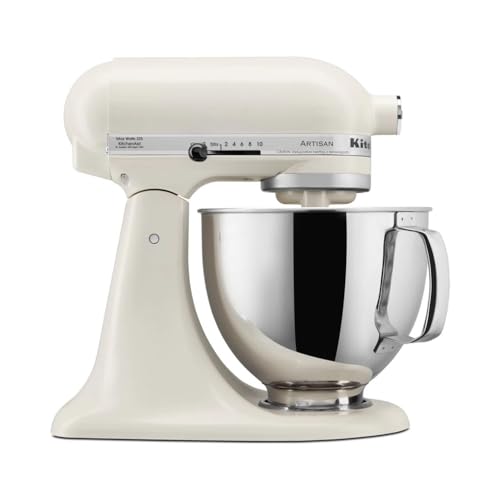
Best overall: KitchenAid Artisan 4.8L
The KitchenAid Artisan is the default recommendation for most home bakers, and it earns that status through a combination of mixing quality, longevity and ecosystem that nothing else quite matches at the price. Its planetary mixing action, where the beater rotates one way while travelling around the bowl the other, is exceptionally thorough, reaching the sides and base cleanly so you spend less time scraping down. For everyday cake batters, biscuit doughs, buttercream and meringue, it is superb, and it does these jobs with a solidity and smoothness that feels reassuringly built to last, because it is; these machines routinely run for decades.
The other half of the Artisan’s appeal is the attachment system. The hub on the front takes a vast range of add-ons, pasta rollers, meat grinders, spiralizers, vegetable sheet cutters, so the mixer can become the anchor of a much wider set of kitchen jobs over time. That ecosystem, and the enormous choice of bowl colours that has made the Artisan a worktop icon, is part of what you are paying for, and whether it is worth it depends on how much you will use it. Our full [KitchenAid Artisan 4.8L review] goes deeper on living with one long-term.
The honest caveats are two. The Artisan is not the best choice for people who bake a lot of stiff bread dough, where its tilt-head design and motor are more stressed than a bowl-lift Kenwood, and it is not cheap. But for the broad middle of home baking, cakes, bakes, frostings, the occasional loaf, it is the most capable, most pleasant and most durable choice, which is exactly why it tops this list.
Best for big batches and heavy doughs: Kenwood Chef XL Titanium
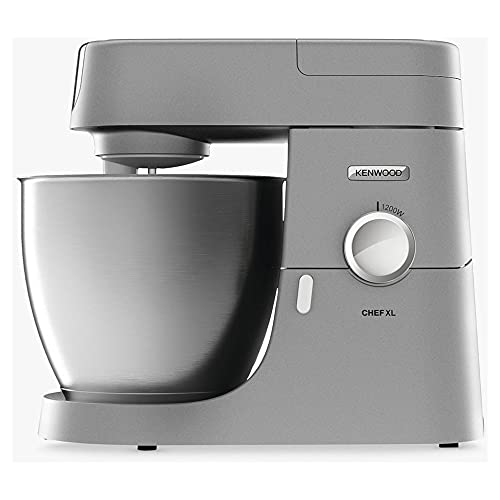
If your baking leans toward bread, large quantities, or both, the Kenwood Chef XL Titanium is the better tool, and for serious or frequent bakers it may be the better buy outright. It pairs a more powerful motor with a larger bowl than the KitchenAid Artisan, and it uses a bowl-lift design that, combined with that extra power, makes it noticeably more comfortable with stiff bread doughs and big batches that would have a tilt-head machine working hard. Where the Artisan is a brilliant all-rounder, the Kenwood is the workhorse, and it shows its advantage exactly when the job gets demanding.
The larger bowl is a genuine practical benefit if you bake for a crowd or batch-cook, letting you double recipes without splitting them, and Kenwood’s own attachment range, while different from KitchenAid’s, is similarly broad and capable. The trade-offs are size and feel: the Chef XL is a big machine that demands real worktop or storage space, and while it is superbly capable, some find its styling and interface a touch more utilitarian than the KitchenAid’s. None of that detracts from what it does best. Our [Kenwood Chef XL Titanium review] covers its capacity and dough performance in detail.
Choose the Kenwood over the KitchenAid if you bake bread regularly, if you frequently make large quantities, or if raw capability matters more to you than the KitchenAid’s polish and colour range. Choose the KitchenAid instead if your baking is more general and you value the smaller footprint and the wider attachment ecosystem. Either way you are buying a machine that will last.
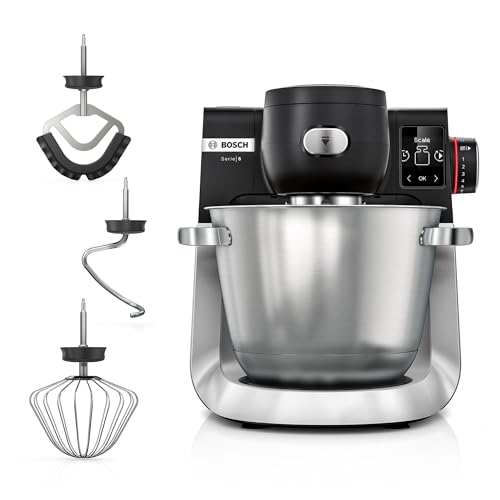
Best value all-rounder: Bosch MUM Series 6
Not everyone needs, or wants to pay for, a KitchenAid or a top Kenwood, and the Bosch MUM Series 6 is our pick for the buyer who wants most of the capability for noticeably less money. It handles the core jobs, creaming, whisking, mixing and lighter doughs, well, comes with a generous bowl, and is lighter to lift than the heavier premium machines, which matters more than people expect if you store your mixer in a cupboard rather than leaving it out. For a household that bakes regularly but not heroically, it covers the ground at a friendlier price.
The compromises are real but reasonable at the money. The Bosch feels less premium than the KitchenAid, its attachment ecosystem is smaller and less glamorous, and it is not the machine to buy if you routinely make stiff artisan bread doughs in big batches, where the premium workhorses pull ahead. But for the great majority of home baking, it does the job competently and for less outlay, which is exactly what a value pick should do. Our [Bosch MUM Series 6 review] weighs up where it matches the pricier machines and where it does not.
Buy the Bosch if you want a capable everyday mixer without premium pricing, if weight and easy handling matter to you, and if your baking does not regularly involve the heaviest doughs. It is the sensible-money choice, and there is no shortage of bakers who would be perfectly happy never owning anything more.
Best budget: a sub-£100 stand mixer
At the bottom of the market sit a cluster of sub-£100 stand mixers from value brands and supermarket own-labels, of which Argos’s Cookworks line is a familiar UK example. These machines exist to answer a real question, what if I only bake occasionally and cannot justify spending serious money, and on those terms they are a defensible choice. A budget mixer will cream butter and sugar, whip cream, and mix a cake batter perfectly well, and for someone who bakes a few times a month it removes the worst of the manual effort for very little outlay.
It is important to be clear-eyed about what you are not getting, though. Budget mixers vibrate and walk across the worktop more, they are louder, their motors are weaker and will labour or overheat with stiff doughs, and they are built to last years rather than decades. They are a false economy if your baking is heavy or frequent, because you will outgrow or wear out the machine and end up buying twice. But if your baking is genuinely light, a budget stand mixer is an honest, money-saving way in, and far better than no mixer at all.
Buy a budget machine only if you are sure your baking is light and occasional, and go in expecting more noise, more movement and a shorter life than the premium options. If you suspect you will bake more than that, stretch to the Bosch instead, which will reward the extra spend many times over.
How to choose a stand mixer: what actually matters
Specifications on a stand mixer box can be misleading, with wattage in particular doing a lot of marketing work it does not deserve, so it helps to know which numbers and features genuinely affect the baking and which are noise. The short version is that build quality, mixing action and the right capacity matter far more than a big wattage figure, and the section below explains why. For a deeper walkthrough, our [how to choose a stand mixer for a UK kitchen] guide takes it step by step, with a table comparing the key specs side by side.
[INSERT COMPARISON TABLE HERE – 5 rows, 4 columns: Spec | What it means | What to look for | Common trap. Rows: Motor & wattage; Bowl capacity; Drive/mixing action (planetary, tilt-head vs bowl-lift); Build & weight; Attachments & ecosystem]
Power and motor: ignore the wattage headline
Wattage tells you how much electricity the motor draws, not how effectively the machine mixes, and cheaper mixers often quote high wattage precisely because their motors are inefficient. What matters is whether the machine can knead stiff dough without bogging down or overheating, and that comes from motor quality and gearing, not raw watts. The premium machines feel effortless on heavy doughs not because they draw more power but because they are engineered to deliver it well. Treat a low wattage on a well-built machine as no cause for concern, and a high wattage on a cheap one as no reassurance.
Bowl size: match it to how you bake
Bowl capacity should match your typical batch, not the largest thing you might one day attempt. A 4 to 5 litre bowl, like the KitchenAid Artisan’s, suits most home baking comfortably and is easier to use for small quantities than a very large bowl, which can leave a single egg white stranded out of reach of the whisk. Go larger, toward the Kenwood Chef XL’s capacity, only if you genuinely batch-bake or cook for crowds, because a bigger bowl also means a bigger, heavier machine that takes more space. Bigger is not better; right-sized is better.
Tilt-head versus bowl-lift: a real choice
The two main designs handle differently. Tilt-head machines, like the KitchenAid Artisan, let you tip the head back to access the bowl, which is convenient and keeps the machine more compact, and they suit most home baking well. Bowl-lift machines, like the Kenwood Chef XL, raise the bowl up to a fixed head and tend to be sturdier under heavy load, which is why the serious bread machines use them. Neither is simply better; tilt-head wins on convenience and footprint, bowl-lift wins on stability under stiff doughs. Match the design to your baking rather than to a spec.
Build quality and weight: the hidden everyday factors
Two practical factors get overlooked on paper and matter every time you use the machine. Build quality, especially a metal rather than plastic gear train and a heavy, stable base, is what separates a mixer that lasts decades from one that wears out, and it is the main thing your money buys at the premium end. Weight is the flip side: a heavy, well-built machine is stable in use but a genuine chore to lift in and out of a cupboard, so if you cannot leave your mixer on the worktop, a lighter machine like the Bosch may serve you better day to day. Be honest about where the machine will live before you buy.
Also worth considering
A few machines sit outside our core picks but deserve a mention because they suit specific buyers well. The Smeg stand mixer is the choice for people who want their mixer to be a design object as much as a tool: it bakes capably and its retro styling has made it a worktop favourite, though you do pay a premium for the looks relative to outright performance. If style leading the decision sounds like you, it is a credible buy; if not, your money goes further elsewhere.
At the higher end, Kenwood’s Titanium Chef Baker range adds a built-in weighing scale to the bowl, which sounds gimmicky until you have used it and realised how much faster and tidier it makes weighing ingredients straight into the mix. For keen bakers who weigh everything, that single feature can justify the step up. And for anyone tempted by the very top of the market, the larger bowl-lift KitchenAid Professional models offer more capacity and dough capability than the Artisan, at a price and footprint that only frequent bread bakers will want to justify. None of these displaces our main picks for the typical buyer, but each is the right answer for a particular kind of baker.
Attachments worth buying (and ones to skip)
Part of the appeal of a premium stand mixer is the attachment ecosystem, but not every attachment earns its place, and it is easy to spend more on add-ons than on the machine itself. The ones that genuinely transform what the mixer can do are the pasta roller and cutter set, which turns a mixer into a serious pasta maker, and the meat grinder, which is excellent value if you make your own burgers, sausages or mince. A spiralizer or vegetable sheet cutter is useful if you will actually use it, though many people buy one and forget it.
The attachments to think twice about are the novelty ones, ice cream bowls that need long freezing, single-purpose gadgets you will use once a year, and anything that duplicates a cheaper standalone tool you already own. The honest advice is to buy the machine first, live with it, and add attachments only when you hit a specific job you want it to do, rather than buying a bundle on day one. Bought that way, the ecosystem is a real long-term advantage; bought speculatively, it is mostly clutter.
Do you even need a stand mixer?
Before spending, it is worth asking honestly whether a stand mixer is the right tool for you at all, because for some bakers a hand mixer does the job for a fraction of the money and space. If you bake only occasionally, make small quantities, and never tackle bread dough, a good hand mixer will cream butter and sugar and whip cream perfectly well, costs a fraction as much, and tucks into a drawer. The case for a stand mixer is strongest when you bake often, make larger batches, knead dough, or simply value being hands-free while the machine works.
If you are on the fence, the deciding questions are how often you bake and whether you make dough. Frequent bakers and bread makers will get their money’s worth from a stand mixer many times over and should buy one without hesitation; occasional bakers of cakes and biscuits may be better served, and better off financially, with a hand mixer. There is no virtue in owning a machine you use twice a year, however handsome it looks on the worktop.
Which stand mixer should you buy?
For most home bakers, the KitchenAid Artisan 4.8L is the right answer: the best all-round mixing, the widest attachment ecosystem, and a build that will outlast almost everything else in your kitchen. It is the safe, excellent default, and the one to buy if you are not sure. Step up to the Kenwood Chef XL Titanium if you bake bread regularly or in large quantities and want the extra power and capacity, accepting the larger footprint in return.
Choose the Bosch MUM Series 6 if you want a capable everyday mixer without premium pricing and value its lighter weight, and drop to a sub-£100 budget machine only if your baking is genuinely light and occasional and you would rather not spend more. Whichever you pick, buy the right machine for how you actually bake rather than the most impressive one, and read the individual reviews and our [KitchenAid vs Kenwood vs Bosch] head-to-head before you commit. A stand mixer bought well is a decade or more of better, easier baking.
FAQ
What is the best stand mixer in the UK for 2026?
For most home bakers, the KitchenAid Artisan 4.8L, thanks to its excellent mixing, huge attachment range and decades-long build. If you bake a lot of bread or large batches, the Kenwood Chef XL Titanium is the stronger choice, and the Bosch MUM Series 6 is the best value all-rounder for those who want capability without premium pricing.
Is a KitchenAid or a Kenwood better?
It depends on your baking. The KitchenAid Artisan is the better all-rounder, with a smaller footprint and a wider attachment ecosystem, ideal for general baking. The Kenwood Chef XL is more powerful with a larger bowl, making it better for bread and big batches. Neither is simply better; match the machine to what you bake.
Does wattage matter when buying a stand mixer?
Less than you would think. Wattage measures power draw, not mixing effectiveness, and cheap mixers often quote high wattage because their motors are inefficient. Build quality, gearing and mixing action matter far more. A well-built machine with modest wattage will out-knead a poorly built one with a bigger number.
Are budget stand mixers worth buying?
For light, occasional baking, yes. A sub-£100 machine will cream, whisk and mix cake batter perfectly well and removes the worst of the manual effort cheaply. But expect more noise, more vibration, weaker performance on stiff dough, and a shorter life. If you bake often or make bread, a budget mixer is a false economy.
How long should a good stand mixer last?
A premium machine like a KitchenAid or top Kenwood can last for decades with basic care, which is why they are described as buy-once purchases. Mid-range machines like the Bosch should give many years of regular use, while budget mixers are typically built to last a few years of light use rather than a lifetime.