


A digital kitchen scale is the cheapest upgrade you can make to your baking. Cup measures and spoons are notoriously inconsistent – a cup of flour can vary by 20% or more depending on how it is scooped – while a scale gives you the same result every time. Almost every modern UK recipe is written in grams for exactly that reason.
The good news is that you do not need to spend much. A dependable scale costs less than a bag of good-quality baking tins, and the differences between models come down to precision, capacity, platform size and a handful of convenience features. This guide narrows the choice to seven scales available at Amazon UK right now, from a £6 budget option to a £50 premium model. If you are kitting out a kitchen for baking, our best stand mixers guide covers the rest of the essentials.
Prices were checked on Amazon UK in September 2026. Kitchen scales are frequently discounted, so check the live price before you buy.
The best digital kitchen scales at a glance
- Best overall: Salter Disc Digital Kitchen Scale (5kg, 1g) – about £17
- Best premium: OXO Good Grips 5kg Stainless Steel Food Scale – about £50
- Best for precision baking: Etekcity EK9000 (5kg, 0.1g) – about £15
- Best waterproof: BOMATA IPX6 Kitchen Scale (5kg, 0.1g) – about £18
- Best for large quantities: Etekcity 10kg Rechargeable Kitchen Scale – about £23
- Best with a bowl: Etekcity Kitchen Scale with Stainless Bowl – about £16
- Best budget: Amazon Basics Digital Kitchen Scale – about £6
How kitchen scales differ
Kitchen scales fall into three broad groups. Standard flat scales weigh in 1g steps up to around 5kg and cover almost all everyday baking and cooking. Precision scales weigh in 0.1g steps, which matters for small quantities such as yeast, salt, baking powder and coffee. Premium and specialist scales add better build, larger capacities, rechargeable batteries, waterproofing or clever touches like a display that pulls away from the platform.
Until recently, 0.1g precision usually meant a small pocket scale with a capacity of 500g or so. That has changed: several scales in this guide combine 0.1g increments with a full 5kg capacity, so one scale can now handle both a bowl of bread dough and the 7g of yeast that goes into it. For many bakers, that makes a 0.1g model the smartest single purchase.
The best digital kitchen scales in detail
1. Salter Disc Digital Kitchen Scale – Best overall (about £17)
Salter has been making kitchen scales for generations, and the Disc is one of the best-selling scales in the UK for good reason. It weighs up to 5kg in 1g increments, which covers everything from a batch of bread dough to a heavy mixing bowl of cake batter, and the round stainless steel platform is designed to hold most mixing bowls without hiding the display.
The add-and-weigh (tare) function lets you zero the scale between ingredients and weigh everything into a single bowl, saving on washing up. The Aquatronic feature means it can also measure liquids in millilitres, so you can pour water or milk straight into the bowl rather than using a jug. It switches between metric and imperial units and runs on a CR2032 coin battery.
At around 630g, it is light and slim enough to stand on its end in a cupboard or slide into a drawer. The main limitation is precision: like any 1g scale, it is not the right tool for weighing 2g of yeast or salt accurately. It is sold by Amazon and holds an average rating of around 4.5 out of 5 at the time of writing.
Best for: anyone who wants one reliable, affordable scale for everyday baking and cooking.
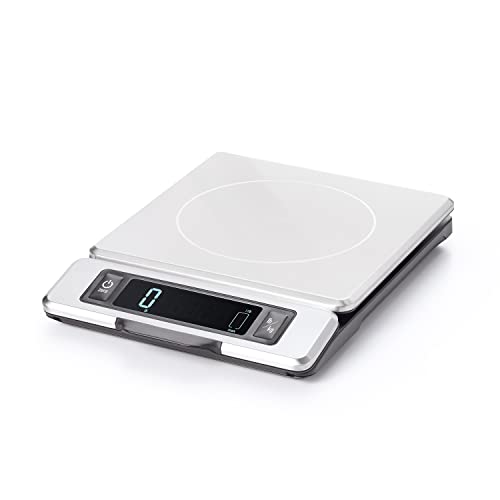
2. OXO Good Grips 5kg Stainless Steel Food Scale – Best premium (about £50)
The OXO Good Grips scale solves the most common annoyance with flat kitchen scales: a large bowl overhanging the platform and blocking the display. Here, the digital display pulls away from the base, so you can read it clearly whatever size of bowl or plate is on top. The large numbers have an optional backlight, too.
It weighs up to 5kg in 1g increments, starting from 2g, and a capacity meter shows how much of the maximum weight you have left – handy when you are building up a large bowl of ingredients. The stainless steel platform is easy to wipe clean, the thin profile makes it simple to store, and four AAA batteries are included. OXO also backs it with its Better Guarantee for repairs or replacements.
The catch is price. It offers the same 1g accuracy as the Salter at roughly three times the cost, so you are paying for build quality, convenience and the pull-away display rather than more accurate weighing. It is currently sold by Harts of Stur through Amazon rather than by Amazon directly, and averages around 4.7 out of 5 – one of the highest ratings in this guide.
Best for: keen bakers who weigh ingredients several times a week and want a scale built to last.
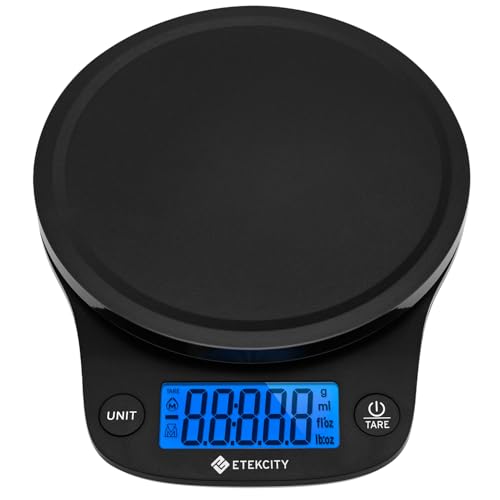
3. Etekcity EK9000 – Best for precision baking (about £15)

The Etekcity EK9000 is the scale to buy if you bake bread, make pastry or brew coffee. It weighs in 0.1g increments from a minimum of 0.3g, so small quantities of yeast, salt, baking powder and spices can be measured properly rather than rounded to the nearest gram. Unlike traditional pocket scales, it still has a 5kg capacity, so it can handle a full mixing bowl as well.
It measures in five units – grams, ounces, pounds, fluid ounces and millilitres – and can switch between water and milk density when measuring liquids. The ultra-slim design runs on AAA batteries and stores easily, and the 6.3 x 2.5cm LCD display is clear and easy to read.
The trade-off for its compact size is a smaller platform than the Salter or OXO, so larger bowls will overhang and can partly obscure the display. For under £15, though, it offers a level of precision that used to require a separate scale. It is sold by Amazon and averages around 4.6 out of 5.
Best for: sourdough and bread bakers, pastry makers and coffee enthusiasts who need 0.1g accuracy.
4. BOMATA IPX6 Waterproof Kitchen Scale – Best waterproof (about £18)
Kitchen scales get covered in flour, butter and splashes, and most cannot be rinsed. The BOMATA scale is rated IPX6 waterproof and dustproof, so it can be cleaned under running water when things get messy – a genuine advantage if you do a lot of baking with sticky doughs and batters.
It also offers 0.1g increments with a measuring range of 0.5g to 5kg, seven units of measurement (including millilitres and fluid ounces for milk as well as water), a tare function, auto-off and a calibration option. The stainless steel weighing pan measures 14.3 x 14.3cm, the touch-sensitive buttons have no gaps for crumbs to collect in, and the backlit LCD display is easy to read. Two AAA batteries are included.
BOMATA is a less familiar name than Salter or OXO, and the scale has far fewer reviews than the big brands, although it averages around 4.6 out of 5 at the time of writing. It is sold by BOMATA directly through Amazon.
Best for: messy bakers who want 0.1g precision and a scale they can wash properly.
5. Etekcity 10kg Rechargeable Kitchen Scale – Best for large quantities (about £23)

Most kitchen scales top out at 5kg, which can be limiting if you batch-bake, make large quantities of bread dough, brew beer or preserve fruit. This Etekcity model doubles the capacity to 10kg while still weighing in 1g increments from a minimum of 2g.
It is USB-C rechargeable, so there are no batteries to replace, and it is rated IPX6 waterproof for easy cleaning. A hold button locks the reading on screen for up to three minutes, which is useful when a large bowl or tray covers the display, and the bright LED screen is easier to read in dim light than a standard LCD. It converts between five units and has the usual tare function.
The scale cannot be used while it is charging, so it is worth topping it up before a big baking session. At around £23 it costs a little more than the standard 5kg scales, but for anyone who regularly weighs heavy loads the extra capacity is worth having. It is sold by Amazon and averages around 4.4 out of 5.
Best for: batch bakers, home brewers and anyone who regularly weighs more than 5kg.
6. Etekcity Kitchen Scale with Stainless Bowl – Best with a bowl (about £16)
A traditional bowl scale is still one of the easiest designs to use, because ingredients go straight into a container that is sized for the platform and there is no risk of a bowl blocking the display. This Etekcity model comes with a detachable 1.96-litre stainless steel bowl, which can be removed and used on its own or replaced with your own mug, plate or bowl thanks to the tare function.
It weighs up to 5kg in 1g increments and has a white backlit display with low-battery and overload warnings. Unusually, it also includes a kitchen timer and an ambient temperature sensor, so it can take the place of a separate timer on the worktop. An auto-off function after two minutes helps to save battery life.
The bowl makes it bulkier to store than a flat scale, and 1g increments mean it is not the one for precision measuring. It is, however, the highest-rated scale in this guide, averaging around 4.8 out of 5, and it is sold by Amazon.
Best for: anyone who prefers weighing into a dedicated bowl, and those who would like a built-in timer.
7. Amazon Basics Digital Kitchen Scale – Best budget (about £6)
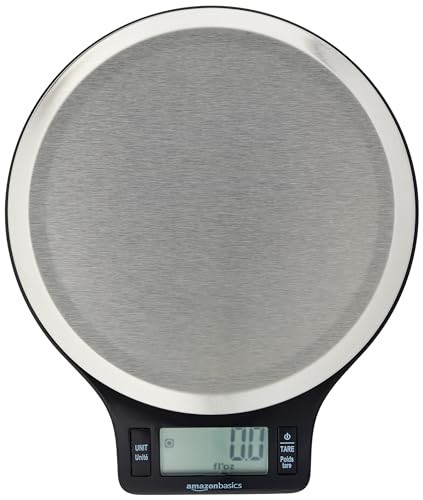
If you simply need a scale that works, the Amazon Basics Digital Kitchen Scale is hard to argue with at around £6. It weighs up to 5kg from a minimum of 2g in 1g increments, displays results in grams, ounces and pounds on a large LCD, and has a tare button for weighing into bowls. Batteries are included, so it is ready to use straight away.
It is one of the most widely reviewed kitchen scales on Amazon UK, with an average of around 4.6 out of 5 across more than 100,000 ratings. The stainless steel platform is easy to wipe clean, and at under 400g it takes up almost no space.
There are compromises: the platform is smaller than the Salter’s, there is no liquid measuring mode or backlight, and the build feels more basic than the pricier picks. None of that affects its ability to weigh flour and sugar accurately, which makes it an excellent first scale, a spare, or a scale for a student kitchen.
Best for: occasional bakers, first kitchens and anyone who wants a cheap spare scale.
How to choose a kitchen scale
Accuracy and increments: 1g or 0.1g?
For flour, sugar, butter and liquids, 1g increments are more than enough. The difference matters for small quantities, where a single gram is a large proportion of the total – 7g of yeast, 10g of salt or 18g of coffee. If you bake bread or pastry regularly, a 0.1g scale such as the Etekcity EK9000 or BOMATA will give more consistent results. Bear in mind that the increment is not the same as accuracy: a 0.1g scale is more precise, but every scale has a small margin of error.
Capacity and platform size
A 5kg capacity covers almost all home baking, including the weight of a heavy mixing bowl. Choose 10kg if you batch-bake or weigh very large quantities. Platform size matters just as much: a small platform with a large bowl on top can hide the display, which is why the OXO’s pull-away display and the Etekcity 10kg’s hold function are so useful.
Tare, units and display
Every scale here has a tare (zero) function, which lets you weigh multiple ingredients into the same bowl. Liquid modes that measure in millilitres save you using a measuring jug, and a backlit display is easier to read in a dim kitchen. Imperial units are useful if you use older or American recipes.
Cleaning, power and storage
Flat stainless steel or glass platforms wipe clean easily, while waterproof scales can be rinsed. Most scales run on AAA or coin-cell batteries that last a long time; rechargeable models save on batteries but need charging. Slim flat scales store in a drawer or stand on end in a cupboard, while bowl scales need more space.
How to check your kitchen scale is accurate
You do not need calibration weights to check a kitchen scale at home. UK coins have precise standard weights: a £1 coin weighs 8.75g, a 1p coin 3.56g and a 2p coin 7.12g. Stacking a few coins of the same type gives you a quick reference point for checking low weights, which is where cheaper scales are most likely to drift.
For larger weights, an unopened 1kg bag of sugar or flour is a reasonable guide, although packaged weights are only accurate to within a few grams. A litre of water weighs almost exactly 1kg, so weighing a measured litre is another simple test. If your scale is consistently out, check the batteries first – a low battery is the most common cause of inaccurate readings – and make sure the scale is on a flat, stable surface.
Also worth considering
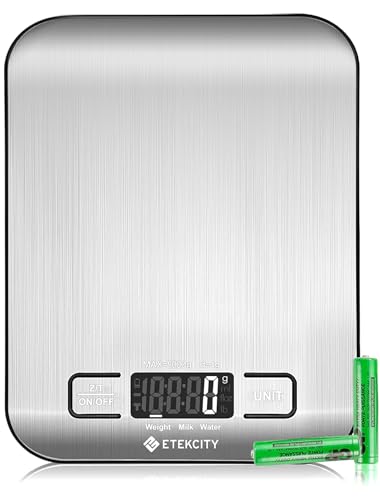
The Etekcity Digital Kitchen Scale (standard 1g model) is a good alternative to the Amazon Basics at around £9.50. It has a slim 1.4cm profile, an 18 x 14cm stainless steel platform, a backlit display and liquid modes for water and milk, making it a step up in features for a few pounds more.
Coffee enthusiasts may want a dedicated coffee scale with a built-in timer and flow-rate display, which makes dialling in pour-overs and espresso easier. Smart scales that connect to an app via Bluetooth appeal to those tracking nutrition or following app-based recipes, but for everyday baking they add cost and complexity that most people do not need.
Which kitchen scale should you buy?
- Most home cooks and bakers: Salter Disc Digital Kitchen Scale. Accurate, simple and cheap, with a liquid mode.
- Bread, pastry and coffee: Etekcity EK9000. 0.1g precision and 5kg capacity for under £15.
- Messy bakers: BOMATA IPX6. Precision weighing and a scale you can rinse under the tap.
- Big batches: Etekcity 10kg Rechargeable. Double the capacity, with no batteries to replace.
- Weighing into a bowl: Etekcity with Stainless Bowl. A classic design with a built-in timer.
- A premium scale that lasts: OXO Good Grips 5kg. The pull-away display makes large bowls a non-issue.
- The lowest price: Amazon Basics. A dependable 5kg scale for around £6.
Kitchen scale FAQs
What is the best digital kitchen scale in the UK for 2026?
For most people, the Salter Disc Digital Kitchen Scale is the best choice. It weighs up to 5kg in 1g increments, can measure liquids in millilitres, is slim enough to store easily and costs around £17.
Do I need a 0.1g scale for baking?
Not for most recipes, but it helps with bread, pastry and anything that uses small quantities of yeast, salt or raising agents. Scales like the Etekcity EK9000 now combine 0.1g increments with a 5kg capacity, so you do not need to buy two scales.
Are cheap kitchen scales accurate?
Generally, yes. Budget scales like the Amazon Basics model use the same type of strain gauge sensor as more expensive ones and are accurate enough for everyday baking. Paying more tends to buy you a bigger platform, better build quality and extra features rather than dramatically better accuracy.
What does the tare function do?
Tare resets the scale to zero with a container or ingredient already on it. This lets you weigh a bowl, press tare, add flour, press tare again and add sugar, all in the same bowl, without doing any maths.
Why is my kitchen scale giving wrong readings?
The most common causes are a low battery, an uneven or soft surface, or weighing something too light for the scale to register. Replace or recharge the battery, use the scale on a flat, hard worktop and check it with a known weight such as a £1 coin (8.75g).
Can kitchen scales measure liquids?
Many can. Scales with a liquid mode, such as the Salter Disc, Etekcity EK9000 and BOMATA, convert weight to millilitres. For water, 1g equals 1ml, and some scales also include a milk setting to account for its slightly higher density.
The verdict
The Salter Disc Digital Kitchen Scale is the best kitchen scale for most people. It is accurate, easy to use and easy to store, and at around £17 it is one of the most cost-effective upgrades you can make to your baking.
If you bake bread or weigh small quantities often, the Etekcity EK9000 adds 0.1g precision for even less money, and the BOMATA offers the same precision in a waterproof design. The OXO Good Grips 5kg is the one to buy if you want a premium scale with a display you can always see, while the Amazon Basics proves a reliable scale needn’t cost more than a few pounds.