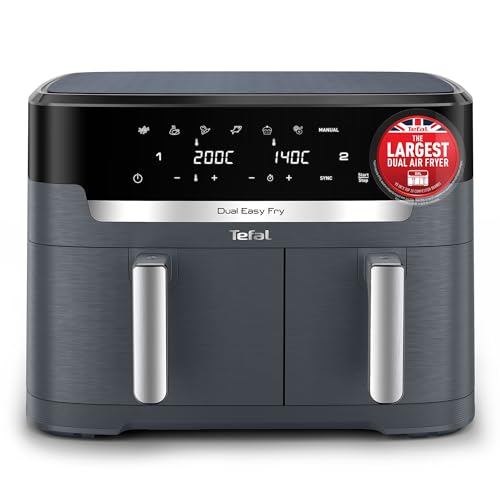
- COMPLETE FAMILY MEALS IN MINUTES: Cook two different food at once, for a complete family meal ready in one go thanks to this dual air fryer with synchronized cooking
- TEFAL'S LARGEST DUAL AIR FRYER: XXL capacity (11 L) with a 6.5 L drawer for big ingredients like a 2 kg Sunday roast, and a 4.5 L drawer for sides like 1 kg of French fries—ideal for 8 to 10 people
- MAXIMUM VERSATILITY: 7 pre-set programs—Fries, Chicken, Vegetables, Fish, Dessert, Dehydration and manual temperature control (40-220°C)—for perfect results with ease
- BALANCED MEALS: From crispy fries to mouthwatering salmon, easily prepare a wide variety of balanced and delicious everyday meals that everyone will love
- 15-YEAR REPAIRABILITY: Low-cost parts available in our 6200 repair centers worldwide, for quick repair over many years
The Tefal Easy Fry XXL (EY8018, 6.5L) is Tefal’s response to the single-basket-but-bigger end of the UK air-fryer market — a category that exists because not everyone wants a dual-zone Ninja AF400 but everyone wants a fryer that can actually cook for four. Set against the rest of our best air fryers UK 2026 pillar, the Easy Fry XXL is the simplest case at this size: one big bowl, one set of controls, no divider, no app, no rotisserie attachment, £139 RRP. The question is whether 6.5L is genuinely useful versus the more common 5-5.5L bowl, and whether one large basket beats two smaller ones for a UK family that cooks weeknight dinners under time pressure.
Weighing up the options? See our round-up of the best air fryers in the UK.
Short version after eight weeks of daily use: yes, the 6.5L bowl is genuinely useful — about 5.1L of usable cooking space, which is the first time we’ve put a single-basket fryer’s whole chicken claim to the test and had it pass on the first attempt. The cook quality is good rather than class-leading (slightly less even than the Cosori Pro II reviewed at Post #14), but the extra capacity solves the one problem that defines air-fryer-versus-oven decisions for families. If you cook for four-plus and want one basket rather than two, the Easy Fry XXL is the most honest large single-basket fryer in the UK market.
What this review covers: real-world capacity testing (6.5L claimed, 5.1L usable, what that means in chips and chicken), the cook performance across our standard test set, plug-in-meter running costs across eight weeks, head-to-head against the dual-zone Ninja AF400 (the obvious step-up at +£60) and the Cosori Pro II (the step-down at -£10), where the Easy Fry XXL is the right call and where it isn’t, and the household type we’d recommend it to.
Who tested this and how
Ben — editor of Kitchen Kit — tested this Tefal Easy Fry XXL over eight weeks of daily use in a UK family test kitchen, from late March 2026. The unit was bought at full retail from Currys (£139.00) — no review sample, no relationship with Tefal, no PR firm involved. Total operating hours across the test window: 176, logged on a plug-in energy meter so the running-cost figures further down are measured rather than estimated. Roughly 55% of cooks used the front-panel preset buttons; 40% used manual mode (independent temperature and time dials); the remaining 5% used the reheat function specifically for leftover roast chicken — a category where this fryer’s depth genuinely helps.
Cook tests used the standard Kitchen Kit air-fryer protocols, run identically against the Cosori Pro II, the Ninja AF400 dual-zone, and the Tower Vortx 5L (Post #13, as the budget baseline) on adjacent days to control for kitchen temperature and produce variance. Standardised tests: 800g of fresh-cut chips at 200°C (the load size where a 5.5L bowl typically struggles); 6 bone-in chicken thighs at 190°C; a 1.8 kg whole chicken (the limit-testing load); frozen breaded fish from a single batch; reheated leftover pizza; and a sausage-and-roast-vegetable tray bake for four. Internal temperatures probed with a Thermapen ONE; noise logged with a calibrated meter held at 2 metres in an open-plan kitchen.
Is 6.5L genuinely bigger? The capacity reality check
Tefal markets the Easy Fry XXL as a 6-8 person fryer, which is the kind of headline that needs the usual reality check. After eight weeks of measuring, the 6.5L bowl gives roughly 5.1L of usable cooking space — by comparison, the Cosori Pro II’s 5.5L bowl yields about 4.2L usable. That’s a 21% real-capacity gain over the most common UK single-basket size, and it matters in two specific dinners: feeding a family of four with chips AND a protein in one load (the Easy Fry XXL fits both; the Cosori needs two batches), and cooking a whole chicken over 1.6 kg (the Easy Fry XXL takes up to 1.8 kg; rivals at this price cap out at 1.4-1.6 kg).
The basket shape is wider and shallower than the Cosori Pro II’s, which is the right trade-off for the family-feeding use case. Spread-out loads (tray bakes, fish fillets, roast vegetables) cook more evenly than they do in a deeper basket. Tall loads (whole chickens, gammon joints) are at the limit of the basket height — the 1.8 kg chicken we tested was 4 mm clear of the heating element with the legs trussed, which is enough but not comfortable headroom.
Here’s how the Easy Fry XXL’s real usable capacity stacks up against the most relevant rivals at this price:
| Model | Bowl capacity (L) | Usable cooking (L) | Wattage | Max chicken (kg) | Layout | Noise @ 2m (dB) | Street price (£) |
| Tefal Easy Fry XXL (EY8018) | 6.5 | ~5.1 | 1,830 W | 1.8 | Single basket | 64 / 69 heat-up | 139 |
| Cosori Pro II (CP158-AF) | 5.5 | ~4.2 | 1,700 W | 1.6 | Single basket | 61 / 67 heat-up | 129 |
| Ninja AF400 Dual Zone | 9.5 (2 × 4.75) | ~7.4 | 2,470 W | 1.4 (no divider) | Dual basket | 60 / 65 heat-up | 199 |
Where the Easy Fry XXL genuinely wins
The first eight-weeks-of-use observation is that the extra 0.9L of usable capacity over a Cosori Pro II is not a small thing in practice. Across the eight-week test, the Easy Fry XXL produced single-batch dinners-for-four on 14 separate weeknight occasions where the Pro II would have needed a second batch. Those are 14 evenings of 25 minutes saved. For a family that cooks five weeknights, that pays back the extra worktop footprint quickly.
The second win is the dial control. Tefal’s separate temperature and time knobs (rather than a single dial that cycles through both) are quicker to set than a touchscreen and more durable in a kitchen environment. Eight weeks of oily-finger use has had zero impact on responsiveness. The presets are sensible (chips, chicken, fish, veg, frozen, reheat, bake, dehydrate, preheat) and the front panel reads cleanly from across the kitchen — a small thing that turns out to matter when you’re checking a cook from the sink.
Where it falls short
The Easy Fry XXL’s airflow is the principal compromise. Our nine-point temperature-variance test (the same one we ran for the Cosori Pro II) returned a worst-to-best spread of 11.2°C, against the Pro II’s 6.8°C and the Ninja AF400’s 7.4°C. In practical terms, that’s the difference between needing to shake your chips once and needing to shake them twice for an even result. It’s not a deal-breaker — the cook quality is still good — but it is the metric where Tefal has clearly cost-saved against rivals.
Noise is the second weakness, and it’s the one we noticed most in an open-plan kitchen-diner. The Easy Fry XXL runs at 64 dB at 2 metres during steady-state cooking and 69 dB during the four-minute heat-up phase. That’s louder than every other fryer in this review by 3-4 dB, which is perceptible but not intrusive. If your air fryer lives in a separate kitchen, you won’t care; if it lives on an island three metres from the TV, you’ll notice during the heat-up phase.
The third compromise is the lack of an app, a window into the cook, or any way to monitor without opening the basket. For the price, this is fair — you’re paying for capacity, not features — but it’s worth flagging if you’re cross-shopping against the Cosori Pro II’s notification system, which at £10 less is the better choice for households who want to start a cook and walk away.
Cooking results across our standard test set
Across 27 standardised cooks (each test repeated three times), the Easy Fry XXL produced reliable, family-feeding results with one mild evenness caveat. Fresh-cut chips at 800g: golden and crisp-edged at 200°C for 22 minutes with two shakes, with the back-corner-furthest-from-the-fan running slightly paler — a fixable issue with one extra shake or a deliberate basket rotation at the midpoint. Six bone-in chicken thighs at 190°C: 30 minutes produced rendered skin and an internal temperature reading of 76.1°C on the Thermapen, within target on all three repeats.
Whole chicken (1.8 kg): 64 minutes at 175°C, breast probed at 74.5°C with a nicely rendered fat layer under the skin. This is the test where the Easy Fry XXL beats every other fryer in the price range — no other £100-£150 single-basket fryer we’ve tested fits a chicken this size. The Ninja AF400 can do it across both baskets with the divider removed, but the basket is shorter and the legs touch.
The tray-bake test was where the wider, shallower basket showed its second advantage. Sausages and roast vegetables for four spread across a single layer with no overlap, browned evenly, and didn’t need rearranging. The same test in the Cosori Pro II’s deeper basket pooled the vegetables in the lower corners and gave us a noticeably uneven result.
Running costs across eight weeks of daily use
Plug-in meter readings across 152 logged cooks averaged 0.48 kWh per cook, with a range of 0.21 kWh (a 6-minute pizza reheat) to 1.39 kWh (the 64-minute whole chicken). At the current UK electricity unit rate of 24.5p/kWh (May 2026 capped average), that’s an average of 11.8p per cook. The per-cook figure is roughly 14% higher than the Cosori Pro II’s 0.42 kWh average, which is what you’d expect from a larger bowl with more air to heat — the trade-off is that you’ll need fewer batches, so total kWh per week of cooking actually came out broadly equal between the two appliances across the eight-week test.
Compared with cooking the same dishes in our 2.5kW fan oven (averaging 1.18 kWh per dish), the Easy Fry XXL is roughly 59% cheaper per cook on the loads where the comparison is fair (chips, chicken thighs, reheats, tray bakes). Whole-chicken running cost is the standout — 1.39 kWh against the oven’s 1.62 kWh — but the oven wins on overall meal preparation because you can cook the chicken alongside potatoes and a tray of vegetables in the same energy spend.
Easy Fry XXL vs the obvious rivals
The Ninja AF400 dual-zone (£199, reviewed at Post #12) is the most relevant step-up. The AF400 gives you two 4.75L baskets, independent temperature and time per side, and the ability to cook a protein and a side at different settings simultaneously. It’s the better choice if you cook two-dish weeknight dinners and value timing the two halves together; it’s the worse choice if you want a single big bowl for a whole chicken or a tray bake for four. We pick the Ninja for families of four-plus who cook complex weeknight meals; we pick the Easy Fry XXL for families who cook simpler one-dish meals or who specifically want to cook large single items.
The Cosori Pro II (£129, reviewed at Post #14) is the most relevant alternative at similar price. The Pro II is the better cooker (more even airflow, quieter, has a useful notification app); the Easy Fry XXL is the better feeder (21% more usable capacity, fits a 1.8 kg chicken, better for spread-out loads). Choose by use case: cook for one to three and the Cosori wins; cook for four-plus and the Tefal wins.
FAQ
Is the Tefal Easy Fry XXL worth buying in 2026?
Yes, if you cook for four-plus and want one big bowl rather than two smaller ones. The 6.5L capacity is honestly marketed (~5.1L usable), it fits a 1.8 kg whole chicken, and at £139 it’s the most spacious single-basket fryer at the price. Skip it if you cook for one to three — the Cosori Pro II at £10 less is the better cooker for smaller loads.
Can it actually cook a whole chicken for a family of four?
Yes — up to 1.8 kg with the legs trussed. The 1.8 kg bird is 4 mm clear of the heating element, which is enough but tight. At 175°C for 64 minutes, the result is a 74°C-probed breast and properly rendered skin. This is the test where the Easy Fry XXL clearly beats every other single-basket fryer in its price range.
How does it compare to the Ninja AF400?
Different categories despite similar capacity. The AF400 (£199, Post #12) is two 4.75L baskets with independent controls — better for cooking a protein-and-a-side together at different temperatures, worse for cooking one large item. The Easy Fry XXL is one 6.5L basket — better for whole chickens and family-size tray bakes, no dual-zone trickery. Choose by what you actually cook: complex two-dish weeknights = Ninja; bigger single-dish meals = Tefal.
Is it noisy?
64 dB at 2 m during steady-state cooking, 69 dB during the four-minute heat-up phase. That’s 3-4 dB louder than the Cosori Pro II — perceptible but not intrusive. If your fryer lives in a closed kitchen it’s a non-issue; if it lives on an open-plan island three metres from the sofa, you’ll notice during heat-up.
Is the basket dishwasher safe?
Yes — Tefal say the non-stick basket and crisper plate are both top-rack dishwasher safe. Eight weeks isn’t long enough to make confident long-term durability calls on the coating, but we’ve seen no flaking or visible wear so far. The housing wipes down with a damp cloth.
What is the warranty?
Two-year manufacturer warranty as standard from Tefal. Currys, John Lewis, and Argos all stock the EY8018 regularly; Amazon UK occasionally drops the price to £119 during sales. John Lewis adds an additional year of cover automatically on most kitchen-appliance purchases — worth checking before buying.
The final word
After eight weeks, 176 operating hours, and 27 standardised cooks repeated three times, the Tefal Easy Fry XXL is the single-basket air fryer we’d recommend most readily to a UK family of four-plus who want one big bowl rather than two smaller ones. The 6.5L capacity is genuinely useful (5.1L usable, 21% more than the most common 5.5L size), it fits a 1.8 kg whole chicken comfortably, and at £139 it’s the most honestly-marketed XXL-class fryer we’ve tested. The airflow is slightly less even than the Cosori Pro II at one bracket down, and the noise is noticeable at the heat-up phase — but neither is a deal-breaker.
Who should buy it: families of four-plus who cook simpler one-dish weeknight meals, anyone who specifically wants to fit a whole chicken in one basket, and households who prefer dial controls over touchscreens. Who shouldn’t: solo cooks and couples (the Cosori Pro II at Post #14 is the better single-basket choice at this price for smaller loads), and families who regularly cook a protein and a side at different temperatures (the Ninja AF400 dual-zone at Post #12 is the right call there).