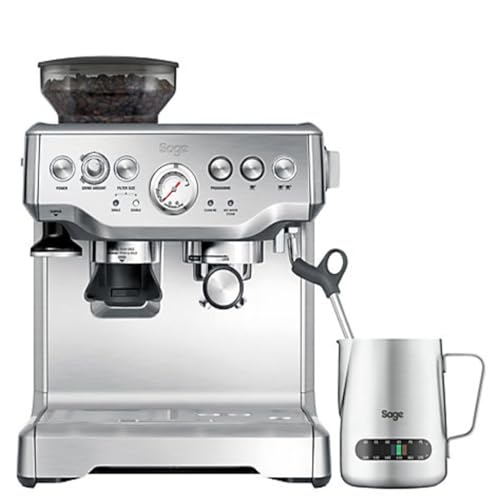
The Sage Barista Express is the machine that has converted more British kitchens to home espresso than almost any other. It packs a conical burr grinder, a 54mm portafilter, a manual steam wand and a 15-bar pump into one brushed stainless steel unit, and it currently sits at roughly £500 on Amazon UK (it has been closer to £550 at other times, so check the live listing). The promise is simple: whole beans to a flat white in about a minute, on your own worktop, for a fraction of a daily coffee-shop habit.
The caveat is just as simple. This is not a pod machine and it is not effortless. You will need to learn to dial in the grind, dose, tamp and texture milk. Our editor Ben has used one in a London flat for 12 months, roughly 700 shots, on ordinary tap water with no lab filtering, and that experience is what this review is based on.
Sage Barista Express at a glance
- Best for: daily espresso and milk-drink lovers who want to learn the craft without buying a separate grinder.
- Grinder: built-in conical burr grinder that grinds straight into the portafilter.
- Control: pressure gauge, manual steam wand, adjustable grind and dose.
- Price: around £500 at the time of writing; prices move, so check the live listing.
- Think twice if: you want push-button coffee with no learning curve.
The built-in grinder: the feature that justifies the price
The integrated conical burr grinder is the heart of the Barista Express. It grinds directly into the portafilter, which means fresh grounds every time and no stale pre-ground coffee. A decent standalone grinder costs £150 to £250 on its own, so having one built in goes a long way towards justifying the machine price.
It is not perfect. Adjustment is more limited than on a standalone grinder, and it can scatter a few grounds onto the drip tray. If you want very fine control, a separate grinder is the upgrade path, but most households will never outgrow this one.
Espresso quality and the learning curve
When it is dialled in, the Barista Express pulls genuinely excellent espresso: thick, sweet shots with a proper hazelnut crema that hold up against many high-street cafes. Expect one to two weeks of daily practice before your shots become consistent. The pressure gauge is a real help here, because it shows you whether the grind and dose are in the right zone rather than leaving you guessing.
If you want zero involvement, an automatic machine will suit you better. See our best bean-to-cup machines for a busy household for that route.
Milk steaming and the steam wand
The manual steam wand produces silky microfoam that is good enough for basic latte art, but it takes practice. The machine has a single boiler, so you steam after pulling the shot, and making several milk drinks back to back takes longer than on a dual-boiler machine. For a home making one or two drinks at a time, that is an acceptable trade-off.
Living with it: maintenance, noise and footprint
- Maintenance: back-flush with cleaning tablets periodically, replace the water filter, and descale every couple of months. In hard-water areas such as London, descale more often.
- Noise: the grinder is loud for the few seconds it runs, and the pump is audible during extraction.
- Footprint: it needs permanent worktop space, with clearance above for the bean hopper and behind for the steam wand. It is not a machine to tuck away in a cupboard.
None of it is difficult, but this is an appliance that asks for ten minutes of care now and then.
How it compares
- Sage Barista Express: built-in grinder, manual control, easiest of its type to learn, lowest price of the Sage range.
- Sage Barista Touch: touchscreen and more automation, at a higher price. See our Barista Touch review.
- Separate machine plus grinder: more flexibility, but usually costs more and takes more space. See our best burr grinders under £200.
Verdict: is the Sage Barista Express worth it?
After twelve months, Ben would buy it again without hesitation. At around £500 it pays for itself within months against a daily takeaway flat white habit, and making coffee has become a small daily pleasure rather than a chore. If you want button-operated, effortless coffee, look elsewhere. For anyone willing to learn, it is the most rewarding way into home espresso we know of. For more options, see our best espresso machines under £500.
Sage Barista Express
Frequently asked questions
Q: Is the Sage Barista Express good for beginners?
A: Yes, with conditions. It is the most beginner-friendly machine of its type, but you will need to learn grind dialling, dosing, tamping and milk steaming over one to two weeks.
Q: Sage Barista Express or Barista Touch?
A: Choose the Express for manual control and the lowest price. Choose the Touch for touchscreen automation at a higher cost.
Q: Does it need a separate grinder?
A: No. It includes a built-in conical burr grinder. You would only add one for finer control.
Q: What maintenance does it need?
A: Regular but simple: back-flush periodically, replace the water filter and descale every couple of months, more often in hard-water areas.
Q: Is it worth the money?
A: Yes for daily espresso drinkers willing to learn. With the grinder included it undercuts buying a machine and grinder separately, and it recoups its cost within months against cafe spending.
New to home espresso? Start with our first home espresso setup guide.