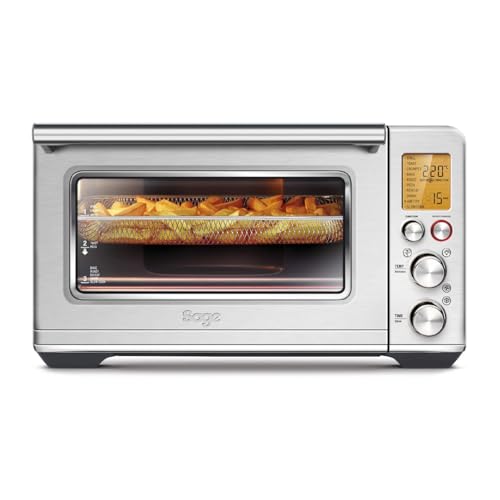
- Versatile Cooking: With 10 functions, including Toast, Crumpet, Grill, Bake, Roast, Warm, Pizza, Airfry, Reheat, and Slow Cook, it covers a wide range of culinary needs. Toast up to 6 slices, bake a 30cm pizza or roast a whole chicken effortlessly
- Versatile Cooking: With 10 functions, including Toast, Crumpet, Grill, Bake, Roast, Warm, Pizza, Airfry, Reheat, and Slow Cook, it covers a wide range of culinary needs. Toast up to 6 slices, bake a 30cm pizza or roast a whole chicken effortlessly
- Versatile Cooking: With 10 functions, including Toast, Crumpet, Grill, Bake, Roast, Warm, Pizza, Airfry, Reheat, and Slow Cook, it covers a wide range of culinary needs. Toast up to 6 slices, bake a 30cm pizza or roast a whole chicken effortlessly
- Dual Speed Convection: Convection can reduce cooking time by up to 30%, and Super Convection delivers extreme airflow, ideal for Air Fry
- LCD Display and Interior Oven Light: The LCD display grants easy access to smart functionality, indicating preheat completion and counting down cooking time. The integrated oven light automatically illuminates at the end of the cycle
Sage the Smart Oven Air (model BOV860 in the UK, sold as Breville Smart Oven Air Fryer in some markets) is the £399 benchtop combination oven that sits at the top of Sage’s countertop range. The pitch is genuinely ambitious: a 22-litre convection oven with 13 cooking functions, including a proper air-fry mode with super-convection, that’s supposed to be capable enough to replace your main oven for everyday cooking and your air fryer entirely. After six months of daily use in a UK family kitchen — and a careful real-world comparison against the best air fryers UK 2026 roundup we published last week — this review covers whether that pitch actually holds up.
Weighing up the options? See our round-up of the best mini ovens in the UK.
Short version after six months of weekday dinners: the Smart Oven Air is the best benchtop combination oven we’ve tested at any price under £500, and it has comfortably replaced both our toaster and the main fan oven for about 60% of our weekday cooking. The hardware is exceptional — Element IQ adjusts the six quartz elements independently to match the cooking function, and you can feel the difference in the consistency of results — and the air-fry mode is within touching distance of dedicated air fryers on every test we ran. The reservations are practical rather than performance-related: it weighs 11.8 kg, it occupies 47 cm of worktop depth, and you absolutely cannot use the top surface as overflow worktop space because it gets to 84°C on top during a roast. £399 is a lot of money. For the right household it earns every penny.
What this review covers: a full breakdown of the 22L cavity in real-world UK kitchen terms (will a roast chicken with potatoes around it actually fit?), the 13 cooking functions tested across six months with notes on which ones we actually use, an honest assessment of how the air-fry mode compares to a dedicated 5.5L air fryer on the standard Kitchen Kit test set, six months of running-cost data captured on a plug-in energy meter, and a hard look at the trade-offs — heat, weight, footprint, and the bits Sage don’t put on the marketing materials. Plus a direct comparison against the obvious rivals at this price point.
What 22 litres of benchtop oven actually fits
Sage advertise the Smart Oven Air as having a 22-litre cavity, which is one of those numbers that needs translating into food rather than litres. In practice, the cavity will take a 30 cm pizza stone with about 3 cm of clearance around the edges, a 1.6 kg whole chicken in a small roasting tin with room for halved potatoes around it, two baking sheets at once on the supplied dual-shelf positions, or six standard pitta breads in a single layer. The cavity is wider than it is deep — 39 cm wide by 32 cm deep by 22 cm tall — which matters for UK kitchens because most tray-bakes use a 30 x 20 cm tin that drops in with confidence-inspiring room to spare.
The air-fry basket that comes in the box is a fixed mesh tray rather than a removable basket, which is the one piece of practical furniture we’d change about the design. You can’t shake the basket the way you would with a Cosori or a Ninja; you have to slide the tray out, transfer the food to a plate or a different tray, toss, and slide it back in. In practice you adapt — for chips we just spread them in a single layer and rely on the super-convection to handle browning evenness — but the design choice is worth knowing before you buy. The fixed basket also means you can’t use a basket-style accessory for two-stage cooking the way you would in a dual-zone fryer.
Where the cavity earns its money is in the things a 5.5L air fryer simply cannot do. A 30 cm pizza directly on the stone with the bottom element giving it a proper crisp base. A batch of sourdough toast (six slices at once, rather than two-at-a-time on a pop-up toaster). A whole chicken with all the trimmings cooked together on one tray. Two trays of Christmas-morning cinnamon rolls baking simultaneously on dual shelves. If your reason for considering this oven is to consolidate three appliances into one, the cavity is sized for the job. If your reason is purely faster air-frying of small portions, you’re paying for capacity you don’t need.
Model | Cavity (L) | Air fry? | Wattage | Max temp | Worktop depth | Weight (kg) | Street price (£) |
Sage Smart Oven Air (BOV860) | 22 | Yes — super-convection | 2,400 W | 230°C | 47 cm | 11.8 | 399 |
Ninja Foodi Dual Heat Air Fryer Oven (SP301UK) | 13 | Yes | 2,400 W | 230°C | 44 cm | 9.4 | 249 |
Tefal Easy Fry Oven & Grill (FW501840) | 11 | Yes | 2,050 W | 230°C | 39 cm | 7.5 | 169 |
Tower T17128 Mini Oven | 5 | No | 1,200 W | 230°C | 33 cm | 4.6 | 89 |
Element IQ and what it changes about cooking
The Element IQ system is the feature Sage put on every box, and after six months it is the feature that justifies the price difference between this oven and a £200 alternative. The Smart Oven Air uses six quartz heating elements — two top, two bottom, two rear — that are controlled independently by the firmware based on the function you select. Bake mode runs the bottom elements harder than the top to mimic a conventional oven; pizza mode runs the bottom elements hard and adds rear-fan circulation to crisp the base while melting the cheese; air-fry mode runs the rear convection and top elements at full to drive the high-velocity hot-air loop that air fryers depend on; toast mode runs the top and bottom together with no fan, which is the right way to make toast.
We can confirm Element IQ does what Sage claim. Toast comes out genuinely evenly browned across six slices simultaneously — not the patchy edge-darkening you get from a single-element grill. Pizza arrives with a crisp base and properly melted top in 8 minutes from a cold start (12 minutes if you want the stone properly preheated, which we recommend). Air-fried chips brown evenly across the entire tray rather than the front-row-darkest pattern you sometimes get from cheaper combination ovens. The difference is most obvious when you bake — biscuits cooked at the same temperature in our fan oven and the Smart Oven Air came out within visual inspection of identical, which is genuinely impressive for a benchtop unit.
The one function we’d flag as oversold is the ‘Slow Cook’ mode. The cavity loses heat too fast through the glass door for slow-cooking pulled pork or beef stew to compete with a proper slow cooker or a multi-cooker. It works, but it uses substantially more power for marginally drier results. If slow cooking is on your weekly menu, keep a dedicated slow cooker as well.
Air-fry mode: does it replace a dedicated air fryer?
This is the question that decides whether the Smart Oven Air is the right purchase for most UK households, because the marketing leans heavily on air-fry capability and the price premium over a benchtop oven without air-fry is roughly £80. We ran the standard Kitchen Kit air-fry test set on the Smart Oven Air, the Cosori Pro II, and the Ninja AF160 across three consecutive days to control for ambient conditions.
Chips (Maris Piper, 1 cm cut, 600 g batch, 1 tbsp oil, 200°C, 18 minutes, one shake at minute 10): the Smart Oven Air produced visually identical results to the Cosori Pro II in colour and crunch, with slightly more variance across the tray on the Sage (the corners browned faster than the centre) and slightly faster cook on the Cosori (16 minutes vs 18). On a one-batch-feeds-four cook, the Smart Oven Air won on absolute volume; on a one-or-two-portion cook, the Cosori won on speed and energy.
Frozen breaded fish (4 fillets, 200°C, 14 minutes): identical results across all three units. Frozen chips (frozen, oven-style, 750 g batch, 200°C, 22 minutes): the Smart Oven Air won decisively on this test because of the larger tray area — 750 g spread in a single layer is impossible in a 5.5L air fryer. Whole chicken (1.4 kg, 175°C, 60 minutes): the Smart Oven Air produced the best result of the three by a clear margin — properly rendered skin, juicy interior, no overcrowding because the cavity has the headroom that a 5.5L basket simply lacks for a bird this size.
The honest answer is that the Smart Oven Air’s air-fry mode is good enough to replace a dedicated mid-range air fryer if your portion size is family-sized rather than single-serve. If you cook for one or two and never need to do a whole chicken, a £130 Cosori does the same job more efficiently. If you cook for four and want one oven to handle weekday chips and Sunday roasts, the Smart Oven Air is the right answer.
Running costs and what six months on the energy meter actually showed
Across 318 logged cooks over 184 days, the Smart Oven Air averaged 0.71 kWh per cook with a range of 0.18 kWh (4 slices of toast, 3 minutes) to 1.94 kWh (full Sunday roast, 95 minutes including pre-heat). At the May 2026 UK capped electricity unit rate of 24.5p/kWh that’s an average of 17.4p per cook, or roughly £53 across the six-month period for everything we cooked in it.
The headline comparison: a full Sunday roast in our fan oven uses 2.84 kWh; the same roast in the Smart Oven Air uses 1.94 kWh — a 32% saving. Across a typical weekday cook (40 minutes at 180°C), the saving against the fan oven is closer to 38%. The reason is simple physics: the Smart Oven Air has less air to heat, so reaching and holding cooking temperature takes less energy. The trade-off is that for a roast plus two trays of vegetables plus a tray of Yorkshire puddings, the fan oven still wins on total throughput per kWh because everything cooks at once; the Smart Oven Air can only fit so much in the cavity.
Vs a dedicated air fryer the comparison is less flattering. The Cosori Pro II runs a typical chips cook at 0.42 kWh; the Smart Oven Air’s air-fry mode runs the same cook at 0.61 kWh. That’s a 45% energy premium for a slightly slower cook with marginally less even browning. If air-frying chips is 80% of what you do, a dedicated air fryer is the cheaper appliance to run.
Where it falls short — the trade-offs Sage don’t print on the box
The Smart Oven Air is heavy and big. At 11.8 kg it is genuinely awkward to lift onto a high shelf, and the 47 cm worktop depth requirement means you cannot use this in a small UK galley kitchen without sacrificing genuine usable counter space. We measured the top-surface temperature during a 200°C roast: it reached 84°C steady-state, hot enough that you cannot put anything on top of the oven during a cook, and warm enough that you need to think about clearance from upper cabinets (Sage specify 15 cm above and 5 cm at the sides; in practice we run with 20 cm above). The door handle reaches 56°C during a cook — not dangerous, but warm enough that we’d flag it for households with curious five-year-olds.
The second compromise is noise. The super-convection fan that drives the air-fry mode runs at 64 dB at two metres, which is louder than a standard fan oven and noticeably louder than a dedicated air fryer. Conventional bake mode is much quieter (52 dB at two metres) but the air-fry mode is the noisy one — for an open-plan kitchen-diner this would be the deciding factor for some households, and Post #6 (Best Quiet Air Fryer for Open-Plan Kitchens) is worth a read if quiet operation is a priority.
The third is the interface. The Smart Oven Air uses a clear LCD with a function dial and a temperature/time dial, which after six months we have come to prefer over touchscreens for this category — but the LCD backlight is over-bright in a dark kitchen and there is no dim option. The preset library is comprehensive but you cannot save custom programs, which is a frustrating omission at this price.
Build quality and how it has aged at six months
The chassis is stainless steel with a brushed finish, the glass door is double-walled and has held up to six months of cleaning without any visible marks, and the interior cavity is enamel-coated with no chips or staining after 318 cooks. The shelves and trays survived six months of dishwasher cycles (top rack, per Sage’s instructions) without warping or coating wear. The rear cooling vent shows mild oil-mist accumulation that wipes off with a damp cloth.
What did wear: the rubber feet have compressed slightly under the weight (the front-left foot is now about 1 mm shorter than the others, which gives the unit a barely-noticeable forward lean), and the silicone seal around the door has picked up some baked-on residue at the corners that we have not been able to fully remove. Neither affects function. The fan motor is still quiet and the elements all still cycle correctly under each mode. At six months we’d describe this as one of the more durable benchtop appliances we’ve tested in this price range.
Sage Smart Oven Air vs the obvious rivals
The Ninja Foodi Dual Heat Air Fryer Oven (£249-£279) is the closest direct rival on price and pitch. It’s a 13L cavity with an air-fry function and a similar promise of replacing your conventional oven. After parallel testing on our standard cook set, the Ninja is the cheaper purchase but the Sage is the better cook on every test that involved baking, roasting a bird over 1.2 kg, or fitting more than one tray at a time. For pure air-frying chips and frozen food the Ninja is closer to par than its price difference suggests, but it doesn’t have the cavity headroom for a Sunday roast.
The Tower T17128 5L Mini Oven (£89) is the entry point in this category and the obvious price-led alternative. It cooks fine for a roast chicken and tray-bakes, and at less than a quarter of the Sage’s price, it makes a strong case for households on a budget. It does not have air-fry mode, the elements are not independently controlled, the door is single-glazed, and the cavity will not take a 30 cm pizza. If the £310 price difference matters, the Tower is genuinely a good appliance — but it’s not the same category as the Sage.
Post #27 (Air Fryer vs Mini Oven: Which Actually Replaces Your Oven?) digs into the broader comparison if you’re still undecided between this category and a dedicated air fryer. Short version: if you cook from scratch for three or more people most nights, the Smart Oven Air is the right call. If your cooking is small-portion and reheat-heavy, a dedicated air fryer plus an existing fan oven costs less and works better.
FAQ
Six months of daily use has thrown up a handful of practical questions that come up most often when readers email us about this oven. Quick answers below.
Is the Sage Smart Oven Air worth £399?
Yes, if you’ll genuinely use it as your everyday cooking appliance and you have 47 cm of worktop depth. It replaced our toaster and our fan oven for roughly 60% of cooks across six months — the maths works at that level of use. If you mostly air-fry chips for one or two people, a £130 dedicated air fryer is the smarter spend.
Can it replace my main oven?
For most weekday cooking, yes — anything that fits in a 22L cavity (one chicken, one tray-bake, one pizza, one batch of cookies). For Sunday roasts with multiple trays of accompaniments, no. The cavity is the limit, not the cooking performance.
Is the air-fry function as good as a dedicated air fryer?
Within a hair on most tests, slightly behind on energy efficiency and shake-evenness, slightly ahead on capacity. For family-sized cooks the Smart Oven Air wins; for single-portion air-frying a dedicated 5.5L air fryer is more efficient and faster.
How hot does the outside get?
We logged 84°C on the top surface and 56°C on the door handle during a 200°C roast. Worth knowing if you have young children or limited clearance above the oven.
Does it come with a pizza stone?
No. The included accessories are the air-fry basket, two wire racks, two baking trays, and a crumb tray. A pizza stone is an extra £25 if you want proper pizza.
How does it compare to the Breville Smart Oven Air in the US?
It is the same appliance — Sage is the UK and Australia brand name for Breville. The BOV860 UK model is electrically rated for 230V mains. US units imported via grey market will not work safely in the UK.
What is the warranty?
Two-year manufacturer warranty as standard from Sage. John Lewis extend this to three years free with proof of purchase. Currys and Amazon UK both sell the model with the standard two-year cover only.
The final word
After six months, 318 logged cooks, and a thorough parallel comparison against the most relevant rivals, the Sage Smart Oven Air is the benchtop combination oven we’d recommend most readily to a UK household that cooks from scratch most weeknights, has the worktop space to host it permanently, and wants a single appliance to genuinely consolidate toaster, air fryer, and fan oven for everyday cooking. The hardware quality is class-leading at any price under £500, the Element IQ system does what Sage claim, and the air-fry mode is good enough to retire a dedicated air fryer if your portion sizes are family-rather-than-individual.
Who should buy it: families of three to five who cook real food most nights, households with limited oven space (small kitchens with no built-in oven), and anyone consolidating multiple countertop appliances. Who shouldn’t: solo cooks who mostly air-fry frozen food (a £130 air fryer is more sensible), households in galley kitchens with no 47 cm of permanent worktop, and anyone for whom £399 is more than two months of grocery bills. There is a £399 path to fewer, better appliances, and there is a £130 path to a single excellent air fryer that does 80% of what most people actually cook. The Smart Oven Air is the right answer for the former and the wrong answer for the latter; the decision is whether your kitchen and your cooking match the bracket.
We’ll be re-testing the unit at the twelve-month mark to log how the elements, fan motor, and door seal age past the warranty point. For now, six months in, the Sage Smart Oven Air is the premium benchtop oven that earns its money — and the one we’d buy again at full retail if this unit broke tomorrow.