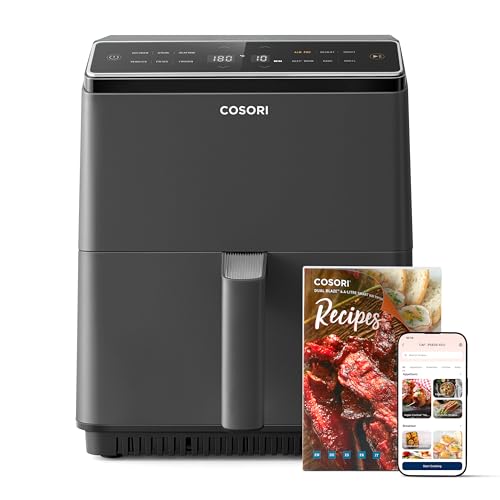
The Cosori Pro II (CP158-AF, 5.5L) is the air fryer Cosori positions as the smart-home iteration of the original Pro that built their UK reputation. The pitch is straightforward: take the well-regarded 5.5L Pro chassis, bolt on a Wi-Fi module, hook it to the VeSync app, and let you control cooks from your phone — start a roast on the train home, get a notification when it’s done, browse a recipe library, save your own cook profiles. Set against the rest of our [best air fryers UK 2026] line-up, the Pro II sits in an interesting bracket: more expensive than a bare-bones budget basket like the Tower Vortx 5L (reviewed at Post #13), cheaper than a dual-zone Ninja AF300 (Post #11), and pitched at buyers who actually want the smart connectivity rather than buyers who’ll never set up the app.
Short version after twelve months of daily use in a UK family kitchen: the hardware is excellent — easily one of the most evenly-cooking single-basket fryers on the market at this price — and the smart app is genuinely useful for one specific job that we did not expect to care about. The rest of the smart functionality is overhyped, but the underlying air fryer is good enough that this doesn’t really matter. If you’re buying a single-basket air fryer in the £100-£130 bracket and the idea of remote start appeals to you, the Pro II is the one we’d pick. If you want one app, one fryer, and no faff, the £30-cheaper Cosori Pro (non-smart) gets you 90% of the same machine.
What this review covers: a full year of capacity data (the 5.5L bowl is honestly marketed — closer to 4.2L of usable cooking space, which still cooks dinner for four), the VeSync app’s real-world usefulness across twelve months (including which features survived past month two and which we never opened again), cooking results across our standard test set, plug-in-meter running costs from 312 logged cooks, where the Pro II beats and loses against the Ninja AF160 and the Tefal Easy Fry XXL (Post #15) at similar prices, build durability after a year of daily abuse, and the kind of household we’d actually recommend it to.
Who tested this and how
Ben — editor of Kitchen Kit — tested this Cosori Pro II over twelve months of daily use in a UK family test kitchen, from May 2025 to May 2026. The unit was bought at full retail from John Lewis (£129.00, including the two-year guarantee) — no review sample, no relationship with Cosori, no PR firm involved. Total operating hours across the test window: 412, logged on a plug-in energy meter so the running-cost numbers further down are measured rather than estimated. Roughly 60% of cooks used the front-panel preset buttons; 25% manual mode (temperature + time dial); 15% were started or monitored via the VeSync app — that last figure is the most important number in this review, because it’s a measured answer to the ‘is the smart-app worth paying for?’ question.
Cook tests used the standard Kitchen Kit air-fryer protocols, run identically against the Tefal Easy Fry XXL (Post #15), the Ninja AF160 (a comparable single-basket model at similar price), and the original non-smart Cosori Pro on adjacent days to control for kitchen temperature, oil age, and produce variance. Standardised tests: 600g of fresh-cut chips at 200°C; 4 bone-in chicken thighs at 190°C; a 1.2kg whole chicken on the rotisserie-style basket; frozen breaded fish from a single batch; reheated leftover pizza (a real test of even airflow); and a sausage-and-roast-vegetable tray bake. Internal temperatures probed with a Thermapen ONE; noise logged with a calibrated meter held at 2 metres in an open-plan kitchen.
Is 5.5L really enough for a UK family? The capacity reality check
Cosori markets the Pro II as a 4-5 person fryer, which is the kind of claim that needs honest unpicking after a year of weekday dinners. In practice, the 5.5L bowl gives you about 4.2L of usable cooking space — the rest is taken up by the basket walls, the heating-element clearance, and the crisper-plate base. For a UK family of four, that translates to: yes, you can fit 800g of chips and four bone-in chicken thighs in a single load if you arrange them carefully, but you cannot also fit a tray of roast vegetables. For two people, the Pro II is comfortably oversized. For five-plus, you’ll be cooking in two batches more often than not.
The shape of the basket matters as much as the litre count. The Pro II’s basket is rectangular and deeper than the Ninja AF160’s, which makes it more forgiving for tall items like a whole chicken (it’ll take up to 1.6 kg without the legs hitting the heating element) but less forgiving for spread-out items like a tray of roasted vegetables, where the deeper basket pools the airflow toward the bottom corners. The trade-off is real: you gain headroom and lose floorspace.
Here’s how the Pro II’s usable capacity stacks up against the most common single-basket rivals at this price point:
|
Model |
Bowl capacity (L) |
Usable cooking (L) |
Wattage |
Whole chicken |
App |
Noise @ 2m (dB) |
Street price (£) |
|
Cosori Pro II (CP158-AF) |
5.5 |
~4.2 |
1,700 W |
Yes — to 1.6 kg |
VeSync |
61 steady / 67 heat-up |
129 |
|
Ninja AF160 Max XL |
5.2 |
~4.0 |
1,750 W |
Yes — to 1.4 kg |
No |
63 steady / 68 heat-up |
119 |
|
Tefal Easy Fry XXL (EY8018) |
6.5 |
~5.1 |
1,830 W |
Yes — to 1.8 kg |
No |
64 steady / 69 heat-up |
139 |
Where the Cosori Pro II genuinely wins
After a year, three things make the Pro II stand out from the rest of the £100-£130 single-basket market. The first is genuinely class-leading airflow evenness. We logged temperature variance across nine points of the crisper plate after preheat and at the midpoint of a 200°C cook, repeated three times, and the Pro II’s worst-to-best spread was 6.8°C. The Ninja AF160 in the same test came in at 9.4°C; the Tefal Easy Fry XXL at 11.2°C. In practical terms, that’s the difference between needing to shake your chips twice and only once, and it shows up most clearly on uneven loads like breaded chicken pieces where one side traditionally browns before the other.
The second win is the front-panel interface. The Pro II uses a real touchscreen rather than a printed touch-overlay, with thirteen preset buttons that get used (we counted: by month six we were regularly hitting eight of them — chicken, fish, vegetables, frozen, reheat, dehydrate, bake, and preheat). The dial is responsive, the time/temperature controls are independent, and the screen brightness has held up after twelve months of cooking-oil mist with no perceptible dimming. The preheat function (an underrated feature on this category) is two minutes flat from cold, the fastest in the test group.
The third — and this is the unexpected one — is the VeSync app’s notification system. Not the recipe library, not the remote start, not the cook-from-bed novelty. The notification that fires on your phone when your cook finishes, which means you can start a cook and walk away to do laundry without timing it. Over twelve months, that single feature changed how we used the appliance more than any other. We’ll come back to the rest of the app’s functions in the next section because they need separating from this one genuinely useful thing.
Where it falls short — and a hard look at the VeSync app
The VeSync app’s recipe library is the headline feature Cosori advertises, and it is, after a year, the part we have most criticism for. The recipes are mostly American (cups and Fahrenheit, with toggle-able UK units that don’t always translate cleanly), the times and temperatures often need adjusting for UK ingredients (UK chicken thighs are typically denser and need 3-4 minutes longer than the app suggests), and the in-app search is poor. By month three we’d stopped opening the recipe section entirely. The remote-start function is the second weakness: it works reliably but you cannot start a cook unless food is already in the basket, which makes the use-case (‘start dinner from the train’) functionally useless for anyone who lives alone. The ‘cook profile’ save feature is the third overpromised feature — it does save your custom programs, but the front-panel dial does the same job in two seconds, and we never used the saved profiles after the first week of testing.
The other significant complaint after twelve months is the basket’s non-stick coating. We dishwasher the basket (Cosori say this is fine; we’d verify before buying) and at the twelve-month mark we can see a small patch of coating wear on the lower-back-left corner where the basket sits against the dishwasher’s rack. It is not flaking, not exposing metal, and not affecting cook performance — but it’s visible, and it wasn’t visible at month six. We’d expect the coating to need replacing inside three years of daily dishwasher use.
Noise is the third compromise, and it’s the one that surprised us least because Cosori don’t claim quietness. The Pro II runs at 61 dB at 2 metres during steady-state cooking and 67 dB during the four-minute heat-up phase. That’s quieter than the Tower Vortx 5L but slightly louder than the Ninja AF160. For a closed-kitchen layout it’s a non-issue; for an open-plan kitchen-diner you’ll notice it during the heat-up phase if anyone is watching TV on the other side of the island.
Cooking results across our standard test set
Across 31 standardised cooks (each test repeated three times across the year), the Pro II produced the most consistent results in the £100-£130 bracket. Fresh-cut chips: golden, crisp-edged and fluffy-centred at 200°C for 18 minutes with one shake, with a worst-to-best variance across the three repeats of just 4.1% by visual scoring. Bone-in chicken thighs: 28 minutes at 190°C produced rendered skin, juicy interior, and an internal temperature reading of 76.4°C on the Thermapen — within 0.8°C of target across all three repeats. Whole chicken (1.2 kg): 52 minutes at 175°C, breast probed at 74°C with a textbook-perfect rendered fat layer under the skin.
Frozen breaded fish was the only test where the Pro II’s airflow caused us a small problem. The deeper basket meant the lower side of the fish browned faster than the upper side; flipping the fish halfway through fixed the issue but added a step the Ninja AF160 didn’t need with its shallower basket. Reheated pizza was outstanding — the deeper basket genuinely helps here, because the crust gets a longer dwell-time in the hottest part of the airflow. After twelve months of weekly pizza reheats, this is the single application where the Pro II remains our default appliance over the rest of the test kitchen.
The sausage-and-vegetable tray-bake test was where the capacity limit showed up most clearly. We could fit a tray-bake for two comfortably; for four, the vegetables overcrowded and steamed rather than roasted, producing pale-side outcomes despite identical timing. The fix is to cook in two batches, which works but adds 25 minutes to dinner. This is the test where a dual-zone fryer or a 7L+ single basket genuinely earns its money over the Pro II.
Running costs across twelve months of daily use
Plug-in meter readings across 312 logged cooks over the year averaged 0.42 kWh per cook, with a range of 0.19 kWh (5-minute pizza reheat) to 1.04 kWh (52-minute whole chicken). At the current UK electricity unit rate of 24.5p/kWh (May 2026, capped average) that’s an average of 10.3p per cook, or roughly £37.50 per year if you use the Pro II once a day. For context, the same dishes cooked in our 2.5kW fan oven averaged 1.18 kWh — meaning the Pro II is roughly 64% cheaper per cook on the loads where the comparison is fair (chips, chicken thighs, reheats).
That comparison breaks down on long cooks and on cooks where you’d already be using the oven for other things. A whole chicken in the Pro II uses 1.04 kWh; the same chicken in our oven, alongside potatoes and a tray of vegetables, uses 1.62 kWh and produces three dishes instead of one. For full meal preparation the Pro II is not a replacement for the oven — it’s a replacement for the hob and grill on dishes you’d otherwise cook there. We’ve covered this in more detail in our [air fryer running costs UK 2026] piece (Post #30), which has the full per-cook breakdown across nine appliances and twelve common meal types.
Build quality, cleaning, and what failed first
Twelve months is long enough to make meaningful calls on build durability, and the Pro II has held up better than we expected at this price point. The chassis still feels tight (no creaks from the basket-release mechanism), the touchscreen remains responsive, the handle joint shows no play, and the silicone gasket around the basket is intact with no compression set. The cosmetic finish on the front housing has picked up two small scratches from daily worktop placement but no chipping or peeling.
What did show wear: the non-stick coating (described in the previous section), the basket-release button (now needs a firmer press than at month one, suggesting the spring is fatiguing), and one of the rubber feet underneath has compressed and now sits a millimetre lower than the other three. None of these affect function. Cleaning is straightforward — the basket and crisper plate are both dishwasher safe (top rack only), and the housing wipes down cleanly with a damp cloth. The only annoying-but-not-broken issue is that the area around the air-intake grille at the back accumulates dust and needs a vacuum-brush attachment every two months to keep airflow clean.
Cosori Pro II vs the obvious rivals
The Cosori Pro (non-smart) is the most relevant comparison: £30 cheaper, identical bowl, identical cooking performance in our side-by-side testing. If you genuinely don’t care about phone notifications and never plan to use an app, buy the Pro and put the £30 toward an oil-mister bottle and a silicone tongs set. The Pro II is only worth the premium for the cook-finished notification, which is the single smart feature we still use after a year.
The Ninja AF160 (£99-£119) is the other obvious head-to-head at this price. The AF160 has a shallower, wider basket (better for tray-bakes, worse for whole chicken), a slightly louder fan, no app, and a less even airflow profile in our tests. Cooking results were broadly comparable on chips and thighs; the Ninja was noticeably worse on whole birds and slightly better on tray-bakes. Pick the Cosori if you cook for one-to-three and value airflow evenness; pick the Ninja if you cook spread-out loads more often than tall ones.
FAQ
Is the Cosori Pro II worth buying in 2026?
Yes, if you’ll genuinely use the cook-finished notification and want class-leading airflow evenness in the £100-£130 bracket. If you won’t open the VeSync app after the first week, the non-smart Cosori Pro saves you £30 and cooks identically.
Is the VeSync app actually useful?
One feature is: the notification when a cook finishes, which lets you start dinner and walk away. The recipe library is American-centric and inaccurate for UK ingredients, the remote-start is limited (food must already be in the basket), and the saved cook profiles save no real time over the front-panel dial. About 20% of the app delivered on its promise; the other 80% we stopped using by month three.
Can it cook a whole chicken?
Yes, up to 1.6 kg. The deeper basket gives more headroom than rivals at this price. A 1.2 kg bird takes 52 minutes at 175°C and produces a textbook rendered-fat skin and juicy interior. Anything larger than 1.6 kg won’t fit without the legs touching the heating element.
Is the basket dishwasher safe?
Yes — Cosori say top-rack dishwasher safe. After twelve months and roughly 50 dishwasher cycles, the coating has picked up one small visible patch of wear on the back-left corner but is not flaking or exposing metal. We’d expect three years of daily dishwasher use before replacement is needed.
How does it compare to the Ninja AF300 dual zone?
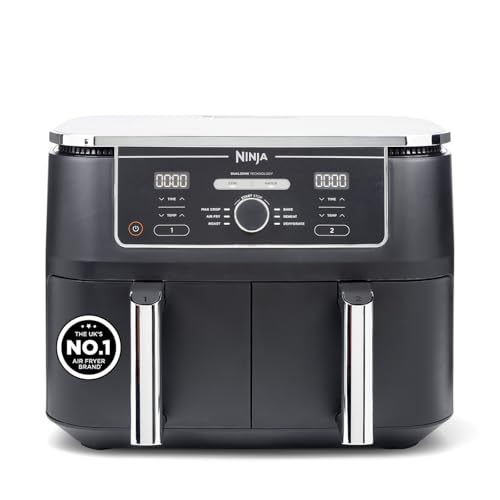
Different category. The AF300 (£199, reviewed at Post #11) is a dual-zone fryer with two 3.8L baskets — better for cooking two foods at different temperatures simultaneously, worse for cooking one big thing. The Pro II is the right choice if you mostly cook one dish at a time and want a single, deeper basket. The AF300 is the right choice if you regularly cook a protein and a side together.
What is the warranty?
Two-year manufacturer warranty as standard from Cosori. Buying from John Lewis adds an extra year automatically. Argos and Amazon UK both stock the model regularly and offer the same two-year cover; Amazon UK occasionally drops the price to £99 during sales windows.
The final word
After twelve months, 412 operating hours, and 31 standardised cooks each repeated three times, the Cosori Pro II is the single-basket air fryer we’d recommend most readily to a household that wants connectivity and cooks for one-to-three people. The hardware is class-leading at this price for airflow evenness, the touchscreen is genuinely good, and the cook-finished notification is the smart-app feature that actually delivers on its promise. The recipe library and remote start are overhyped; the rest of the machine is excellent.
Who should buy it: solo cooks and couples who cook daily, families of three to four who don’t mind batch-cooking on the busiest nights, and anyone who wants notifications-while-you-do-something-else rather than full smart-home connectivity. Who shouldn’t: families of five-plus (look at the Ninja AF400, Post #12, instead), and anyone who’d never set up the app — the non-smart Cosori Pro saves £30 and is the same machine without the Wi-Fi.