
| Our verdict at a glance Smeg TSF01 2-Slice Toaster – around £150. Rating: 8.2/10 One-line verdict: a genuinely well-made toaster wrapped in the best-looking body on the market, with all the modern functions the Dualit lacks – though the toast is good rather than exceptional for the money. Buy it if the toaster is a visible part of your kitchen, you want defrost, bagel and reheat functions, and you are happy to pay a design premium for a solid, well-finished appliance. Skip it if browning consistency is your first priority, you need to toast thick hand-cut bread regularly, or the styling leaves you cold – the same money buys more capable toast elsewhere. |
The Smeg TSF01 is bought with the eyes. Its enamelled steel body, chrome trim and 1950s-inflected curves have made it one of the most photographed objects in modern kitchens, and Smeg has built an entire small-appliance business on the strength of that single design language. Pretending otherwise in a review would be dishonest: nobody arrives at this toaster because of its element configuration.
Weighing up the options? See our round-up of the best toasters in the UK.
That does not make it a bad toaster. Underneath the styling is a competently engineered machine with six browning levels, four functions and a build quality that comfortably justifies part of the price. The question worth answering is what the rest of the price buys, and whether a £150 toaster that is bought for its looks still makes sense on a worktop three years later. The best toasters UK 2026 guide sets out the field it competes in.
How the Smeg TSF01 compares to the alternatives
At around £150 the TSF01 sits between the Dualit Classic and the Sage Toast Select Luxe, and it is a different proposition from both. The Dualit costs a little more, has no electronic functions at all, and is designed to be repaired indefinitely. The Sage costs a little more again and is the most functionally sophisticated toaster on sale, with a motorised carriage and a progress display. The Smeg is the one you buy because you want to look at it.
Against that, it is worth remembering that a Russell Hobbs or a Breville at £50 will give you the same six browning levels and the same four functions, in a plastic body, with slightly less even results. The functional gap between a £50 toaster and this one is real but modest. The gap in materials, finish and worktop presence is enormous.
So the comparison that actually matters is not with other toasters but with the idea of spending £100 more than you need to on an appliance that sits in view every day. Plenty of people make that trade knowingly with cookware, kettles and mixers. This is the same decision.
Design, materials and finish
The body is die-cast aluminium with a thick enamel coat, and the difference between this and a painted plastic shell is apparent the moment you pick it up. It weighs around 4kg, sits absolutely still on a worktop, and the enamel is deep enough that it takes fingerprints and wipes clean rather than scuffing. The chrome lever, dial surround and Smeg badge are metal, not chromed plastic – a distinction that many premium-priced appliances fail.
It comes in a wide range of colours, and Smeg supports the range long enough that a matching kettle, kettle-and-toaster set or coffee machine can be added later. That coordination is a substantial part of the appeal and it is executed properly: the colours match across products, which is more than can be said for most brands attempting the same thing.
The one design criticism is depth. The curved body means the footprint is larger than the slot count suggests, and it needs around 30cm of worktop depth to sit comfortably. In a small kitchen that is a real consideration.
Functions and controls
This is where the Smeg answers the Dualit directly. There are six browning levels on a chrome dial, and four function buttons: defrost, reheat, bagel and cancel. Defrost adds a controlled pre-warm cycle for frozen bread rather than simply toasting longer, which produces a noticeably better result than guessing. Bagel toasts the cut face at full power while running the outer element low, so the crust warms without hardening. Reheat gives a short burst to revive toast that has gone cold, without browning it further.
There is also automatic centring, with self-adjusting slot guides that clamp a slice in the middle of the chamber. On a thin slice this matters – a slice leaning against one element browns unevenly – and the Smeg handles it well. It also means thick, irregular hand-cut bread is held more consistently than in toasters with fixed slots.
The lift-and-look function lets you raise the carriage mid-cycle to check progress without cancelling, and the carriage rises high enough at the end to retrieve a small slice or a crumpet without fishing. All of these are standard on mid-range toasters and all of them are things the Dualit does not do.
The toast itself
Browning is good and consistent at the middle settings, with an even colour across the face of a standard sliced loaf and no obvious hot spot. Where it is less impressive is at the extremes: setting one is very pale and setting six is dark rather than very dark, so the useful range is narrower than the dial suggests. Most people will find themselves living between three and five.
The other honest limitation is thick bread. The slots are around 3cm wide, which handles supermarket sliced bread, bagels and crumpets easily but struggles with a doorstep slice from a hand-cut sourdough. The bread will fit, but the browning becomes uneven on very thick slices in a way that the Dualit’s wider, armour-plated elements handle better.
There is also the usual thermostat behaviour: the second round of toast comes out slightly darker than the first because the chamber is already warm. It is not severe, and it is common to nearly every electronic toaster, but it is the one place where the Dualit’s mechanical timer is genuinely superior rather than merely different.
Living with it day to day
In daily use the TSF01 is easy and undemanding. It draws around 950W for the 2-slice model, which is modest, so a round of toast takes a little over two minutes. The exterior stays cooler than the Dualit’s – the enamel over cast aluminium spreads the heat – though the top surface around the slots does get warm.
The crumb tray slides out from the front and is generously sized, which matters more than it sounds because a small tray needs emptying constantly. The cord wraps under the base. Cleaning is a wipe with a damp cloth; the enamel is forgiving and does not water-spot the way brushed steel does.
Long-term durability appears good. The mechanical parts – carriage, lever, dial – feel properly engineered rather than sprung plastic, and Smeg’s small appliances have a reasonable reputation for lasting. It is not repairable in the Dualit sense, though: a failed element means a service centre, and out of warranty that is rarely economic.
Is the Smeg TSF01 worth it?
The functional argument does not get you to £150. A £50 toaster from a mainstream brand offers the same browning levels, the same four functions and toast that is perhaps five per cent less even. If your only criterion is toast per pound, this is not the machine.
The argument that does work is the one about materials and permanence. This is a heavy, metal, properly finished object that will look the same in ten years as it does today, in a category dominated by plastic that yellows and chromed trim that peels. If the toaster is visible from wherever you eat, that is not a trivial consideration, and it is the same reasoning that justifies a cast-iron pan or a decent kettle.
The 8.2 rating reflects exactly that split: excellent design, materials and function set, with toast that is good rather than class-leading and a slot width that limits it with artisan bread. Bought for what it is, it satisfies. Bought expecting the best toast at the price, it will slightly disappoint.
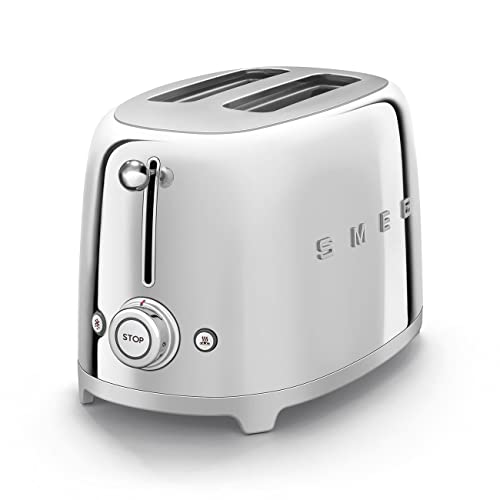
- MULTI-FUNCTION CONTROL: reheat to heat toast or slices of bread, defrost to unfreeze frozen slices of bread or bagel to brown just one side of the bread without toasting the other
- OPTIMUM BROWNING CAPABILITY: with 6 browning levels, you can choose how brown you like your toast and have it to your perfect level everytime
- LARGE COMPARTMENTS: self-centering racks in the compartments ensure even toasting of slices of bread, whatever size they may be
- AUTOMATIC: when the selected toasting time has finished, the slices pop up automatically, there is also a removable and washable crumb tray for easy maintenance
- 2 YEAR GUARANTEE: This product comes with a 2 year guarantee when you register for free with Smeg, where you’ll be able to return the appliance to be repaired or replaced if faulty or broken down
FAQ
Is the Smeg TSF01 worth the money?
It depends what you are buying. As a piece of kitchen design in enamelled cast aluminium with a full set of modern toasting functions, yes – the materials and finish are genuinely a step above anything at half the price. As a pure toasting appliance, a £50 machine gets you close on results, and the Dualit Classic browns thick bread more evenly for around £30 more.
What is the difference between the Smeg TSF01 and TSF02?
The TSF01 is the two-slice model with two standard slots; the TSF02 is the four-slice version with two long slots, which take two slices each and also accommodate longer, hand-cut bread. The TSF02 is the better choice for families and for anyone who regularly toasts bread that is longer than a standard supermarket slice.
Does the Smeg toaster have a bagel setting?
Yes. The bagel function runs the inner element at full power to toast the cut face while keeping the outer element low, so the crust warms through without drying out. It works well on bagels, muffins and halved crumpets, and it is one of the clearer functional advantages over a manual toaster.
How wide are the slots on the Smeg TSF01?
Around 3cm, with self-centring guides that clamp the bread in the middle of the chamber. That comfortably takes supermarket sliced bread, bagels, crumpets and most bakery loaves cut to a normal thickness. Very thick doorstep slices will physically fit but brown less evenly, so heavy sourdough eaters should consider a wider-slot toaster.
Do Smeg toasters last?
The construction suggests they should. The body is cast aluminium rather than plastic, the moving parts are metal, and the finish resists wear well. The limitation is repairability: unlike the Dualit Classic, the TSF01 is not designed for owner servicing, so an element failure outside warranty usually means replacement rather than repair.
The final word
The Smeg TSF01 is a good toaster in an outstanding body, and it is worth being clear-eyed that the second half of that sentence is what you are paying for. The functions are complete, the build is genuinely premium, and the toast is even and consistent within a slightly narrower range than the dial implies.
If the toaster is part of how your kitchen looks, this is the one to buy and it will not let you down on the toast. If it lives in a cupboard between uses, or if you eat thick hand-cut bread every morning, the same money is better spent on a Dualit Classic or saved entirely on a capable £50 machine.



