The Sage Barista Touch takes the popular Barista Express and adds a colour touchscreen and automatic milk texturing, while keeping the same grinder, portafilter and pump. It is a touchscreen bean-to-espresso machine aimed at people who want café-style drinks at home without a long learning curve. This review looks at what the extra technology changes and whether it is worth the premium. Prices are approximate, so check the live listing.
Our verdict at a glance
- Best for: households that drink lots of milk-based coffees and want repeatable results.
- Also good for: beginners who want guidance rather than a steep learning curve.
- Think twice if: you mostly drink black espresso, where the cheaper Barista Express gives very similar coffee.
Sage Barista Touch at a glance

- Built-in conical burr grinder with adjustable grind size.
- Colour touchscreen with guided drink menus and preset drinks.
- Automatic steam wand that textures milk to your chosen temperature and texture.
- Custom drink profiles you can save.
- Typical price: roughly £900 to £1,050. Check the live listing.
How it compares to the alternatives
The obvious comparison is the manual Sage Barista Express, which shares the espresso hardware but has a manual steam wand and analogue controls. It costs a good deal less. Our Sage Barista Express review covers it in detail, and our Sage Barista Express vs Touch comparison sets the two side by side.
If you would rather have a fully automatic machine that makes the drink at the touch of a button, our DeLonghi Magnifica Evo review looks at a more hands-off, and cheaper, option. The Touch sits between the two: you skip the milk steaming but keep the portafilter and a proper espresso process.
For the money, the Touch is at the top end of what most UK households spend on a home espresso machine, so it needs to earn its place.
The touchscreen: what it actually changes
The screen provides step-by-step guidance, which is genuinely useful for beginners, and lets you save custom drink profiles with your preferred espresso length, milk temperature and texture. In a household where several people drink different things, being able to recall your own settings saves fuss. You still need to grind, dose and tamp, so this is not a fully automatic machine.
Automatic milk texturing
The headline feature is the steam wand, which textures the milk for you and stops automatically when it reaches your chosen settings. That gives consistent microfoam without extensive practice, and it is the biggest practical difference from the Express. If you find manual steaming frustrating, or make several milk drinks a day, this is where the money goes. As always, keep the wand clean after use.
Espresso quality and ease of use
The espresso is essentially identical to the Barista Express, because the core components are shared. Once dialled in with fresh beans, you can expect the same quality of shot. The screen makes the process easier to learn, and a complete novice can make a good flat white on the first day.
Regular descaling and cleaning are needed, as with any machine of this type. It is also a substantial machine, so measure your worktop and the height under wall units before ordering.
Is it worth the premium over the Barista Express?
It depends on your drinks. The Touch costs several hundred pounds more than the Express, and you are paying for convenience and consistency, not better espresso. If milk drinks dominate and you will use the automatic wand daily, it can be worth it. If you drink mostly espresso or Americanos, or enjoy learning to steam, the Express is the better value.
The Touch is a good choice for:
- Latte and flat white drinkers who want repeatable milk.
- Beginners who want guided operation.
- Households with several users who want saved preferences.
Look elsewhere if you are on a tighter budget or want a fully automatic machine.
Prefer to learn manual steaming and save money? See the Express:
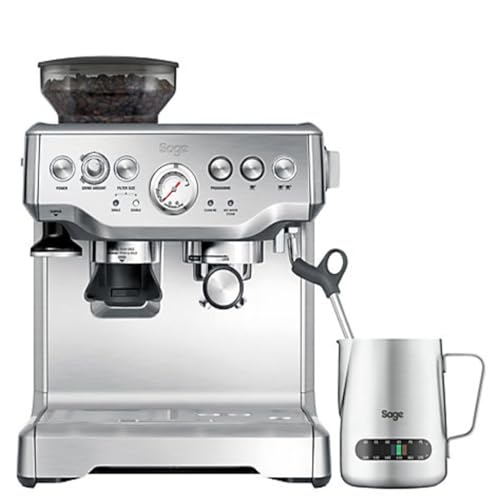
Grinder and everyday features
The built-in conical burr grinder is a real strength of the Barista range. Grinding fresh for each shot gives noticeably better flavour than pre-ground coffee, and the adjustable grind size lets you adapt to different beans. You will need to tweak it occasionally as beans age or when you switch roast, which is part of owning any grinder.
Beyond the grinder, the Touch offers saved drink profiles, so you can set espresso length, milk temperature and texture once and repeat them. Those details are what make it easier to live with in a busy household, where different people want different drinks.
Running costs are mostly beans, milk and descaling. There are no pods, so per-cup cost stays below capsule machines over time, though the upfront price is much higher. A good milk jug and a knock box are sensible extras.
Living with it day to day
A normal morning is simple: fill the hopper, grind into the portafilter, tamp, pick your drink on the screen and let the machine pull the shot and texture the milk. Because you can save your settings, a second drink is quicker than the first. The routine is more involved than a fully automatic machine, but far less fiddly than a manual setup, and it feels like making proper coffee.
The machine is a big appliance, so plan for where it lives. You will want quick access to the water tank, hopper and drip tray, and room above for lifting lids. Keep the steam wand wiped after each use and purge it, and descale when prompted, and it should stay in good order.
Who should buy it, and who should not
Buy the Touch if you want café-style milk drinks without a long apprenticeship, if several people will use the machine, or if the guided screen appeals. Skip it if you want the cheapest route to good espresso, if you enjoy manual control, or if you would prefer a fully automatic machine with no grinding and tamping. In those cases the Express or a bean-to-cup machine such as the Magnifica Evo is a better match.
Whichever you choose, spend a little on good beans. The machine can only be as good as the coffee you put in.
FAQ
Q: Is the Sage Barista Touch good for beginners?
A: Yes. The guided screen and automatic milk mean a complete novice can make a good flat white on the first day.
Q: Is the espresso better than the Barista Express?
A: No. It is essentially identical, since the core components are shared.
Q: Does it need regular maintenance?
A: Yes. Regular descaling and cleaning are needed.
Q: Will the automatic milk work with plant milks?
A: Results vary by milk, so check the manufacturer’s guidance and reviews on the live listing.
Q: Is it worth it over the Express?
A: Only if you value the automatic milk and touchscreen enough to pay the difference.
New to home espresso? Start with our first home espresso setup guide.