
| Our top picks at a glance Best overall: Sage the Nutri Juicer Cold – a fast centrifugal machine with a cold-spin system and a wide chute that takes whole apples (around £200). Best cold-press: Nama J2 – a self-feeding vertical slow juicer with the highest yield here and a hopper that lets you walk away mid-batch (around £450). Best budget: Philips Viva Collection HR1832 – a compact centrifugal juicer that does the job well for a fraction of the price (around £70). Best mid-range slow juicer: Fridja f1900 – proper cold-press yield and quiet running at around half what the premium machines cost (around £200). |
Juicers divide into two camps, and the choice between them shapes everything else about ownership. Centrifugal juicers shred the fruit against a spinning mesh basket and fling the juice out at high speed. Masticating or cold-press juicers turn a slow auger that crushes and squeezes the produce against a screen. The first is fast, loud and cheap; the second is slow, quiet and expensive. Both make juice.
What people rarely factor in before buying is the cleaning. A juicer that takes eight minutes to disassemble, scrub and reassemble will be used twice and then live in a cupboard, no matter how good the juice is. That is the single biggest reason juicers get abandoned, and it is why this guide weighs cleaning time as heavily as yield. If the machine is a hassle, the yield is irrelevant.
This round-up covers four machines spanning £70 to £450, two of each type. If you already know you want a slow juicer, the dedicated best masticating juicers UK guide goes deeper on that category alone. Otherwise, read on – the honest answer for a lot of households is that a good centrifugal machine is the more sensible purchase.
At a glance: the juicers in this guide
The Sage and the Philips are centrifugal machines at very different prices; the Nama and the Fridja are cold-press machines, likewise. Each gets a full write-up below covering what it does, who it suits and where the money goes.
Sage the Nutri Juicer Cold – best overall
The Nutri Juicer Cold is the machine that best answers the practical version of the question ‘which juicer should I buy?’. It is a centrifugal juicer, so it is fast – a full jug of apple and carrot juice takes well under a minute – but Sage has addressed the two standard criticisms of the format. The Cold Spin system keeps the juice under 5C above ambient during extraction, which counters the argument that centrifugal machines heat and oxidise the juice, and the extra-wide 84mm feed chute takes whole apples without pre-chopping.
That chute is a bigger deal than it sounds. The main time cost of juicing is not the juicing, it is the preparation and the washing-up, and a chute wide enough to swallow whole fruit removes a chunk of the first. Combined with a five-part disassembly and parts that go in the dishwasher, it takes the total round-trip for a jug of juice down to something you would plausibly do on a weekday.
The build is what you would expect from Sage at this price: brushed stainless, a heavy motor base that does not walk across the worktop, and a locking arm that feels engineered rather than moulded. Yield is good for a centrifugal machine, though a cold-press will beat it, particularly on leafy greens where a centrifugal juicer struggles by design.
Buy it if you want a fast, capable juicer you will actually use on a weekday morning. Skip it if wheatgrass, kale and celery are the main things you plan to juice.

Nama J2 – best cold-press
The Nama J2 is the machine that made vertical slow juicers viable for people who do not enjoy standing over an appliance. Its defining feature is the sealed hopper on top: you load a full batch of chopped produce, close the lid, press start and walk away. Every other juicer here requires you to feed it piece by piece with a plunger. That single design decision changes the experience more than any spec on the sheet.
Yield is the best in this guide, particularly on soft fruit, celery and leafy greens, where the slow auger extracts noticeably more than any centrifugal machine can. The pulp comes out dry to the touch, which is the practical test. The juice separates less on standing and keeps better in the fridge, which matters if you batch a couple of days at a time.
Cleaning is the usual cold-press story, softened by good design. There are more parts than a centrifugal juicer and the screen needs the supplied brush, but Nama’s screen is easier to rinse clear than most and the whole assembly disassembles without force. Expect four to five minutes rather than the two the Sage needs, or the eight that older slow juicers demanded.
At around £450 it is by a distance the most expensive machine here, and the honest position is that the juice is not four times better than the Philips’s. What you are buying is yield, quiet running and the hopper. If you juice most days, that adds up. If you juice once a fortnight, it does not.

Philips Viva Collection HR1832 – best budget
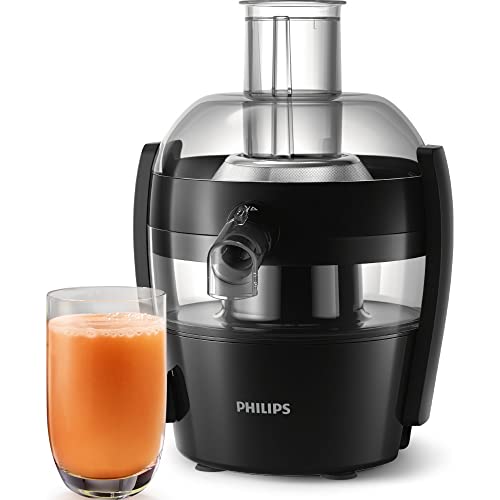
The Philips Viva is the machine to buy if you are not sure whether juicing will stick. At around £70 it is cheap enough to be a low-risk experiment, and it is a genuinely competent centrifugal juicer rather than a token one. The QuickClean design is the reason to pick it over similarly priced rivals: the sieve has a smooth surface that rinses clear under a tap in well under a minute, which for a budget machine is remarkable.
It is compact, which suits a small kitchen, and it comes apart into few enough pieces that cleaning does not become an event. The feed chute is 55mm, so apples need halving and larger produce needs chopping, and there is a real time cost to that compared with the Sage. Capacity is modest too – the pulp container fills quickly on a large batch and needs emptying mid-run.
It is loud, as all centrifugal juicers are, and the yield on leafy greens is poor. Neither of those is a fault so much as a characteristic of the format at this price. For citrus, apples, carrots, beetroot and ginger – which is what most people actually juice – it performs well above what £70 suggests.
Fridja f1900 – best mid-range slow juicer
The Fridja f1900 is the sensible entry point into cold-press juicing. It is a horizontal masticating juicer that delivers most of what the premium vertical machines do at around £200, and it does so with a build that feels considerably more substantial than the price implies.
Yield is close to the Nama’s on hard produce and only slightly behind on greens, which is where the money usually shows. It runs at a low speed, so it is quiet enough to use early in the morning without waking a household – a genuine advantage over any centrifugal machine and the reason many people move to cold-press in the first place. The horizontal layout also handles fibrous produce like celery and ginger particularly well, because the auger has a longer crushing path.
The compromises are feeding and cleaning. There is no hopper, so you feed it piece by piece with the plunger, and the chute is narrow enough that most produce needs cutting into batons. Cleaning takes five or six minutes with the supplied brush. Neither is unreasonable, but both are the reason the Nama costs more than twice as much.
Buy it if you want cold-press yield and quiet running and can accept a slower process. Skip it if the appeal of juicing for you is speed.


Cold-press or centrifugal: which should you buy?
The received wisdom is that cold-press is simply better, and on yield and juice quality that is broadly true. A masticating juicer extracts more from the same produce, produces juice that separates less and keeps longer, and copes with leafy greens that a centrifugal machine mostly turns into damp pulp. If those things matter to you, the decision is easy.
But the received wisdom skips the part that determines whether the machine gets used. A centrifugal juicer produces a jug of juice in about a minute and cleans in two. A slow juicer takes three to five minutes to run and four to six to clean, and needs the produce chopped smaller. Over a year, that is a substantial difference in effort, and effort is what decides whether an appliance stays on the worktop.
The practical rule is this: if you juice hard produce – apples, carrots, beetroot, citrus, ginger – and you value speed, buy a good centrifugal machine and spend the savings elsewhere. If you juice greens, celery or wheatgrass, or you batch-juice for several days at a time, buy cold-press, because the yield difference on those ingredients is large enough to pay for the machine over time.
How much should you spend on a juicer?
Around £70 to £100 buys a competent centrifugal juicer with a narrow chute and a modest pulp bin. That is the right amount to spend if you are trying juicing out, or if you juice occasionally. The Philips sits here and does not feel like a compromise for the money.
The £180 to £220 band is where the two formats meet, and it is the most interesting part of the market. It buys either a premium centrifugal machine with a wide chute and better cleaning, like the Sage, or an entry-level cold-press with proper yield, like the Fridja. Choosing between them is choosing between speed and extraction, and both are defensible.
Above £400 you are in specialist territory. The Nama J2 earns its price through the hopper, the yield and the quiet, but only for someone juicing several times a week. For anyone else it is a lot of money tied up in an appliance that will be used occasionally, and the same budget spent on a good blender and a mid-range juicer would serve more purposes.
What to look for in a juicer
Chute width is the specification that most affects daily use and the one most often overlooked. A 75mm or wider chute takes whole apples and large chunks; a 50mm chute means chopping everything. Over a year of regular juicing, that difference is measured in hours.
Then look at how the machine comes apart and whether the parts are dishwasher safe. Count the components in the product photographs – fewer is better – and look specifically at the mesh or screen, because that is the part that takes the longest to clean and the part that determines whether you keep using the machine.
Motor power matters less than the marketing suggests for centrifugal machines, where anything from 700W upward will handle household produce, and matters not at all for cold-press machines, which work by torque at low speed rather than raw wattage. Ignore the headline number and look at the warranty on the motor instead, which is a better proxy for how well it is built.
Finally, think about noise and about where the machine will live. Centrifugal juicers are genuinely loud – comparable to a food processor at full tilt – which matters in a flat or an open-plan kitchen with someone still asleep. Cold-press machines hum rather than scream. And any juicer that has to be lifted out of a low cupboard before use will get used less than one that stays out.
FAQ
What is the best juicer in the UK?
For most households the Sage Nutri Juicer Cold is the best all-round choice, combining centrifugal speed with a wide chute and easy cleaning. For maximum yield and quiet running the Nama J2 is the strongest cold-press machine here, and the Philips Viva HR1832 is the best inexpensive way to find out whether juicing suits you.
Is cold-press juice actually healthier?
The nutritional difference is smaller than marketing suggests. Cold-press machines extract more juice from the same produce and introduce less air, so the juice oxidises more slowly and keeps longer in the fridge – typically two to three days versus around 24 hours. Some heat-sensitive nutrients are marginally better preserved. But juice from a decent centrifugal machine drunk immediately is nutritionally very close.
How long does fresh juice keep?
Juice from a centrifugal machine is best drunk within a few hours and will keep around a day in a sealed container in the fridge. Cold-press juice keeps two to three days. In both cases, fill the container to the brim to minimise air contact, keep it cold, and expect some separation, which is normal – shake before drinking.
Can you juice leafy greens in a centrifugal juicer?
Poorly. Spinach, kale and wheatgrass have little free liquid and are simply flung against the mesh rather than crushed, so yield is low and much of the leaf ends up in the pulp. Rolling greens tightly and feeding them between harder items like apples helps a little, but a masticating juicer is the right tool if greens are a regular part of what you juice.
What can you do with the leftover pulp?
Carrot and apple pulp works well in muffins, loaf cakes and fritters; vegetable pulp goes into soups, stocks and bolognese to add body; and any of it can go on a compost heap. It is worth noting that the pulp is largely fibre, which is the part of the fruit that juicing removes, so returning some of it to a recipe is not a bad idea nutritionally.
The final word
The most common juicing mistake is buying more machine than the household will maintain. A £450 cold-press juicer that gets used twice makes considerably worse juice than a £70 centrifugal machine used three times a week, and the cleaning burden is what decides which of those happens. Be honest about that before spending.
For most people the Sage Nutri Juicer Cold is the right balance – fast enough for a weekday, wide enough to skip most of the chopping, and easy enough to clean that it stays on the worktop. If you juice greens or batch-juice for the week, step up to the Fridja f1900 or the Nama J2 and accept the extra few minutes at the sink. And if you are not yet sure juicing is for you, the Philips Viva costs less than a month of shop-bought juice and will tell you within a fortnight.



