
Our top picks at a glance Weighing up the options? See our round-up of the best toasters in the UK. Best overall: Breville Ultimate Deep Fill Toastie Maker (VST082) – properly sealed deep-fill triangles with a floating hinge that handles a thick sandwich (around £45). Best budget: Salter Deep Fill Sandwich Toaster – the sealed-edge toastie done cheaply and reliably, with non-stick plates that clean easily (around £30). Best panini press: Cuisinart 2-in-1 Grill and Griddle – flat ribbed plates, a floating lid and enough heat to mark bread properly (around £120). Best all-rounder: Tefal Snack Collection – swappable plates that turn one machine into a toastie maker, panini press, waffle iron and more (around £90). |
There are two quite different appliances hiding behind the phrase ‘sandwich toaster’, and buying the wrong one is the most common mistake in this category. A traditional toastie maker has moulded plates that cut the sandwich into sealed triangles or squares, trapping the filling inside. A panini press has flat, usually ribbed plates and a floating lid that squashes a sandwich rather than sealing it. Both make excellent toasted sandwiches. Neither can do the other’s job.
Which one you want depends almost entirely on the bread you buy. Sliced white or wholemeal from a supermarket loaf suits a sealed toastie maker, and the sealed edge is the whole point – it is what stops molten cheese escaping onto the plates. Ciabatta, sourdough, focaccia and anything with an irregular crust needs a flat press, because a moulded plate simply will not close on it. If your household eats both, a multi-plate machine is the sensible compromise, and this guide covers one.
The wider breakfast setup matters here too – a toastie maker sits alongside the kettle and the toaster as a weekday-morning appliance rather than a weekend one, and it is worth reading this next to the best toasters UK 2026 guide if you are refreshing the whole worktop. Prices below are typical UK street prices.
At a glance: the machines in this guide
Four machines, covering the two main formats and the middle ground between them. The Breville and the Salter are sealed-edge toastie makers at different prices; the Cuisinart is a proper flat grill for ciabatta and paninis; the Tefal is the machine to buy if you cannot decide, or if a waffle iron is also on the shopping list.
Breville Ultimate Deep Fill Toastie Maker (VST082) – best overall
Breville effectively invented this category in the UK and the Ultimate Deep Fill is the model that most clearly shows why they still lead it. The defining feature is the floating hinge, which lets the top plate rise to accommodate a genuinely thick sandwich without crushing it or leaving the edges unsealed. Cheaper machines with a fixed hinge either refuse to close on a deep-fill sandwich or close so hard that the filling is forced out of the sides.
The plates are deep and steeply angled, which produces the classic sealed triangle with a proper cavity for the filling. The seal itself is the part that matters: done well, you can put a handful of grated cheese and a slice of ham into a sandwich and it will still be inside the bread when it comes out. Done badly, it welds itself to the plates. The Breville seals reliably, which is the single most important thing a toastie maker can do.
Build quality is solid without being luxurious – a brushed stainless top plate, a plastic body and a latch that holds the lid closed for upright storage. The plates are fixed and non-stick, so cleaning means wiping them while still warm rather than putting them in the dishwasher. At around £45 it is the standout value pick in this guide.
Buy it if you want deep-fill sealed toasties from sliced bread and want them to work every time. Skip it if your household mostly eats ciabatta or sourdough.
![Breville Ultimate Deep Fill Toastie Maker | 2 Slice Sandwich Toaster | Removable Non-Stick Plates | Stainless Steel | Black [VST082]](https://m.media-amazon.com/images/I/41Se9bKlf9L.jpg)

Salter Deep Fill Sandwich Toaster – best budget
The Salter covers the same territory as the Breville for around £15 less, and for a lot of households that will be the right trade. It makes two deep-fill sealed sandwiches at a time, the non-stick coating releases well, and there is a locking latch and upright storage so it does not sprawl across a cupboard shelf.
The compromises are in the hinge and the heat distribution. The lid does not float as generously as the Breville’s, so a very thickly filled sandwich will squeeze out at the edges rather than sealing cleanly. And the plates run slightly hotter at the centre than at the edges, which means the middle of the sandwich browns first. Both are manageable once you know about them: fill a little less and rotate the sandwich if you want an even colour.
It heats up quickly, with a ready light rather than a timer, and a toastie takes around four minutes from a cold start. For students, small households and anyone who wants a toastie machine without thinking hard about it, this is a sensible amount to spend.
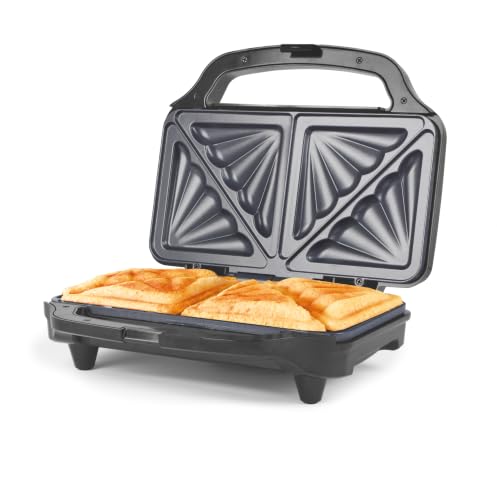
Cuisinart 2-in-1 Grill and Griddle – best panini press
If you buy your bread from a bakery rather than a supermarket, this is the machine you want. The plates are flat and ribbed rather than moulded, and the lid floats on a tall hinge so it will close on a ciabatta roll as happily as on a flat slice. That is what turns it from a sandwich toaster into a genuine panini press.
It also runs considerably hotter than a sealed toastie maker, which is what produces proper dark grill marks and a crust rather than a uniform pale brown. Adjustable temperature control lets you dial it back for a delicate filling or push it up for a hard sear. The plates open out flat into a griddle, which is where the ‘2-in-1’ comes from – useful for a couple of eggs, some halloumi or a small piece of fish, and a genuine argument for keeping it on the worktop rather than in a cupboard.
The plates are removable and dishwasher safe, which at around £120 is what you would hope for and what the cheaper machines here cannot offer. It is the largest and heaviest machine in this guide by some margin, so it needs a permanent home. Buy it if you eat paninis, toasted sourdough and grilled sandwiches on proper bread. Skip it if what you actually want is a sealed cheese toastie – it will not make one.
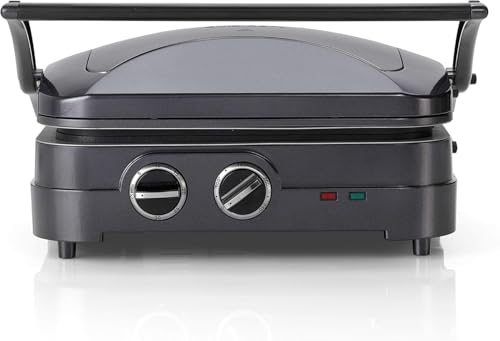
Tefal Snack Collection – best all-rounder
The Tefal Snack Collection solves the sealed-versus-flat problem by refusing to choose. The base unit is a heated clamshell with a quick-release plate system, and you buy the plates you want: sandwich triangles, flat panini plates, waffle plates, doughnut moulds, bagel plates and several more. Two sets usually come in the box and the rest are sold separately.
In practice it does most of those jobs at around eighty per cent of the quality of a dedicated machine, which is a fair description of every multi-tool ever made. The toasties are good but the seal is not as convincing as the Breville’s; the paninis are good but the heat is lower than the Cuisinart’s; the waffles are decent but shallower than a dedicated iron’s. What you get in exchange is one appliance and one cupboard slot instead of three.
The plates release with a button and go in the dishwasher, which is a bigger practical advantage than it sounds – it removes the main reason people stop using toastie machines. At around £90 with two plate sets it is well priced for what it does, though buying every plate set pushes the total well past £150 and undermines the value argument.
How much should you spend?
Around £30 is the entry point for a machine that seals properly and lasts. Below that the coatings tend to be thinner, the hinges flimsier and the seals unreliable, and a toastie maker that leaks filling onto the plates gets abandoned within a month. The Salter sits at the sensible bottom of the market.
The £40 to £60 band is the sweet spot for sealed toasties. That buys a floating hinge, better heat distribution and a build that survives daily use, and the Breville is the clearest example. Most households never need to spend more than this.
Above £90 you are buying either versatility, as with the Tefal, or a proper high-heat grill with removable plates, as with the Cuisinart. Both are justifiable, but only if you will actually use the extra capability. A panini press bought by a household that eats sliced bread will sit unused.
What to look for in a sandwich toaster
Start with the hinge, because it is the part that determines whether a thick sandwich works. A floating or adjustable hinge lets the upper plate rise to meet the sandwich rather than crushing it, and it is the single clearest difference between a cheap machine and a good one. Look for it explicitly in the specification – manufacturers who have it always mention it.
Plate coating and removability come next. Removable plates go in the dishwasher and transform how easy the machine is to live with, but they are uncommon below £80. If you are buying fixed plates, look for a deep, well-applied non-stick coating and accept that cleaning means a warm cloth and a soft brush rather than a wash-up.
Then think about capacity and storage. Almost every machine here does two sandwiches at once, which is right for most households; four-slice machines exist but are large. A locking latch and upright storage make a real difference to how much cupboard space the machine claims, and to whether it gets used.
Finally, check for a ready indicator. It is a small thing, but the difference between a machine with a heat-ready light and one without is the difference between a consistently browned toastie and a guess. None of these machines have timers, so the light is doing all the work.
FAQ
What is the difference between a sandwich toaster and a panini press?
A sandwich toaster has moulded plates that cut and seal the sandwich into triangles or squares, trapping the filling inside. A panini press has flat, usually ribbed plates and a floating lid that presses the sandwich flat without sealing the edges. Sealed toasties suit sliced bread and runny fillings; panini presses suit ciabatta, sourdough and anything with an irregular shape.
Can you put buttered bread in a sandwich toaster?
Yes, and buttering the outside of the bread is what produces the crisp golden crust. Butter the side that faces the plate, not the side that faces the filling. Some people use mayonnaise instead, which has a higher smoke point and browns more evenly. Either way, a light film is enough – excess butter pools in the plate channels and smokes.
How do you stop cheese leaking out of a toastie?
Leave a clear border of about a centimetre around the edge of the bread, use less filling than feels right, and grate the cheese rather than slicing it so it melts evenly instead of sliding out in a sheet. A machine with a floating hinge helps considerably, because it seals the edges before the filling has had time to liquefy.
How do you clean a sandwich toaster with fixed plates?
Unplug it and let it cool until warm rather than hot, then wipe the plates with kitchen paper while any residue is still soft. For baked-on cheese, lay a damp cloth over the closed plates for a few minutes to steam it loose, then remove it with a soft brush or a wooden spatula. Never use metal utensils or abrasive pads, and never submerge the unit.
Are multi-plate machines worth it?
They are if you would genuinely use two or more of the plate sets and cupboard space is tight. A Tefal Snack Collection with sandwich and waffle plates replaces two appliances for around the price of one and a half. If you only ever want toasties, a dedicated machine does the job better for less.
The final word
For most UK households the Breville Ultimate Deep Fill is the right machine at the right price. It does the one thing a toastie maker has to do – seal a thick sandwich reliably – better than anything else near its money, and at around £45 it is not an extravagant purchase. The Salter is the budget alternative and gives up less than the price gap suggests.
The decision only gets interesting if you eat bakery bread. In that case the sealed-edge machines are simply the wrong tool, and the Cuisinart’s flat, hot, removable plates are worth the extra outlay. And if the honest answer is that you want both, the Tefal Snack Collection is the pragmatic middle path – a little worse at everything, and one appliance instead of three.



