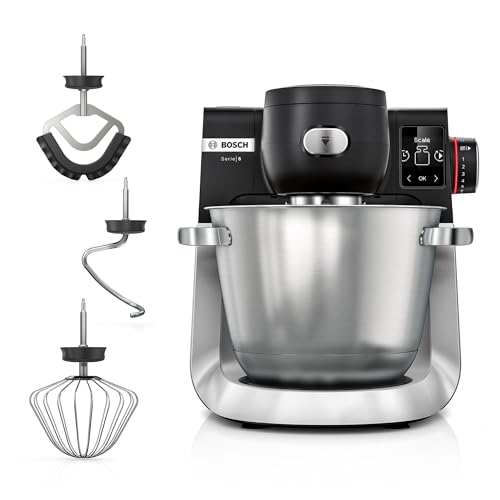
INTELLIGENT SENSING FOR GREAT RESULTS EVERY TIME: The 7 sensor-driven programmes monitor the mixture and stop the machine automatically when it reaches the desired consistency. Select a programme for cake mix, pastry dough, whipped cream and more
POWERFUL 1600W MOTOR: Suitable for mixing large quantities and heavier dough. The unique Air Cooling technology ensures several hours of use with minimal noise. You can rely on your Bosch Series 6 stand mixer time and time again
3D PLANETARY MIXING: Mimics hand kneading, for perfect end results. The angled movement of the attachment ensures all ingredients are evenly mixed and kneaded so there’s no need to intervene by hand.
EXTRA-LARGE 5.5L BRUSHED STAINLESS STEEL BOWL: Prepare large amounts of dough in a single step and up to 3.5kg of cake mixture. The large capacity of the bowl coupled with 3D Planetary Mixing ensures large quantities can be handled with ease.
INTEGRATED SCALE FOR PRECISE MEASUREMENTS: Weigh ingredients on top of the mixer or in the bowl with ease. The LED display shows the measurement to the exact gram, millilitres of oil or milk, and in pounds or ounces too, for optimal results.
Our verdict at a glance Rating: 4 / 5 One-line summary: the Bosch MUM Series 6 is the sensible-money stand mixer — a strong motor, a generous bowl and surprisingly good dough handling for the price, wrapped in a design that is more practical than pretty. Best for: value-focused bakers who want real dough power without paying icon money, and anyone who bakes bread regularly on a budget. Think twice if: you want a design statement, a huge attachment ecosystem, or the tactile polish of a KitchenAid or Kenwood — the Bosch is capable but plainer to live with.
The Bosch MUM Series 6 is the stand mixer people buy when they have looked at the price of a KitchenAid, winced, and gone hunting for something that does the actual work for less. Having used one as a daily mixer for months, I can report that the strategy holds up: this is a genuinely capable machine that undercuts the famous names and, in one important respect, out-performs some of them. Our best stand mixers UK 2026 guide places it against the field, but it earns its spot mostly on value.
The Series 6 sits in the middle of Bosch’s MUM range, above the entry MUM 4 and 5 lines. You get a roughly 1000-watt motor, a 5.5-litre stainless bowl, and Bosch’s distinctive bowl-drive design where the bowl itself rotates. It is not the machine you buy to admire on the worktop. It is the one you buy because it kneads dough well and does not empty your wallet.
Over the review period I put it through the ordinary jobs a home baker actually does, and paid particular attention to the two things that matter at this price: whether the motor really copes with bread, and whether the value comes at the cost of build quality or usability. The answers are mostly reassuring, with a few honest caveats.
Bosch MUM Series 6: the essentials at a glance
It helps to place the Series 6 against the machines people cross-shop it with — chiefly the KitchenAid Artisan above it on price and the standard Kenwood Chef alongside it. The Bosch’s pitch is simple: similar working capability for less outlay, at the cost of some polish and a smaller accessory range.
The pattern is that the Bosch buys you capability rather than character. It will not turn heads and the accessory catalogue is narrower, but pound for pound it does the core jobs of a stand mixer as well as machines costing considerably more. If you judge a mixer by results rather than looks, that is a strong argument.
The bowl-drive design: Bosch’s clever quirk
The most distinctive thing about the MUM is that the bowl rotates rather than the tools orbiting a fixed bowl. In practice this means the beaters stay in two fixed positions while the bowl turns underneath, and it works better than it sounds — ingredients are drawn through the tools continuously, which helps with even mixing and, crucially, with dough. It is a different rhythm to a planetary mixer, and it takes a batch or two to trust, but it is effective.
The quirk has consequences. The fixed-tool layout means you cannot fit the range of decorative bowls and accessories a planetary system offers, and scraping down is a slightly different exercise. But for the jobs most people do — and especially for dough — the rotating bowl is a genuine engineering answer rather than a gimmick, and it is part of why the Bosch punches above its price on kneading.
Motor and dough power for the money
The roughly 1000-watt motor is the reason to take the Series 6 seriously. On 500 to 700g bread doughs it kneads steadily without the labouring or walking that plagues cheap mixers, and it managed enriched doughs without complaint. It is not quite in Kenwood Chef XL territory for the very heaviest 1kg-plus loads, but for the size of dough most home bakers actually make, it is more than sufficient.
Lighter work is quick and clean. Creaming, whisking and meringue all come out well, and the speed range is usable across the board. As with any powerful mixer, start slow to avoid a flour cloud, then let it run — the supplied splash guard does its job once you are underway. The overall impression is of a motor working comfortably within itself, which bodes well for longevity.
Living with it: build, storage and cleaning
This is where the value shows, for better and worse. The body is largely plastic rather than the die-cast metal of premium rivals, so it feels lighter and less jewel-like on the worktop. The upside is that at a modest weight it is easier to move and store than a 10kg KitchenAid, which suits a small kitchen. The build has held up well over months of use, with no rattles or slack developing, but it does not have the reassuring heft some buyers want.
Day to day it is easy to live with. The bowl and tools are dishwasher-safe, the controls are simple, and the footprint is reasonable. The accessory range is narrower than Kenwood’s or KitchenAid’s, so if you dream of pasta rollers and mincers hanging off your mixer, this is not the platform for it. For straightforward baking, though, it asks little and delivers plenty.
Speed range, noise and everyday jobs
For the lighter, more frequent jobs a home baker actually does, the Series 6 is quietly excellent. Creaming butter and sugar for a sponge, whisking cream to soft peaks, whipping egg whites for meringue – all come out well and quickly, and the rotating-bowl action means ingredients are drawn through the tools rather than sitting in a dead zone at the edge. The speed range is broad and usable, from a genuine slow stir for combining dry ingredients up to a fast whip, so you are not forced to choose between too gentle and too aggressive.
On noise it behaves like a value machine should: a firm working hum rather than a harsh whine, louder at the top speeds but never unpleasant, and composed under dough. The everyday jobs it is not built for are worth noting – it is not a food processor and the accessory range will not turn it into one – but for the core stand-mixer work of cakes, biscuits, bread and desserts, it simply gets on with things. After months of use the controls still feel positive and the action has not developed any slop, which is exactly what you want to see from a machine bought to save money without cutting the wrong corners.
Is the Bosch MUM Series 6 worth it?
For value-focused bakers, yes. The Series 6 is the machine that does the important 90 per cent of stand-mixer work — including bread, which many budget mixers fumble — for meaningfully less than the famous names. You give up polish, colour choice and a big accessory ecosystem, but you keep the capability that actually matters.
Buy it if your priority is real dough power on a sensible budget and you do not need a worktop showpiece. Look elsewhere if you want the tactile luxury and accessory range of a Kenwood or KitchenAid, or if a design statement matters to you. For where it lands against those two, our KitchenAid vs Kenwood vs Bosch comparison sets out the trade-offs in full, and our small-kitchens round-up covers compact alternatives.
FAQ
Is the Bosch MUM Series 6 good for bread dough?
Yes, better than most mixers at its price. The roughly 1000-watt motor and rotating-bowl design knead 500 to 700g loaves and enriched doughs steadily. Only the very heaviest 1kg-plus doughs start to ask more of it than a bigger machine like the Kenwood Chef XL.
Bosch MUM Series 6 vs KitchenAid Artisan — which is better value?
The Bosch is the clear value pick: it costs less and matches the Artisan on core mixing and beats it on outright dough power. The KitchenAid wins on build feel, colour choice and accessory range, which is what you are paying the premium for.
How big is the Bosch MUM Series 6 bowl?
It is 5.5 litres, larger than the KitchenAid Artisan’s 4.8 litres and the standard Kenwood Chef’s 4.6 litres, which makes it a comfortable size for family-batch baking.
Why does the bowl rotate on the Bosch MUM?
Bosch’s MUM design turns the bowl beneath fixed tools rather than orbiting the tools around a static bowl. It draws ingredients through the beaters continuously, which helps even mixing and dough kneading. The trade-off is a narrower range of compatible bowls and accessories.
Is the Bosch MUM Series 6 well built?
It is largely plastic-bodied rather than die-cast metal, so it feels lighter than premium rivals, but it has proven solid and rattle-free over months of use. It prioritises capability and value over the tactile heft of a KitchenAid or Kenwood.