
Stand mixers are the most emotionally purchased appliance in the kitchen. People do not choose between these three machines on a spreadsheet. They choose the KitchenAid because it is beautiful, or the Kenwood because their mother had one, or the Bosch because it is sensible and they resent paying for a colour. All three instincts are defensible, and all three machines are genuinely good, which is why this comparison is harder than most.
But they are not interchangeable. These are three different answers to the question of what a stand mixer is for. KitchenAid says it is a beautiful, permanent object that bakes cakes and accepts an attachment for everything else. Kenwood says it is a serious piece of kit that should handle bread dough and big batches without complaint. Bosch says it is a tool, it should be good, and it should not cost a fortune. Once you know which of those descriptions is yours, the choice mostly makes itself. Our best stand mixers UK 2026 round-up covers the rest of the field if none of the three fits.
This piece is about where the money actually goes, where each machine is genuinely better rather than merely different, and which one belongs on your worktop. Prices are approximate UK Amazon prices at the time of writing and move often, so check the live listing.
How the three machines compare at a glance
The headline differences are bowl size, motor character and price, but those numbers hide the more important distinction: the KitchenAid and the Bosch are tilt-head machines, while the Kenwood Chef Baker XL uses a bowl-lift design with a much larger bowl. That single architectural choice drives most of what follows: head stability under heavy dough, how easy it is to add ingredients mid-mix, and how much you can make in one go.
The table below lines up the points that decide the purchase rather than the ones that fill a spec sheet.
Feature | KitchenAid Artisan 4.8L | Kenwood Chef Baker XL Titanium | Bosch MUM Series 6 |
Bowl size | 4.8L tilt-head | 7L bowl-lift (plus 5L second bowl) | About 5.5L tilt-head |
Heavy bread dough | Capable but works hard at capacity | Strongest of the three | Good, occasional head movement |
Attachments | Largest ecosystem, mostly paid extras | Strong range, more in the box | Decent range, fewer specialist options |
Build and feel | Metal, heavy, heirloom quality | Metal, very solid, more clinical | More plastic, lightest, least premium |
Approx. price | About £463 | About £654 | About £499 |
Owner rating (Amazon) | 4.7 stars, 560 ratings | 4.3 stars, 85 ratings | 4.0 stars, 41 ratings |
Read that table and the shape of the decision appears. You are choosing between the best object, the most capable machine, and the middle-priced all-rounder, and there is no option that is all three.
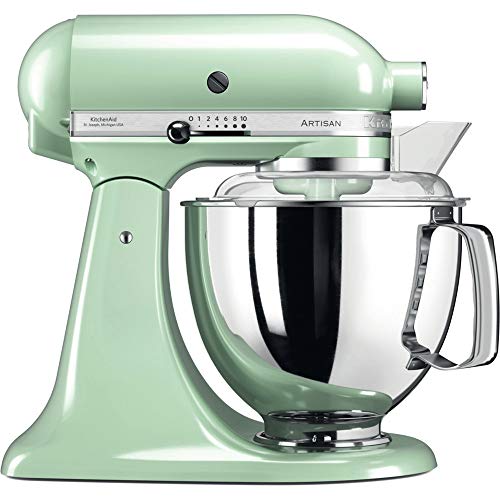
KitchenAid Artisan 4.8L (5KSM175PS): best for cakes, looks and attachments
The KitchenAid Artisan is the one people picture when they think of a stand mixer. It is a 4.8 litre tilt-head machine in solid metal, available in a long list of colours, and it is the most refined of the three at low speeds and small quantities. On Amazon the 5KSM175PS is around £463 and in stock at the time of writing, with about 4.7 stars from more than 550 ratings, which is a strong owner-satisfaction record.
It is our pick if you mainly bake cakes, biscuits and meringues, want an object you will enjoy looking at for twenty years, and intend to use the attachment hub properly. It is not the machine to buy as a dedicated bread maker. At its capacity with a stiff dough, the head is under visible strain. Buy it for what it does best.

Kenwood Chef Baker XL Titanium (KVL85.004SI): best for bread and big batches
The Kenwood Chef Baker XL Titanium is the most capable machine of the three. It is a bowl-lift design with a 1,200W motor and a large 7 litre bowl, and the version we recommend comes with a second 5 litre bowl too, which makes it far more flexible for everyday jobs. It is the dearest of the three at around £654, and it has about 4.3 stars from a smaller pool of ratings.
Choose it if bread is a regular thing in your house, you bake for a crowd, or you make full batches of stiff dough and want a machine that will not labour. It is not the prettiest and it will not spawn a shelf of accessories, but it does the actual work better than either rival, and more is included in the box.

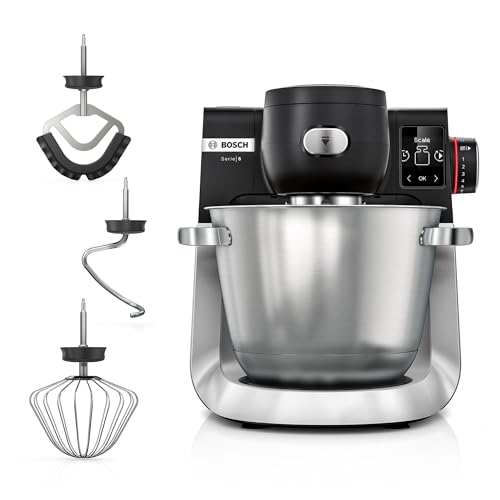
Bosch MUM Series 6 (MUMS6ZM00G): best value all-rounder
The Bosch MUM Series 6 is the sensible choice. It is a tilt-head machine with a bowl of around 5.5 litres, and at about £499 it sits in the middle on price. Owners rate it a little lower than the other two at around 4.0 stars, but from a much smaller pool of ratings, so treat that as a softer signal.
It gives up some refinement, some heavy-dough headroom and the attachment range, but it does the core jobs well, and its lighter weight may mean you use it more than you would use either rival. It suits people who want a genuinely good stand mixer without paying for the badge, and who value being able to lift it out of a cupboard without a struggle. Check the price against the KitchenAid before deciding, as the gap is small.
Cakes, creaming and whipping: closer than you would think
For the jobs most people do most often, such as creaming butter and sugar, making a sponge, whipping cream and beating egg whites, all three machines are good, and the differences are smaller than the price gaps imply. Any of them will make you an excellent cake. Nobody eating the results could tell you which machine produced them.
Where the KitchenAid edges ahead is refinement. The planetary action is smooth, the beater covers the bowl well, and it feels controlled at low speeds, which matters when you are folding rather than beating. It is also the best of the three at very small quantities, such as one or two egg whites, because the bowl geometry and whisk keep contact with tiny volumes that the larger Kenwood bowl can leave stranded at the bottom.
The Kenwood counters with sheer scale. If you are making a large batch, the bigger bowl means one go rather than two, and that is a real advantage every time you bake for a crowd. The Bosch sits between them, competent at both, exceptional at neither. For cake baking alone, buy the one you like looking at.
Bread and heavy dough: the real dividing line
This is where the three machines separate, and where the Kenwood earns its recommendation. Heavy dough is the hardest thing you can ask a stand mixer to do. It is a sustained, high-torque load that stresses the motor, the gearing and, on a tilt-head machine, the latch holding the head down.
The Kenwood Chef XL handles it with ease. Bowl-lift architecture means the load is fighting the machine’s structure rather than a hinge, and the motor has the torque to knead a full batch of stiff dough for ten minutes without protest. It is the only one of the three we would trust at its stated maximum dough capacity, repeatedly, for years.
The KitchenAid Artisan is capable but visibly working. It will knead bread dough well at moderate quantities, but push it towards capacity with a stiff dough and you can feel the head under strain and hear the motor labour. It will not break, as these machines are well made and last decades, but it is doing a job it was not primarily designed for. If bread is your main output, the 4.8L Artisan is the wrong KitchenAid.
The Bosch is a pleasant surprise: better at dough than its price suggests, and only occasionally showing the tilt-head weakness of slight head lift with a heavy, unevenly distributed load. For weekend loaves it is adequate. For a serious weekly bread habit, the Kenwood is the machine.
Attachments: KitchenAid’s real moat
The KitchenAid’s attachment ecosystem is the strongest argument for buying one. The hub takes an enormous range of tools, including pasta rollers, mincers, spiralisers, grain mills, ice cream bowls and vegetable sheet cutters, supported by decades of first- and third-party production. If you want your mixer to become a food-preparation platform, KitchenAid is the answer.
The catch is that almost all of it is a paid extra, and the good ones are not cheap, so the true cost of the KitchenAid route is considerably more than the machine. Kenwood’s range is narrower but strong on the things people genuinely use, and it tends to include more in the box. Bosch’s range covers the basics competently and thins out beyond that. Be honest with yourself: most people who buy a KitchenAid for the pasta roller make pasta twice.
Living with them: noise, weight and worktop reality
All three are loud enough to interrupt a conversation under load, but they are loud differently. The Kenwood is the most mechanically insistent, a purposeful industrial hum. The KitchenAid is lower and smoother. The Bosch is the highest-pitched and the most plasticky in tone, which is the clearest place its price shows.
Weight is the practical decider people ignore. The KitchenAid is heavy, and the Kenwood is not far behind. If either lives in a low cupboard, you will lift it out with two hands and some commitment, and how often you are willing to do that determines how much use the machine gets. The Bosch is meaningfully lighter. If your kitchen is tight, our best stand mixer for small UK kitchens round-up is worth reading before you commit to any of them.
The KitchenAid is also, unavoidably, the nicest thing to look at, and that is not a frivolous point. A mixer that earns permanent worktop space because you like seeing it will be used far more than one exiled to a cupboard.
So which stand mixer should you buy?
For most people who bake bread or in bulk, the Kenwood Chef Baker XL Titanium. It is the most capable machine of the three, handles everything from a single sponge to a full batch of bread dough, and includes a second bowl. It costs the most at around £654, and it will not spawn a shelf of accessories, but it does the actual work better than either rival.
Buy the KitchenAid Artisan if you are primarily a cake and biscuit baker, want an object you will love for twenty years, and intend to use the attachment ecosystem properly. At around £463 it is currently the cheapest of the three on Amazon, but do not buy it as a bread machine.
Buy the Bosch MUM Series 6 if you want a good, lighter stand mixer without the premium look. It gives up refinement, some heavy-dough headroom and the attachment range, but it does the core jobs well. There is no wrong answer here, only a wrong match.
FAQ
Is a KitchenAid better than a Kenwood? Not straightforwardly. The KitchenAid Artisan is more refined at low speeds, better with very small quantities and has a far bigger attachment ecosystem. The Kenwood has a larger bowl and handles heavy bread dough far more comfortably thanks to its bowl-lift design. Choose the KitchenAid for cakes and longevity, the Kenwood for capability and bread.
Which stand mixer is best for bread dough? The Kenwood Chef Baker XL Titanium, clearly. Its bowl-lift architecture means heavy dough loads the machine’s structure rather than a tilt-head hinge. The KitchenAid Artisan 4.8L manages moderate quantities but works visibly hard near capacity.
Is the Bosch MUM Series 6 worth buying over a KitchenAid? If weight and practicality matter more than looks, yes. It handles the core jobs well and is lighter to lift out of a cupboard. You give up some build quality, refinement and the KitchenAid attachment range. Compare the current prices, because the gap is not large.
Are KitchenAid attachments worth the money? Only if you will genuinely use them. The ecosystem is the largest in the category, but almost everything is a paid extra and the useful ones are not cheap.
What size stand mixer bowl do I need? For most household baking, around 4.5 to 5 litres is ample. Step up to the Kenwood’s larger bowl if you regularly bake for a crowd or make full batches of bread. Very large bowls are worse at tiny quantities like a single egg white.
Weighing up the options? See our round-up of the best stand mixers in the UK.