
The Sage Barista Express and Barista Touch are two of the most popular bean-to-cup style espresso machines in UK homes. Both have a built-in conical burr grinder, so you can go from beans to a finished drink on a single appliance. The real question is whether the Touch’s touchscreen and automatic milk texturing are worth the extra money over the Express and its manual steam wand.
In short: the espresso is very close, the milk is where they part company, and the price gap is large. Prices below are approximate and move often, so check the live listing before you buy.
Our verdict at a glance
- Best for most people: Sage Barista Express. Excellent espresso, a manual steam wand you can learn on, and a much lower price.
- Best for milk-drink households: Sage Barista Touch. Automatic milk texturing and a touchscreen make flat whites and lattes repeatable with almost no practice.
- Best if budget matters: the Express, with the saving put towards good beans or a proper milk jug and thermometer.
How the two machines compare at a glance
- Grinder: built-in conical burr grinder on both, with adjustable grind size.
- Controls: Express uses an analogue dial, buttons and a pressure gauge. Touch uses a colour touchscreen with guided drink menus and preset beverages.
- Milk: Express has a manual steam wand. Touch has an automatic steam wand with preset milk temperature and texture settings.
- Extraction: both use the same style of portafilter and pump-driven espresso system, with pre-infusion to help even extraction.
- Typical price: Express roughly £500 to £600; Touch roughly £900 to £1,050. Check the live listings.
- Worktop: both are substantial machines, so measure the space under your wall cupboards, including room to lift the hopper lid and water tank.
Espresso quality: closer than the price gap suggests
In the cup, the espresso from these two machines is very close. Both produce comparable shots once properly dialled in, and that is because the core hardware for making espresso is shared. The grinder, the portafilter and the extraction approach are the same family of parts, so the differences you notice day to day come from the controls and the milk system, not the coffee itself.
Like any bean-to-cup style machine, both reward a little care. Use fresh beans, adjust the grind until a double shot takes roughly half a minute, and keep the grinder and group head clean. A machine at either price will still give disappointing results with stale pre-ground coffee.
Milk frothing: the real dividing line
This is where the extra money goes. On the Barista Express you steam the milk yourself. That takes practice: positioning the jug, listening for the right sound, judging temperature. It is a satisfying skill, and once learned it gives you full control over texture, whether you want a flat white, a cappuccino or latte art. It also means a few wasted jugs of milk at the start.
The Barista Touch automates that job. The steam wand textures the milk for you against your chosen temperature and texture settings and stops when it is done. If you make several milk drinks every morning, or want the same result whoever is at the machine, that consistency is a genuine benefit, and it is the main reason to pay more.
Ease of use and the interface
The Express is straightforward. Its dial, buttons and pressure gauge are easy to read, and there is no menu to navigate. The gauge is also a useful teaching aid, showing you whether the shot is in the right range while you learn to grind and tamp.
The Touch’s colour touchscreen walks you through each drink and holds presets for popular drinks. It is friendlier for beginners and for households where not everyone wants to learn barista technique. The trade-off is more electronics and a machine that is less hands-on, which some enthusiasts dislike.
Both need regular descaling and cleaning, so factor that into your routine.
Day-to-day living with each machine
A bean-to-cup style machine like either of these is a daily routine, not a push-button appliance. You fill the hopper, grind into the portafilter, tamp, extract, then deal with milk. Each step is quick once you are used to it, and a typical morning drink takes a few minutes. The Express asks for a little more attention because you are also watching the milk; the Touch lets you walk away from the wand for a moment.
Cleaning matters on both. Purge the steam wand after every use, empty the drip tray and knock box regularly, and descale on the schedule the machine prompts. The automatic wand on the Touch is no excuse to skip this. A neglected wand will clog whichever machine it is on.
Households with children or several coffee drinkers tend to appreciate the Touch, because a saved drink and guided screen mean anyone can make a decent cup. Solo enthusiasts often prefer the Express, where every variable is under your control and a good shot feels earned.
Who each machine really suits
Think about how you will actually use it. If you make one or two drinks a day and like tinkering, the Express is hard to beat. If the machine will be used by a whole household, mostly for milky drinks, the Touch removes the part that puts many people off. Neither is a small purchase, so it is worth being honest about which type of user you are before paying for features you will not use.
It is also worth remembering the cost of getting started with the Express: a decent milk jug, a thermometer if you want one, and some practice milk. Even with those, it remains much cheaper than the Touch.
Price and value
The gap between the two is the largest part of this decision, and it is far more than the price of a good milk jug and thermometer. The Barista Express is the better value machine on pure espresso quality. The Touch costs considerably more for convenience and consistency rather than better coffee.
If you drink mostly black coffee or are happy to learn to steam, the Express makes more sense. If milk drinks dominate and you would use the automation daily, the Touch can justify itself over a few years of avoiding café visits.
Sage Barista Express
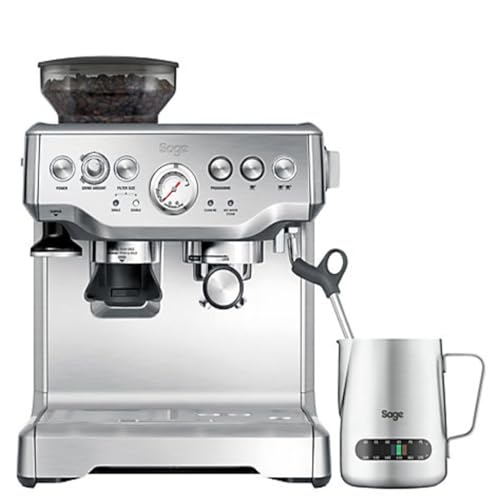
The Express is the machine most people should look at first. It gives you integrated grinding, a manual steam wand and an analogue dial with a pressure gauge, and it is the cheaper of the two. Best for anyone who wants to learn proper espresso technique, or who wants to spend the savings on beans and accessories.
Sage Barista Touch

The Touch adds the touchscreen and automatic milk texturing to the same espresso foundation. Best for households that drink lots of lattes and flat whites and want push-button consistency, and for beginners who would rather be guided than learn the wand.
Grinder, accessories and running costs
Both machines grind to order, which is a big part of why the coffee tastes better than pods. The grind size is adjustable, so you can fine-tune it as beans age or change roast. Expect to adjust it now and then rather than setting it once and forgetting it. Darker, oilier roasts and lighter roasts behave differently, so a small tweak when you change bag is normal.
Running costs are modest but real. Beans are the main expense, followed by descaling products and occasional water filters. Milk adds to it if you drink lots of lattes. Neither machine needs pods, which keeps the cost per cup lower than a capsule system over time, though the upfront outlay is much higher.
Accessories are worth a thought. A decent tamper mat, a knock box if one is not included, and a suitable milk jug make the routine easier. On the Express, a jug with a temperature strip helps while you learn to steam. On the Touch, you will still want a jug that matches the machine’s guidance for the automatic wand.
Buying tips for both machines
- Check the exact model and finish on the listing. Sage sells these in several colours and bundles, and prices differ between them.
- Buy fresh beans from a local roaster and use them within a few weeks of the roast date.
- Use filtered water where your area is hard, to reduce scale and protect the machine.
- Measure your worktop, including the height under wall units, before ordering.
- Prices move often, especially around sales events, so check the live listing before buying.
Which should you buy?
Choose the Barista Express if:
- You value manual milk steaming or want to learn the technique.
- You would rather put the savings towards premium beans or a better jug and accessories.
- You like straightforward analogue controls.
Choose the Barista Touch if:
- Milk drinks make up most of what you drink.
- You want automated, consistent milk texturing.
- The touchscreen interface appeals to you.
FAQ
Q: Is the Barista Touch worth the extra money?
A: Only if you will use the automatic milk system regularly. For espresso alone the Express gives a very similar result for much less.
Q: Does the Touch make better espresso?
A: Not meaningfully. Once dialled in, shots from the two are very close.
Q: What is the main difference between them?
A: Milk. The Express has a manual steam wand; the Touch has an automatic one plus a touchscreen.
Q: Is the Express suitable for beginners?
A: Yes, but expect a learning curve with both grinding and milk steaming. The gauge helps.
Q: Which is better value for money?
A: The Express, unless automated milk is a priority for you.
New to home espresso? Start with our first home espresso setup guide.



