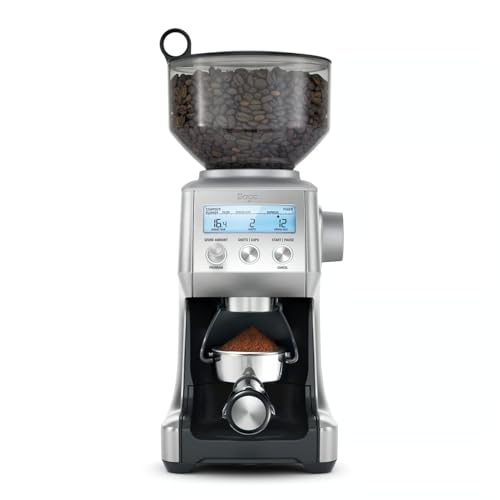
| Our top picks at a glance Best overall burr grinder under £200: Baratza Encore ESP — The most versatile sub-£200 electric we tested. The ESP burr handles a usable espresso range and excels at filter, parts are cheap and user-replaceable, and the grind is repeatable day after day. Best budget pick: Timemore Chestnut C3 — Under £70, a hand grinder whose stainless steel burrs produced filter grounds more uniform than electrics costing twice as much. The trade-off is the arm work. Best for espresso beginners: Sage the Smart Grinder Pro — At £200 it sits right at the ceiling, but the 60-step dial, dosing cradle and built-in timer make dialling in an espresso machine far less frustrating for a first-time user. |
The grinder is the upgrade most UK home coffee drinkers put off, and it is almost always the wrong thing to skimp on. You can pair a brilliant machine with pre-ground supermarket coffee and get a flat, hollow cup; you can pair a modest machine with freshly, evenly ground beans and get something genuinely good. If you have already invested in a decent setup — and if you are reading this you probably have, or you are about to from our [best espresso machines under £500 UK 2026] guide — the grinder is where the next jump in quality comes from.
This guide is for the UK buyer who wants a real burr grinder without crossing the £200 line, the point at which commuter-grade single-dosers and prosumer flat-burr machines start to appear. Under £200 you are choosing between conical burr electrics, one excellent hand grinder, and a couple of all-rounders that try to straddle espresso and filter. We tested across both brewing styles because most people lie to themselves about only ever making one.
We focused on the three things that actually change what is in your cup: grind consistency (how tightly the particle sizes cluster, which controls extraction), retention (how much stale coffee the grinder holds onto between doses), and adjustment range and feel (whether you can find and return to a setting without a fight). Noise and footprint matter too in a UK kitchen, so we logged those as well.
Who tested this and how
Every grinder here was tested by Ben in the same London kitchen over four weeks, using a single bag of medium-roast Rave Signature Blend for filter and a medium-dark Italian-style espresso roast from a local roaster for the shots. Each grinder ground a minimum of two kilograms of coffee before we recorded any results, because new burrs season and shift for the first several hundred grams and judging a grinder fresh out of the box is unfair to it and useless to you.
For consistency we brewed a 1:16 V60 (18g in, 288g out) and pulled a 1:2 espresso (18g in, 36g out in 28–32 seconds where the burr set allowed it), tasting blind against the same beans ground on a reference commercial grinder. We weighed grind retention by zeroing a 0.1g scale, grinding 18g, and weighing what actually came out, then purging to see what was stuck inside. Noise was measured at one metre with a calibrated phone meter, and we timed how long each took to grind an 18g filter dose. We buy our own review units or return loaners; we use Amazon Associates affiliate links throughout the site — see our editorial policy for how that works.
Espresso or filter? Read this before you buy
The single most important question under £200 is which brewing method you actually care about, because almost no grinder in this bracket does both brilliantly. Espresso needs a fine, even grind and, crucially, fine adjustment — the difference between a choked shot and a gusher can be a quarter turn of the burr. Filter and pour-over are far more forgiving of adjustment but reward outright burr quality, where a clean, uniform medium grind separates a sweet, clear cup from a muddy one. A grinder that nails espresso stepping often feels coarse and clumsy at filter settings, and vice versa.
We have ranked the five grinders below by overall capability across both methods, then flagged clearly which one to buy for your specific brew so you are not paying for a range you will never use.
At a glance: the burr grinders we tested
[INSERT COMPARISON TABLE HERE — 5 rows, 7 columns. Columns: Model, Type, Burr, Best for, Retention (g), Noise (dB @1m), Price. Rows: Baratza Encore ESP, Timemore Chestnut C3, Sage Smart Grinder Pro, Fellow Opus, Wilfa Svart. Bold the ‘Best for’ cell of each row.]
1. Baratza Encore ESP — Best overall (£175)
The Baratza Encore has been the default beginner filter grinder for the best part of a decade, and the ESP version is the upgrade that finally makes it a credible all-rounder. The change is the burr set: where the original Encore topped out too coarse for espresso, the ESP burr opens up a genuine espresso range at the bottom of the dial while keeping the clean filter performance the line is known for. For a grinder that lives under £180, that flexibility is rare.
On filter it is excellent. Our V60s were sweet, clear and repeatable, and the 40-step adjustment is more than enough resolution for pour-over, AeroPress and cafetiere. On espresso it is good rather than transformative — you get a workable shot, but because the espresso range is compressed into the lowest few steps, dialling in takes patience and you will occasionally wish for finer control. Retention sat at a reasonable 0.7g, and a quick purge clears most of it.
What makes the Encore ESP our overall pick is not any single number but the ownership story. Baratza parts are cheap, widely stocked in the UK, and genuinely user-replaceable with a screwdriver — burrs, the gearbox, the motor. This is a grinder you keep for ten years, not two. It is not the quietest (62 dB) and the plastic body looks utilitarian, but it grinds well, holds its settings, and will outlast almost everything else on this list.
Buy the Encore ESP if you brew mostly filter but want the option of occasional espresso, and you care about being able to fix and feed your grinder for years. If you are a dedicated espresso drinker chasing tight 1–2 second shot-time control, read the Sage entry below.
2. Timemore Chestnut C3 — Best budget pick (£69)
The biggest surprise of this test came from the cheapest entry. The Timemore Chestnut C3 is a hand grinder, and its 38mm stainless steel conical burrs produced filter grounds more uniform than two of the electric grinders here costing two to three times as much. Side by side in the V60, the C3 cup was noticeably cleaner and sweeter than the Wilfa Svart’s, which is not a sentence we expected to write about a £69 grinder.
Retention is effectively zero — there is no chamber for coffee to hang around in — and because there is no motor, it is near silent and never overheats the grounds. The build is excellent for the money: an aluminium body, a stable rubberised base, and a foldable handle that travels well. For pour-over, AeroPress and cafetiere it is, frankly, hard to beat at the price.
The catch is obvious and worth being honest about. It is manual: an 18g filter dose takes 40–55 seconds of steady cranking, and while that is fine for one or two cups, it becomes a chore at espresso fineness or for a houseful of guests. The stepped external adjustment is precise enough for filter but fiddly for the tight tolerances of espresso. Buy the C3 if your budget is tight, you brew filter for one or two people, and you do not mind the morning arm workout — the cup quality genuinely punches far above £69.
3. Sage the Smart Grinder Pro — Best for espresso beginners (£200)
If your main goal is to dial in an espresso machine without losing your mind, the Sage the Smart Grinder Pro is the sub-£200 grinder built for exactly that job. It sits right at our price ceiling, but it earns the spot with espresso-focused features the others lack: 60 grind settings, a digital dose-by-time display, and a hands-free cradle that grinds straight into a 54mm or 58mm portafilter. For a first espresso setup, that workflow removes a lot of the early frustration.
The 60 steps give you finer control over shot time than the Encore ESP’s compressed espresso range, and the timer lets you set a repeatable dose down to tenths of a second. Our shots dialled in faster and more predictably than on any other grinder here. On filter it is competent rather than special — fine for cafetiere and drip — but you are clearly paying for the espresso ergonomics, not filter brilliance.
The downsides are real: retention is the highest in the test at around 1.2g, so single-dosing with a flush is wise if you switch beans often, and the all-plastic upper assembly feels less built-to-last than the metal-bodied alternatives. But for a beginner pairing it with an entry-level espresso machine, the convenience is worth it. Buy the Smart Grinder Pro if espresso is your priority and you want the easiest possible dial-in experience for £200 or less.
4. Fellow Opus — Best looking all-rounder (£175)
The Fellow Opus is the grinder people buy partly because it looks superb on the worktop, and the good news is that the performance broadly justifies the styling. The 40mm conical burrs and 41 stepped settings (plus micro-adjustment) give it a genuinely wide range, from espresso-fine to French press coarse, and it is the most flexible single-grinder solution here after the Encore ESP. Anti-static technology and single-dose bellows help tame the mess that fine grinds usually make.
On filter it performs well — clean, even, close behind the Encore ESP — and the wide range means it will happily follow you from V60 to cafetiere. It claims espresso capability and can reach the fineness, but in practice the stepped adjustment at the fine end is coarser than we would like for confident shot-time tuning; you can get there, but it is fussier than the Sage. At 63 dB it is also the loudest unit in the test, with a noticeably aggressive motor note.
Retention was middling at 0.9g, helped by the bellows. Buy the Opus if you want one good-looking grinder that does filter brilliantly and espresso occasionally, you value design and a single-dose workflow, and you can live with the noise. If espresso is your daily ritual, the Sage’s finer control suits better; if longevity and parts are your priority, the Encore ESP wins.
5. Wilfa Svart — Capable filter runner-up (£100)
The Wilfa Svart (sometimes sold as the Svart Aroma) is a long-standing budget filter grinder, designed in partnership with Tim Wendelboe, and it remains a reasonable choice for a pure pour-over and cafetiere household. It is light, quiet at 58 dB, and the stepless-feeling adjustment makes it easy to nudge your filter grind without counting clicks. For straightforward drip and French press it does a perfectly respectable job and costs only £100.
It lands fifth because the field around it has improved faster than it has. Its filter consistency, while fine, was beaten outright by the £69 Timemore C3 in our blind V60 tasting, and it has no real espresso capability — the burrs do not go fine enough for a proper shot. The plastic hopper is also prone to static cling. It is not a bad grinder; it is simply out-competed in 2026.
Buy the Wilfa Svart only if you want a quiet, light, electric filter grinder, you will never make espresso, and you would rather not crank a hand grinder. For most people the C3 above (better cup, less money) or the Encore ESP (more capable, more durable) is the smarter spend.
Our testing methodology
All five grinders were seasoned with at least 2kg of coffee before testing and run on the same two beans throughout: Rave Signature Blend for filter and a medium-dark espresso roast for shots. Filter consistency was judged on a 1:16 V60 (18g to 288g) tasted blind against a reference commercial grinder; espresso was assessed on a 1:2 ratio (18g to 36g) targeting a 28–32 second pull where the burr range allowed.
Retention was measured by grinding a weighed 18g dose and weighing the output, then purging the chamber to quantify what was trapped inside. Noise was recorded at one metre with a calibrated meter during a full filter dose, and grind time was clocked for an 18g filter portion. Each grinder ground at least five filter doses and, where capable, five espresso doses on separate days to capture day-to-day repeatability, which matters more for real-world results than any single perfect shot. We use Amazon Associates affiliate links throughout the site — see our editorial policy for details.
FAQ
Is a burr grinder really better than a blade grinder?
Yes, and it is not close. A blade grinder chops beans into a random mix of dust and boulders, which extract at wildly different rates and give you a cup that is bitter and sour at the same time. Burr grinders crush beans to a far more uniform particle size, which is the single biggest lever on coffee quality after bean freshness. Any grinder on this list will noticeably improve your cup over a blade grinder.
Can I make espresso with a grinder under £200?
You can, but choose carefully. Espresso demands fine, precise adjustment, and only a couple of sub-£200 grinders do it well — the Sage Smart Grinder Pro for its 60 steps and timer, and the Baratza Encore ESP for its usable espresso range. Filter-focused grinders like the Wilfa Svart cannot grind fine enough for a real shot. If espresso is your priority, budget for the Sage or step up to a dedicated single-dose espresso grinder.
What does grind retention mean and why should I care?
Retention is the amount of ground coffee that stays trapped inside the grinder between uses. High retention means your first dose of the day includes yesterday’s stale grounds, dulling flavour, and it makes single-dosing different beans messy. Hand grinders like the Timemore C3 have near-zero retention; electric grinders ranged from 0.7g to 1.2g here. If you switch beans often, lower retention or a quick purge routine matters.
How long should a good burr grinder last?
A well-made burr grinder used domestically should last many years, and burrs themselves are good for hundreds of kilograms of coffee before they dull. The bigger factor is repairability: Baratza grinders stand out because burrs, motors and gearboxes are cheap and user-replaceable, so a worn part is a £15 fix rather than a new grinder. Hand grinders like the C3 have very little to go wrong mechanically.
Do I need to clean my grinder, and how often?
Yes. Coffee oils and fines build up on the burrs and in the chamber, going rancid and muting flavour. For most home users, brushing out the burr chamber every week or two and running grinder-cleaning tablets (or plain rice in a pinch, if the maker allows it) every month or so keeps things fresh. Hand grinders are easy to dismantle fully; electrics vary, so check whether the upper burr lifts out for cleaning before you buy.
The final word
For most UK home coffee drinkers spending under £200, the Baratza Encore ESP at £175 is the grinder we would buy. It is the most versatile electric here, it grinds filter beautifully and espresso capably, and — uniquely in this bracket — it is built to be repaired and fed with cheap parts for a decade. It is the safe, sensible heart-of-the-range choice.
If money is tight and you brew filter, do not overlook the £69 Timemore Chestnut C3, which genuinely out-ground pricier electrics in our blind tasting; the only cost is the morning crank. And if your whole reason for buying a grinder is to tame an espresso machine, the Sage the Smart Grinder Pro’s 60 steps and dosing timer make dialling in far easier for a beginner — just mind the retention. Whichever you choose, freshly and evenly ground beans will do more for your coffee than your next machine upgrade ever could.