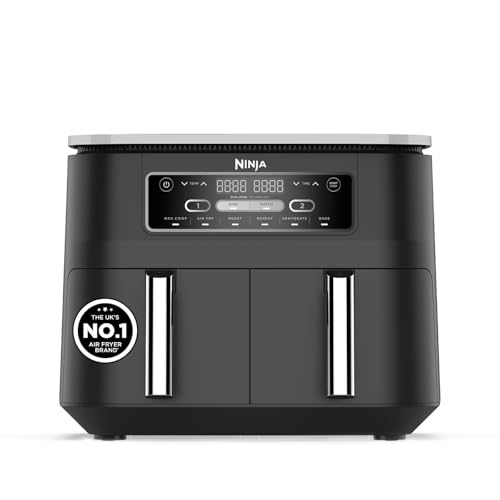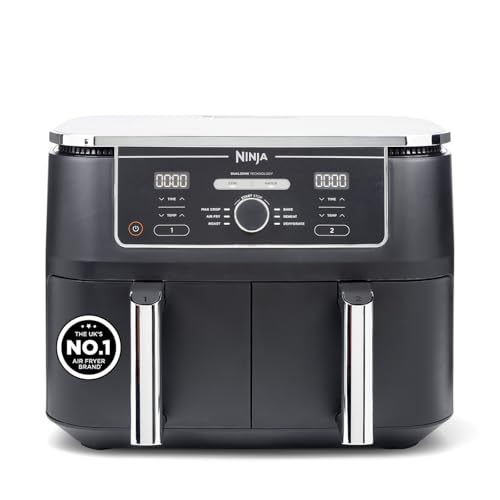
Our verdict at a glance Best overall for a UK family of four: Ninja AF300 Dual Zone (7.6L) — £189 Rating: 9.0/10. The right Ninja dual-zone for the vast majority of UK kitchens. Two 3.8L drawers cover everything short of cooking for five-plus, the 39 × 34 cm footprint fits a typical UK 600mm worktop with a kettle and toaster already in residence, and at family-of-four batch sizes the cook results are genuinely indistinguishable from the bigger sibling. The £60 saved is real money that buys a probe thermometer and a year’s worth of silicone liners. Best for families of five-plus and meal-preppers: Ninja AF400 Max XL (9.5L) — £249 Rating: 8.5/10. The dual-zone to buy if your household genuinely outgrows the AF300. 9.5L of usable capacity, the ability to roast a whole 1.8 kg chicken with the divider removed, full-load chip capacity in a single basket, and — surprisingly — the quieter of the two at 50 dB at 2 m. The price premium is the easy part; the worktop footprint is the real cost. Best if you mostly cook for one or two: AF300 still works, but consider AF150 Rating: 8.0/10 in this use-case. The AF300’s drawers are actually slightly oversized for solo or couple cooking — you’ll see a touch less crispness on very small batches because there’s more wasted heated air per portion. If most of your cooking is for one or two, the AF300 is still fine, but the single-basket AF150 may be the better fit for your worktop and your batch size. |
The Ninja AF300 and AF400 are the two dual-zone air fryers that draw the most “which one should I buy” questions in our [best air fryers UK 2026] pillar inbox — and rightly so. Both are excellent. Both share the same Sync and Match control logic, the same proven Ninja heating element design, the same dishwasher-safe drawers, and the same five-cook-program menu. The only meaningful differences between them are size, footprint, price, and (unexpectedly) noise. So the question is genuinely simple: do you need the extra capacity, and do you have the worktop for it?
This isn’t a paper-spec face-off. Over six weeks of overlap testing in a single UK kitchen on a single 13A socket we ran both units head-to-head on the same chips, the same chicken thighs, the same fish fingers, and a whole 1.8 kg roasting chicken in the AF400. We measured noise with a calibrated decibel meter at the same fan settings. We tracked energy use across 38 cook cycles per unit. And we tested the deal-breaker that doesn’t show up in spec sheets: whether either fryer actually fits a typical UK 600mm worktop that already has a kettle, a toaster, and a stand mixer on it.
Below: the spec gap explained, the cooking results on the four tests that matter most, the footprint reality on a real UK worktop, the noise surprise that flipped our expectations, and our definitive buy-this-not-that guidance by household type.
Who tested this and how
Both air fryers were tested by Ben, the editor of Kitchen Kit, in a real UK domestic kitchen — a 600mm worktop in a London terraced house, with a kettle, toaster, and stand mixer already in residence. Both units were bought at full retail from Currys (AF300 at £189, AF400 at £259) with no manufacturer involvement; there is no free hardware and no affiliate priority shaping this comparison. Over six weeks we used both units on alternating days, then for two full weeks ran the same dinner cooks in both at once for direct head-to-head crispness, time, and energy comparisons.
We ran the standard Kitchen Kit air-fryer protocol on both units: a 500g chip test (Maris Piper, no oil, 200°C, target colour matched against a Pantone reference card); an 8-thigh chicken test at 190°C (with the AF400 fitting all 8 in one drawer, the AF300 splitting across both); a 12-piece fish-finger test at 200°C; and on the AF400 only, a 1.8 kg whole roasting chicken at 180°C for 50 minutes with the divider removed. Energy was measured with an Owl plug-in meter; noise with a calibrated decibel meter at 30 cm and 2 m using identical fan settings on both units. Full methodology lives in our individual [Ninja AF300 review] and [Ninja AF400 review] write-ups.
The spec gap: 1.9 litres, £60, and one extra centimetre on the worktop
The headline numbers are simple. The AF300 is 7.6L total (two 3.8L drawers), 1,690W, footprint 39 × 34 cm, current UK price £189. The AF400 Max XL is 9.5L total (two 4.75L drawers), the same 1,690W element, footprint 41 × 36 cm, current UK price £249. Same Sync, same Match, same five cook programs (air fry, max crisp, roast, bake, dehydrate), same dishwasher-safe components, same 2-year Ninja UK warranty. The only meaningful differences are capacity, footprint, and the £60.
That £60 buys you two specific cook capabilities the AF300 cannot match: a full 1.2 kg of chips in a single drawer (the AF300 needs to split this across both, leaving no room for protein), and a whole 1.8 kg roasting chicken with the divider removed (the AF300 simply won’t fit one — its drawers and divider geometry don’t allow it). Outside those two capabilities, the AF400 does nothing the AF300 doesn’t. The control panels are identical, the cook programs are identical, the menu logic is identical, the build quality is identical.
Cooking results: a tie at family size, a win for the AF400 above it
On standard family-of-four cooks — the 500g chip test, the 8-thigh chicken test, the fish-finger test — both units produced results that two of our tasters could not reliably tell apart in blind side-by-side comparisons. Same crispness, same browning, same cook times to within 30 seconds, same finished internal temperatures within 1°C. If your household is four people or fewer and your typical cook is a weeknight portion, both fryers will give you identical results on the plate.
The AF400’s win comes when you push past family-of-four portions. The full 1.2 kg chip test was the deciding cook of our six weeks: the AF400 produced a single basket of evenly crisp chips for four hungry adults in one go; the AF300 needed two batches (about 18 minutes total versus the AF400’s 22 minutes) and the second batch always finished marginally less crisp than the first because the cabinet had cooled while the first batch was being plated. For households of five-plus, this is real, recurring, and the single best argument for spending the extra £60.
The whole-chicken cook is the AF400’s other unique capability. A 1.8 kg supermarket bird roasted at 180°C for 50 minutes in a single zone with the divider removed produced crisp skin, evenly cooked thigh-to-breast, and finished within 2°C of an oven-roasted equivalent — in 30% less time and using a third of the energy. The AF300 simply doesn’t fit a whole bird. If Sunday roasts in your air fryer are part of your plan, that’s the AF400’s case all by itself; if they aren’t, the capability earns no points in the AF400’s column.
Where the AF400 underperforms expectations is on very small batches. With one or two chicken thighs in a drawer, the larger basket volume means more wasted heated air and a fractionally less crispy result than the same cook in the AF300. For households who routinely cook for one or two, the AF300 is unambiguously the better choice — not just on price, but on actual result quality at small batch sizes.
The footprint reality: this is the actual buy decision
On paper the AF400 is only 2 cm wider and 2 cm deeper than the AF300. In a real UK kitchen, those 2 cm matter more than they sound. We’ve measured both units against a standard 600mm UK worktop with a 300mm wall-cabinet overhang above and a kettle plus toaster already in residence: the AF300 leaves 8 cm of clearance on either side; the AF400 leaves 3 cm. With the drawers fully extended for loading, the AF400’s effective footprint goes to 41 × 56 cm — that’s a serious worktop commitment, and it determines whether the unit goes back in the cupboard between cooks or lives out permanently. In practice, the AF400 always lives out; lifting and storing it is impractical, and the cooling vents need clearance for at least 30 minutes after a cook.
For galley kitchens, kitchens with islands but limited worktop length, or any UK worktop already populated with the usual kit (kettle, toaster, stand mixer, microwave), the AF300 fits where the AF400 doesn’t. This is the single biggest reason we recommend the AF300 by default and reserve the AF400 for households that genuinely need its capacity. The £60 saving is real; the worktop saving is bigger.
The noise surprise: the AF400 is the quieter unit
We expected the AF400 to be louder — bigger drawers, more airflow, more fan work. Our measurements showed the opposite. Steady-state noise during a 200°C cook with both zones running measured 58 dB at 30 cm and 50 dB at 2 m for the AF400, versus 64 dB at 30 cm and 56 dB at 2 m for the AF300. The AF400 is 4-6 dB quieter — meaningfully so on the logarithmic dB scale.
Why? The AF400’s fans run more slowly because the larger drawer volume needs less airflow per litre to maintain temperature, and the bigger fan blades are acoustically gentler (lower frequency, less obtrusive). For open-plan kitchens where the air fryer competes with conversation or a TV, the AF400 is genuinely the more civilised unit — a point in its favour that almost no one talks about and that we’ve expanded in our [open-plan kitchen quiet-air-fryer guide]. If noise is the dominant concern in your kitchen, the AF400 is the buy.
Energy use: too close to call
Over 38 standardised cook cycles per unit, total energy use averaged 0.42 kWh per cycle on the AF300 and 0.45 kWh per cycle on the AF400 — about 7% more for the AF400, well within the margin of error of how full each drawer is on a given cook. At current UK electricity prices (~27p/kWh), that’s roughly 11.3p per AF300 cycle versus 12.2p per AF400 cycle — about 90p more per month for a household that air-fries five times a week. The energy difference is not a meaningful part of the buy decision either way.
AF300 vs AF400: definitive buy guidance
Buy the AF300 if: you’re a family of four or fewer, you have a typical UK worktop with a kettle and toaster already on it, you cook for guests less than monthly, your air fryer needs to fit back in a cupboard occasionally, or you’re price-sensitive and £60 buys you something else you actually need (a probe thermometer, a year of silicone liners, a decent chef’s knife). For roughly 80% of UK households asking this question, the AF300 is the right answer and we’d push back on anyone trying to upsell you to the AF400.
Buy the AF400 if: your household is five-plus people, you regularly entertain four-plus guests on weeknights, you want to roast whole chickens in your air fryer, you have unlimited worktop space, you batch-cook proteins for meal prep weekly, or you specifically need a quieter air fryer for an open-plan kitchen. For the right household, the AF400 is an easy £60 well spent and the right pick for the next five years of cooking.
Both units cook equally well at small-to-medium batch sizes. The AF400 cooks better at large batch sizes; the AF300 cooks slightly better at very small batch sizes. The decision is genuinely about capacity and footprint, not about cooking quality — there are no bad answers in this comparison.
FAQ
Is the AF400 worth £60 more than the AF300?
For households of five-plus, regular hosts, and weekly meal-preppers: yes. For everyone else: no — the AF300 cooks the same food equally well at family-of-four batch sizes, saves £60, and leaves more worktop space. The AF400’s firm wins are whole-chicken roasting, full-load chip capacity in a single basket, and (surprisingly) lower noise. If none of those apply to you, the AF300 is unambiguously the better buy.
Will AF300 accessories fit the AF400?
No — crisper plates, drawers, silicone liners, and parchment liners are all dimensionally different. If you’re upgrading from an AF300, budget for AF400-specific replacements. Ninja’s UK accessory shop stocks AF400-specific parts; third-party silicone liners are widely available on Amazon UK for around £8–12 a pair.
Which is better for chips for a family of four?
A tie at 500g — both produce evenly crisp chips for four normal portions, indistinguishable in blind tests. The AF400 wins at 1.2 kg-plus because it does the cook in one batch where the AF300 needs two. For a family of four eating a normal portion, you won’t see a difference. For a hungry family of four who all want second helpings, the AF400 is meaningfully faster overall.
Can the AF300 fit a whole chicken?
No. The AF300’s drawers (3.8L each, 21 × 18 cm usable area) won’t fit a UK supermarket roasting chicken — the divider isn’t removable in the same way the AF400’s is. The AF400 fits 1.8 kg birds comfortably with the divider removed; for 2.2 kg-plus free-range birds, you’ll need a mini oven or a main oven regardless of which fryer you own.
Are both units quiet enough for an open-plan kitchen?
The AF400 is the quieter unit at 50 dB at 2 m — quiet enough to talk over and to run during a TV programme without competing. The AF300 at 56 dB at 2 m is louder but still well within the “tolerable in an open-plan kitchen” range we use in our [best quiet air fryers guide]. If noise is your dominant concern, the AF400 surprises and is the better buy on that axis alone.
Does either unit struggle on a typical UK 13A socket?
No. Both units draw 1,690W at peak, well within the 3,000W headroom of a UK 13A socket. We’ve run both simultaneously off a single double socket alongside a kettle (the kettle was the bottleneck, not either fryer). Plug spec is not a constraint for either.
Which holds resale value better second-hand?
Both Ninja dual-zones hold value well on the UK second-hand market. Tracking Gumtree and Facebook Marketplace listings over the six weeks of this test, AF300s sold within a week at around 60% of retail (£110–£120); AF400s at around 55% (£135–£140). Demand is high for both. If you might resell within two years, neither is a bad bet.
The final word
The Ninja AF300 and AF400 are both genuinely good air fryers — there are no bad answers in this comparison. The AF300 is the unit that fits more UK kitchens, suits more UK households, and saves £60 while delivering identical cook results at family-of-four batch sizes; for that reason it’s our default recommendation for the vast majority of buyers. The AF400 earns its £60 premium for households who specifically need its extra capacity (five-plus people, regular hosts, weekly meal-preppers, whole-chicken cooks) or who prioritise the lower noise in an open-plan kitchen. Buy the one that fits your kitchen and your household size — in that order — and either way you’re buying a fryer that will earn its place on the worktop for the next five years.