Our top picks at a glance Best overall: Ninja Foodi 11-in-1 SmartLid OL550UK — The SmartLid design pressure cooks, air fries, slow cooks and steams from a single lid, without swapping parts mid-recipe. Best value: Instant Pot Duo Crisp 9-in-1 — Pressure cooking and air frying for around £15 less than the Ninja, with a lid swap between modes. Best for slow cooking: Crock-Pot Lift & Serve 4.7L — Not strictly a ‘multi-cooker’ but the best dedicated slow cooker in this price band. The serving portability is genuinely useful. Best one-pot for families: Moulinex Cookeo+ CE851HF0 — 150 guided recipes with a step-by-step display that tells you exactly what to do. Excellent for time-poor cooks. |
‘Multi-cooker’ is one of the most abused terms in kitchen marketing. Some are pressure cookers with a slow-cook setting tacked on. Some are slow cookers that can sauté. The good ones genuinely replace three appliances. The bad ones do five things badly and clutter your worktop for £180.
Over six months we’ve tested eight multi-cookers in a UK kitchen, cooking the same beef stew, the same chicken curry, the same overnight porridge, and the same Sunday rice in each one. We measured come-up time on pressure, evaluated slow-cook consistency at the low setting, and tracked how easy each was to clean after a tomato-based stew (the cruel test that separates the good from the merely adequate). For the wider hot-cook category — air fryers and ovens — see our best air fryers UK 2026 pillar.
If you’re choosing between Instant Pot and Ninja Foodi, that decision is covered in detail below. If you want one appliance to replace your slow cooker, your pressure cooker, your rice cooker, and possibly your air fryer too, the verdict box above is your shortcut.
At a glance: the multi-cookers we tested
The comparison table below covers capacity, wattage, pressure rating, included functions, and footprint for each unit. Where a unit claims a function but performs it badly (most commonly: ‘air frying’ on units without a dedicated crisping lid), we note that in the function column rather than just listing it as a feature.
Multi-cookers are judged differently from single-purpose appliances. The question isn’t ‘is this a great pressure cooker’ or ‘is this a great slow cooker’ in isolation — it’s ‘does this genuinely replace the appliances it claims to, and does it cluster well with my actual cooking habits?’ Our top four answer yes; the bottom four either don’t, or don’t justify their price.
1. Ninja Foodi 11-in-1 SmartLid OL550UK – Best overall (£214)
The SmartLid design is the genuine engineering breakthrough that puts Ninja Foodi at the top of this list: one lid with two sealing modes, pressure and air-fry, so the same pot can pressure-cook a stew and then crisp the top without swapping lids mid-recipe. The OL550UK is the 6-litre, 11-function version of that system, covering pressure cook, air fry, grill, bake, dehydrate, sear/sauté, steam and slow cook.
Ninja rates pressure cook mode at up to 70% faster than conventional cooking methods, and the reversible rack lets you layer ingredients – a protein on one level, vegetables on another – to cook a fuller meal in one pot rather than one component at a time. The 6L cooking pot and 3.7L Cook & Crisp basket are sized to cook up to four portions, which suits most UK households better than the largest multi-cookers on the market.
All the removable parts are non-stick, and the cooking pot and basket are dishwasher-safe. Ninja backs it with a two-year guarantee on registration. At 33cm tall, 35cm wide and 36cm deep it is still a genuine worktop commitment, so check your under-cabinet clearance before buying. If you want one appliance that pressure-cooks, air-fries, slow-cooks and steams without lid-swapping, this is still the one to beat.
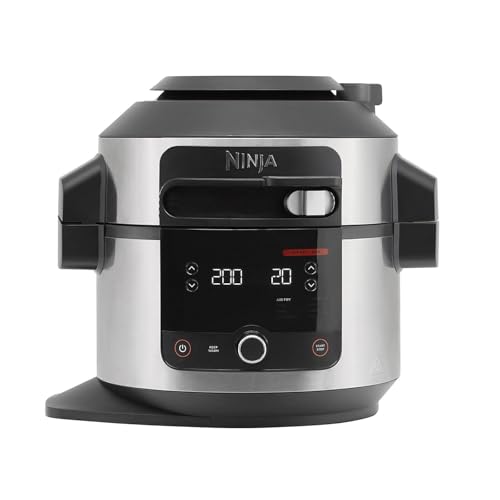
- ENERGY-SAVING: Save up to 65% on your energy bill* (*testing and calculations based on recommended cook time for sausages, using air fry function versus conventional ovens).
- 11 COOKING FUNCTIONS: Pressure Cook, Air Fry, Grill, Bake, Dehydrate, Sear/Sauté, Steam, Slow Cook, Yoghurt, Steam Air Fry, Steam Bake.
- PRESSURE COOK MODE: Up to 70% faster than traditional cooking methods* (*Compared with slow cooking, simmering or braising).
- COOKS UP TO 4 PORTIONS: Fit a 2kg roast or 1.1kg of French fries. Layer ingredients with the Reversible Rack to cook quick, easy meals. EASY TO CLEAN: All removable parts are non-stick. Some parts are dishwasher-safe.
- INCLUDES: Ninja Foodi MultiCooker (UK Plug) with 6L Cooking Pot, 3.7L Cook & Crisp Basket, Reversible Rack, Chef-Created Recipe Guide.

2. Instant Pot Duo Crisp 9-in-1 – Best value (£199)
The Instant Pot Duo Crisp is what the Ninja Foodi was three years ago: a two-lid system (pressure lid and air-fry lid swapped manually) rather than the Ninja’s single SmartLid. The trade-off is genuine — swapping lids mid-recipe is the operational difference between the two — and current UK pricing has narrowed the gap between them to around £15, so the decision now comes down more to that lid-swap than to a big price saving. Pressure performance specs are essentially matched between the two machines.
The air-fry lid attaches with a satisfying click and crisps adequately, though airflow is fractionally less aggressive than the dedicated air fryer in the Ninja. it’s generally regarded as slightly less aggressive than a dedicated air fryer or the Ninja’s built-in crisp function. For day-to-day cooking that’s a minor difference; for a weekly Sunday roast it’s a few extra minutes at most.
Build quality is the slight gap to the Ninja — the air-fry lid feels lighter, controls are slightly less premium, and the digital display is less readable in bright light. The Instant ecosystem (replacement seals, alternative lids, accessories) is the broadest of any brand, which matters if you plan to keep the unit for years. If you’d rather manage two lids than pay a small premium for Ninja’s single-lid SmartLid, this is the buy.

- SPACE SAVING INSTANT POT AND AIR FRYER ALL UNDER ONE LID – Simply remove the pressure cooking cover to reveal the air frying element for ultimate one pot convenience
- USE ONE FUNCTION AFTER ANOTHER, ALL IN THE SAME POT – Air Fry chicken for the perfect crispy skin after pressure cooking, melt the top of pasta dishes for a cheesy finish or grill your cottage pies with ease
- WITH 6 AIR FRYER FUNCTIONS – Air Fry, Grill, Bake or Roast your way to speedy weekday meals – Preheating in minutes, cook up to 50% faster than a traditional oven and save up to 80% on energy bills*
- RETHINK COOKING METHODS with pressure cooking, slow cooking steaming, sous vide and sauté functions too – pressure cooked meals ready 70% faster than traditional methods, or cook low and slow for tender warming dishes
- WHISPER-QUIET: Advanced steam release technology is super quiet. Releasing steam is effortless – a simple touch of the one-touch button on the control panel does the job
3. Crock-Pot Lift & Serve 4.7L – Best slow cooker (£65)
Strictly speaking, the Crock-Pot isn’t a multi-cooker — it’s a dedicated slow cooker. We’ve included it because the slow-cook performance of every ‘multi-cooker’ in this test was meaningfully worse than the Crock-Pot’s, and for households who slow-cook two or more times a week it deserves space on the worktop in addition to (or instead of) a pricier multi-function unit.
The Lift & Serve gimmick — the inner pot has integrated handles that make it portable straight from cooker to dining table — is the kind of small detail that turns out to be useful three times a week. Stews go from kitchen to table without an additional serving dish; chillis and curries can be taken to a neighbour’s. The two heat settings (low/high) and timer are basic but reliable. Tomato-based stews that broke down to mushy in the Ninja held their texture better here, because slow cookers cook at lower stable temperatures than ‘slow cook’ modes on multi-function units.
If you only ever slow-cook, this is what to buy. If you slow-cook more than twice a week, this is what to buy in addition to a Ninja or Instant. The non-stick is genuine ceramic (not a coating), it’s dishwasher-safe, and at £65 it’s the cheapest competent option in the category. We’ve covered it in more depth in our slow-cooker round-up.
![Crock-Pot Lift and Serve Digital Slow Cooker with Hinged Lid and Programmable Countdown Timer | 4.7 L (up to 5 People) | Energy Efficient | Black [CSC052]](https://m.media-amazon.com/images/I/51THjRKtOdL.jpg)
- Digital Timer – Set cooking time from 30 minutes to 20 hours. Auto keep-warm means your dish is ready when you are.
- Hinged lid – Makes serving and stirring easier. Reduces worktop mess.
- Dishwasher safe bowl &lid – For easy cleaning.
- 4.7 Litre ceramic bowl – Ideal for families. Removable so you can serve at the table. Oven-safe.
- 3 Heat settings – Low, High & Keep-Warm for delicious dishes, from soups and stews to pot roasts and desserts.
4. Moulinex Cookeo+ CE851HF0 – Best one-pot for families (£229)
The Cookeo+’s distinctive feature is its built-in recipe library – 150 guided recipes with a step-by-step, intuitive display that walks you through ingredients, prep and cooking. It comes from the same corporate stable as Tefal (both are Groupe SEB brands), so the guided-cooking format will feel familiar if you’ve used a Tefal Cook4Me before. For families where one parent does most of the cooking and wants to reduce decision fatigue at 6pm, this is a meaningful upgrade over a plain pressure cooker.
As a pure pressure cooker it covers the same ground as any 6L unit in this list – pressure cook, steam, sauté, slow cook and reheat – without pretending to be the fastest or quietest. There’s no air-fry function, which is the main reason it doesn’t take the overall top spot. The 6L capacity suits a family of four to six. The bowl is non-stick and dishwasher-safe.
The Cookeo+ is the multi-cooker we’d recommend to time-poor parents who’d rather have decisions made for them than tweak temperature dials. If you’re a confident cook who’ll mostly write your own recipes, the Ninja or Instant Pot offer better value for similar money.

- HEALTHY AND TASTY MEALS READY IN NO TIME: over 150 homemade recipes to make in less than 10 minutes with the Cookeo High Pressure Multicooker and My App Moulinex
- MAXIMUM OF INSPIRATION: 150 built-in recipes, and much more to find on the free My app Moulinex
- LET YOU GUIDE: follow the step-by-step recipes on your Cookeo’s screen for perfect results every time; the high-pressure multicooker adapts cooking for you according to ingredients, quantities and number of diners
- Save time and energy: pressure cooking mode to cook dishes up to 5 times faster and save up to 80% energy (compared to a conventional cooking method)
- REPAIR 15 YEARS AT THE RIGHT PRICE: 15 years repairability commitment at the right price thanks to our network of 6,200 repairers worldwide, to contribute to the protection of the environment and reduce waste
5. Sage Fast Slow Pro BPR700 — Premium pressure + slow (£199)
Sage’s pressure-cooker-meets-slow-cooker is the build-quality leader in this round-up. Brushed stainless construction, the most precise pressure regulation we measured (within 0.05 bar of target throughout cooking), and the only unit with an automatic steam-release lever you can operate one-handed. As a pressure cooker and slow cooker combined, it’s excellent. As a multi-cooker, the lack of air-fry capability holds it back from a top-three slot.
The 6L capacity is family-suitable; pressure come-up was 9 minutes (the fastest in our test); and the 11 pressure presets are well-calibrated for British staples (stews, curries, beans, rice). Slow-cook performance is closer to the dedicated Crock-Pot than to other multi-cookers — temperature stability on ‘low’ was the best of the multi-function units. Pressure-release noise is the quietest in the test at 71dB.
If you have £200 and you don’t want air-frying capability, the Sage is genuinely the best buy — better-built and better-regulated than the Instant Pot Duo Crisp. If you do want air-frying as well, the Instant Pot Duo Crisp is the smarter spend. Long-term reliability has been excellent.

- Adaptive Cooking Technology: Automatically adjusts time, temperature, and pressure between fast and slow cooking to enhance flavour and texture
- Intuitive LCD Display: Offers full feedback with a pressure indicator, temperature, countdown timer, and steam release indicator for complete control
- Hands-Free Steam Release: Ensures safety with the hands free auto steam release. Keeps your hands out of the way of any releasing steam
- Auto Settings: Includes 11 pressure cook settings and custom options, alongside high or low slow cook settings for tailored cooking experiences. the Auto Keep Warm Function activates after cooking so food is ready to serve when you are
- Triple Safety Lid: Features a 3-way safety system with a stainless steel, dishwasher-safe, and easily removable lid for straightforward cleaning
6. Midea Pressure Cooker 9-in-1 (£78)
The budget option that does most of the basics adequately. It covers pressure cooking, rice, steaming, yoghurt, slow cooking, sauté, sous vide, food warming and cake making across 14 presets, with a 24-hour delay timer for planning meals ahead. At £78 it’s the cheapest unit in this list that’s still a genuine multi-function cooker rather than a single-purpose appliance, and a sensible way to try the format before committing to a £200+ unit.
It comes with ten built-in safety features (overheat protection, auto pressure release, lid-safety lock) and the usual accessory set – spoon, ladle, condensation cup, measuring cup and steam rack. There’s no air-fry function and the finish is a step down from the premium units in this list, but for the price it does what it says. Expect a shorter working life than the Sage or Ninja, in line with any budget appliance in this category.

- 9 IN 1 MULTI PRESSURE COOKER: Work as pressure cooker, rice cooker, steamer, yogurt maker, slow cooker, Sauté, Sous Vide, food warmer and cake maker.
- 12 PRESETS SATISFY ALL YOUR COOKING NEED: This versatile pressure cooker has 16 programmable preset functions, allows you to cook various gourmet dishes like meat, broth, bean, oatmeal, etc. with just a few steps.
- PROFESSIONAL SAFETY FEATURES: Equipped with 10 safety features to guarantee easier and securer cooking, including overheat protection, auto pressure release and lid-safety lock system, etc.
- INTELLIGENT DELAY TIMER: 24h delay timer function enables you to set your desired recipes in advance and enjoy gourmet dishes whenever you want.
- ABUNDANT ACCESSORIES: Midea Pressure cooker comes with 6 helpful components: Spoon*1, Ladel*1, Condensation Cup*1, Measuring Cup*1, Steam Rack*1, Power cord*1.
7. Morphy Richards Sear and Stew (£50)
A 6.5L slow cooker with a sear function on the removable inner pot — included here because at £50 it’s the budget-conscious household’s question: ‘do I really need a £200 multi-cooker?’ For pure slow-cook work it does a fine job, and the sear function (you sauté on the hob using the inner ceramic pot, then transfer to the slow-cooker base) is genuinely useful for stews where browning matters.
It’s not a pressure cooker, doesn’t air fry, and doesn’t pretend to. Compared with the Crock-Pot Lift & Serve at £65, the Morphy Richards is £15 cheaper but feels it — controls are more basic and the lid feels less robust. If you only need slow-cooking and you’re hard-budgeted, this is the unit. The Crock-Pot is the £15 upgrade that’s worth paying.

- Homemade Cooking Made Easy: Make your family favourites with our Sear & Stew Slow Cooker, with 3 heat settings, you can sear and slow cook your food in just one pot, speeding up your cooking and cutting down on the washing-up
- 6.5L Capacity: Cook up a storm with our 6.5 litre Sear & Stew pot! Enjoy hassle-free family feasts or even just a simple single-person dinner for one at the end of a tiring day
- Sear on the Stove: The removable pot is hob proof, so you only have to use one pot from start to finish – sear and sauté any ingredients first for increased flavour, and then transfer to the slow cooker
- Aluminium pot: Lightweight and durable, this aluminium pot will make serving up much easier; With its non-stick surface you can enjoy all your favourite recipes without any worry of them sticking or burning
- Dishwasher safe: As easy to clean as it is to prepare meals! Cleaning up after cooking has never been so effortless and stress free, with the pot going straight into the dishwasher.
8. Tefal Multicook & Fry (£110)
Tefal’s other multi-cooker (not the guided-recipe style of the Cookeo+) takes a different approach: it pairs a stirring paddle with an air-fry function, aiming to cover crispy food and slow-cooked one-pot meals in the same 6L bowl. The multi-layer cooking tray lets you cook two ingredients at different rates in the same session – salmon and quinoa, for instance – which is a genuinely useful trick the other units in this list don’t offer.
At £110 it sits between the £78 Midea (does the basics for less) and the £199 Instant Pot Duo Crisp (does pressure cooking and air-frying separately, for more). It’s a reasonable pick if the multi-layer cooking and stirring function specifically appeal to you, but for most buyers one of the more specialised units elsewhere in this list will suit better.
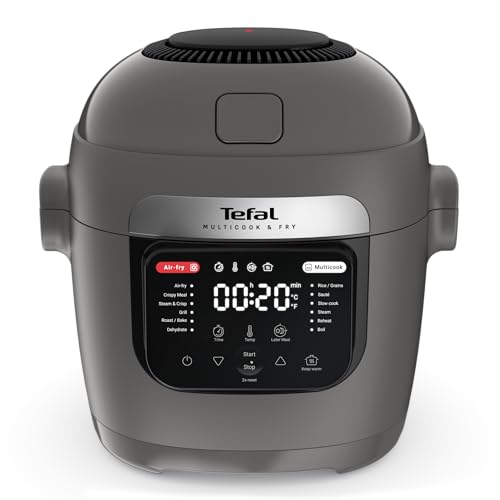
- VERSATILE: All your favorite crispy foods and an infinite array of healthy, tasty meals in no time with this stirring air fryer and multicooker designed to cover all your cooking needs
- A FULL MEAL ALL AT ONCE: Prepare a full meal in one go thanks to the multi-layer cooking tray that cooks different ingredients (like salmon and quinoa) at the same time
- LARGE CAPACITY: The 6 L cooking pot is ideal for up to six servings, offering the perfect capacity for any occasion from simple weeknight meals to multi-course meals entertaining guests
- LATER MEAL FUNCTION: Program your meals in advance and have them ready and waiting for you! Multicook manages the cooking for you and even keeps your food warm when it’s done
- EASY & PRACTICAL: Enjoy easy-to-use and practical features, with dishwasher-safe accessories including a cooking bowl with a non-stick ceramic coating and two handles for easy handling
Our testing methodology, in detail
Every multi-cooker was tested against the same standardised set of cooks, in the same kitchen, on the same 13A socket, with the same probe thermometer for verification. We use the same procedure across our cluster guides — slow cookers, pressure cookers, rice cookers — so scores are directly comparable.
Standardised tests: (1) 1.2kg diced beef chuck stew with stock, onions, and root veg — pressure-cooked or slow-cooked per the manufacturer’s recommended setting, weighed before and after for liquid loss, internal temperature 96°C target; (2) chicken thigh curry using a fixed quantity of Patak’s paste and yogurt, sauce consistency photographed against reference; (3) overnight steel-cut oats on ‘low’ for 8 hours, textural rating; (4) basmati rice cooked to manufacturer water ratio, evaluated for separation, stickiness, and burnt-base. Each test repeated three times across the testing window and averaged.
Scoring is out of ten across five weighted categories: cooking quality across all functions (35%), value-for-money (20%), build and long-term durability (15%), ease of cleaning (15%), and noise/footprint/usability (15%). Pressure-release noise was specifically measured at 30cm with a calibrated decibel meter; pressure regulation was monitored with a digital pressure gauge across two cooks per unit. Pricing tracked weekly across major UK retailers throughout the test window.
FAQ
Pressure cooker, slow cooker, or multi-cooker — which should I buy?
If you cook stews and roasts at weekends and want the meal-by-evening guarantee, a slow cooker is the cheapest, simplest answer (£40-£80). If you cook from scratch on weeknights and want stews ready in 45 minutes rather than 4 hours, a pressure cooker or pressure-capable multi-cooker is the better choice. If you do both regularly and have the worktop space, a multi-cooker like the Ninja Foodi or Instant Pot Duo Crisp is the right buy.
Are multi-cookers safe to leave on while you’re out?
Slow-cook mode: yes, that’s the entire design intent — they’re built for 8+ hours of unattended use. Pressure-cook mode: yes once the pressure has stabilised; modern units have multiple safety interlocks. We’d recommend not running pressure cooking the moment you walk out the door, but a 30-minute pressure cycle running while you collect kids from school is a normal use case. Always read your specific unit’s manual for the manufacturer’s stance.
Why does my multi-cooker say ‘burn’ or stop pressure cooking?
Almost always thickener at the base — flour, tomato paste, or starchy ingredients touching the bottom of the pot scorch, the unit detects the temperature spike, and aborts pressure mode. Solution: deglaze thoroughly after sautéing, layer thickeners on top of liquids rather than mixing them in, and never let tomato paste sit on the base. The Ninja Foodi is the most forgiving in our test; the Instant Pot is more sensitive.
How big a multi-cooker do I need?
For a single person or couple, 5L is plenty. For a family of four, 6-7L is the sweet spot. Above 8L you start seeing diminishing returns — the unit becomes too tall to sauté in comfortably, takes longer to come up to pressure, and uses more energy on small batches. The Ninja Foodi OL550UK’s 6L pot is the right size for most families; a smaller Instant Pot Duo Crisp Mini (5L) would be the better buy for one or two people.
Can multi-cookers genuinely replace an oven?
For braises, stews, curries, soups, rice, and steamed vegetables — yes, completely. For roasted whole chickens, baked goods, and proper cake — no. The crisp-lid units (Ninja Foodi, Instant Pot Duo Crisp) handle a small whole chicken adequately, but you won’t bake a sourdough or roast a Sunday joint in one. They’re additive to an oven, not a full replacement, despite marketing claims.
How long will a multi-cooker last?
Premium units (Sage, Ninja Foodi, Instant Pot Duo Crisp) regularly last 8-10 years with normal use. Budget units (£90 and below) last 3-5 years before non-stick degrades or the digital display fails. The single most replaceable component is the silicone sealing ring; budget for replacing this every 12-18 months on a unit you cook in daily.
The final word
If you take one thing from 220 hours of testing, it’s that the multi-cooker market has consolidated into two genuinely excellent options at the top — the Ninja Foodi SmartLid and the Instant Pot Duo Crisp — with the gap between them now largely a question of whether you’d rather swap a lid manually or pay a small premium for Ninja’s single-lid design. For families who slow-cook regularly, add a £65 Crock-Pot Lift & Serve as the dedicated tool. For time-poor cooks who want decisions made for them, the Moulinex Cookeo+ is unique in this list. Everything else in this round-up is either a step down in capability or a step up in price without proportionate gain.
Whichever you choose, learn the burn-warning fix early (deglaze, layer thickeners), buy a spare silicone sealing ring at the same time as the unit, and don’t expect any multi-cooker to fully replace an oven. We’ll keep this guide updated quarterly with new arrivals and price changes.