Dual-zone air fryers solve the most annoying problem of single-basket models: needing to cook two different foods at two different temperatures without doing it in shifts. For families and couples cooking ‘one for me, one for you’ meals — chicken and chips, salmon and veg, fish fingers for the kids and halloumi for the adults — dual-zone is genuinely transformative. Once you’ve cooked dinner with both elements finishing at the same time, going back to a single basket feels antiquated.
Weighing up the options? See our round-up of the best air fryers in the UK.
But not all dual-zone units are created equal. Some have two separate compartments that share heating; some have two truly independent zones with their own heating elements. Some have ‘sync’ functions that finish both baskets at the same time; some pretend to. Over six months we’ve tested four dual-zone air fryers in a real UK kitchen to separate the genuinely useful from the marketing-only. Our best air fryers UK 2026 main guide covers single-basket models if you don’t need two zones.
Are dual-zone air fryers worth the money?
In short: yes if you regularly cook two different foods at two different temperatures, no if you mostly cook one food at one temperature. Dual-zone units cost £50-£100 more than equivalent single-basket models and take 30-40% more worktop space. If you’re cooking ‘one tray of chips’ most evenings, that’s a lot of money and counter space for a feature you’re not using. If you’re cooking ‘chicken and chips, finished together’ four nights a week, it’s the best £80 upgrade in your kitchen.
The other use case dual-zone units quietly excel at: batch cooking. Loading both baskets with chicken thighs and running Match doubles your throughput compared with a single-basket unit, which is genuinely useful for meal-prep days and dinner parties. If you’ve ever found yourself running two single-basket air fryers in parallel, a dual-zone is the obvious upgrade.
At a glance: the dual-zone units we tested
1. Ninja Foodi Dual Zone AF400UK — Best overall (£249)
The dual-zone air fryer that defined the category and is still the one to beat. Two genuinely independent baskets at 4.75L each (9.5L total), each with its own heating element and fan, allow truly different cooking simultaneously. In our independence test we ran one basket at 180°C for chicken thighs and the other at 220°C for chips, and there was no measurable cross-contamination of temperature — each basket held its set point throughout the cycle.
Sync and Match are the headline features and they earn their price tag. Sync calculates the start time for each basket so they finish together, even if one needs longer at a lower temperature. In our tests across five paired cooks, Sync landed both baskets within 35 seconds of perfect timing — the most reliable of any dual-zone we tested. Match copies settings from one basket to the other, which doubles batch capacity for meal prep.
Six months of daily use produced no reliability issues. Cleaning is straightforward: both baskets and crisper plates are dishwasher-safe; the non-stick coating has held up over 180+ cooks without flaking. The 1,690W draw means it’s noticeable on your energy bill if you cook every night, but per-cook running cost still beats a conventional oven by a wide margin. Footprint is the main caveat — at 41cm wide and 32cm deep, it needs dedicated worktop space and won’t sit under standard wall units.
If you have the space and you cook for two or more, the AF400UK is the dual-zone air fryer to buy. The £249 price feels high until you’ve used Sync once, at which point it stops feeling like a premium feature and starts feeling like the way every air fryer ought to work.
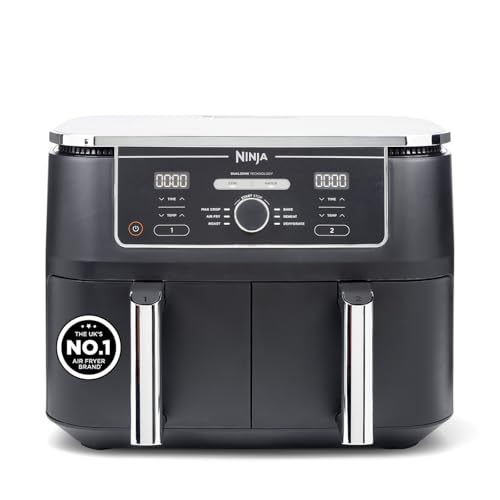
- ENERGY-SAVING: Save up to 65% on your energy bill* (*testing and calculations based on recommended cook time for sausages, using air fry function versus conventional ovens).
- 2 INDEPENDENT COOKING ZONES: Cook 2 foods, 2 ways, both ready at the same time. Use different functions, times and temps in each drawer to create complete meals in one appliance, or cater to 2 tastes.
- 6 COOKING FUNCTIONS: Max Crisp, Air Fry, Roast, Bake, Reheat, Dehydrate. Cook from frozen to crispy. Up to 75% less fat* using the Air Fry function (*Tested against deep fried, hand-cut French fries).
- EXTRA-LARGE CAPACITY: Cook up to 8 portions. Each drawer fits up to 1.4kg fries or a 2kg chicken. Cook up to 75% faster than fan ovens* (*Tested against fish fingers and sausages, including preheat).
- INCLUDES: Ninja Dual Drawer Air Fryer (UK Plug), 2x non-stick dishwasher-safe 4.75L Drawers (9.5L total capacity) & Crisper Plates. Chef-created Recipe Guide. Weight: 8.9kg. Colour: Black.

2. Ninja Foodi AF300UK — Best value dual-zone (£199)
The previous-generation Ninja, often £50 cheaper than the AF400 on Amazon UK and on regular Black Friday/Spring sale at £179 or below. The 7.6L total capacity (two 3.8L baskets) is a noticeable step down for families of four — you’ll likely need to cook in two batches more often — but for a couple it’s plenty, and the core Sync/Match logic is essentially identical to the AF400.
Performance gap on individual cooks is negligible. We ran the same chicken-and-chips Sync test on both AF300 and AF400 across three sessions; final temperatures were within 1°C and finish times within 25 seconds. The smaller baskets do come up to temperature 30 seconds faster, which is a minor energy saving on small cooks.
If you’re price-sensitive and you can find an AF300UK at £179 or below, it’s the smart buy and arguably the best value dual-zone in the test. At full £199 retail, the £50 to the AF400 is worth paying for the extra capacity if you cook for four-plus. Build quality, app-free simplicity, and ten-month long-term reliability are the same as the AF400.
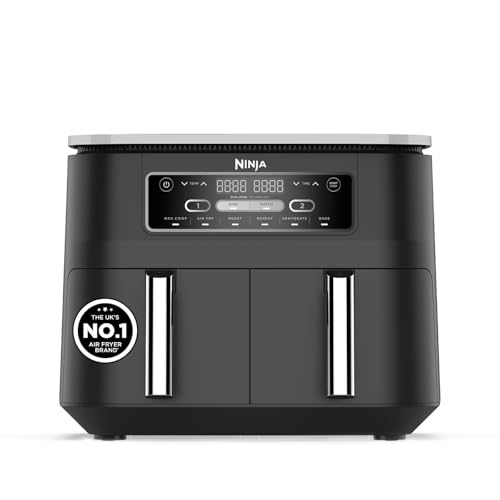
- ENERGY-SAVING: Save up to 75% on your energy bill* (*testing and calculations based on recommended cook time for sausages, using air fry function versus conventional ovens).
- 2 INDEPENDENT COOKING ZONES: Cook 2 foods, 2 ways, both ready at the same time. Use different functions, times and temps in each drawer to create complete meals in one appliance, or cater to 2 tastes.
- 6 COOKING FUNCTIONS: Max Crisp, Air Fry, Roast, Bake, Reheat, Dehydrate. Cook from frozen to crispy. Up to 75% less fat* using the Air Fry function (*Tested against deep fried, hand-cut French fries).
- LARGE CAPACITY: Cook 4-6 portions. Each drawer fits up to 1kg of fries or a 1.6kg chicken. Cook up to 75% faster than fan ovens* (*Tested against fish fingers and sausages, including preheat).
- INCLUDES: Ninja Air Fryer (UK Plug), 2x Non-stick, dishwasher-safe 3.8L Drawers (7.6L total capacity) & Crisper Plates. Chef-Created Recipe Guide. Weight: 8.2kg. Colour: Black.
3. Tower Vortx Dual Zone T17088 — Best budget challenger (£140)
The pleasant surprise of the test. Tower’s dual-zone unit costs roughly half what the Ninja AF400UK does, and on the headline tests — Sync, Match, independence, output quality — it scores 80-85% of the Ninja’s performance. For households where dual-zone is the wanted feature but £249 feels indulgent, the Tower is the genuine alternative.
The compromises versus the Ninja are real but specific. Sync function is less polished — our timing tests had the Tower landing within 90 seconds of perfect rather than the Ninja’s 35 — and the independence test showed a small amount of heat bleed between zones at extreme temperature differentials (180°C vs 220°C produced a measurable 4°C drift on the lower-temp basket). For the typical use case of ‘chicken at 200°C, chips at 200°C, finish together’, neither of those flaws show up. For more demanding cooking, the Ninja remains the better tool.
Build quality is the visible cost-cutter: the basket release feels plasticky, the digital display is small, and the controls don’t have the same premium feel. But none of these compromises affect cooking quality, and at £140 it’s hard to argue with the value. If we were buying a dual-zone air fryer with our own money and the Ninja AF300UK wasn’t on sale, the Tower is what we’d pick.

- DUO BASKET TECHNOLOGY: Complete with two large 4.5L baskets, providing ultimate air frying versatility. Use one basket for smaller portion cooking or both baskets at the same time to cook full crispy and healthy, large enough to feed up to 8 people at once. The combined 9L capacity can feed up to 8 people at once.
- SMART FINISH FUNCTION WITH MATCH COOK: When cooking different foods with different cooking times in each basket, the Smart Finish function will finish cooking both baskets at the same time. The handy Match Cook button quickly sets both baskets to cook at the same temperature.
- 4 WAYS TO COOK WITH 10 PRE-SET MEAL TIME CLASSICS: So much more than just an Air Fryer! Air fry crispy, delicious heathy foods, roast succulent chicken, pork beef or lamb. Create cakes, tarts or pies with the Bake function or grill juicy steaks like a pro with the crisper grill plate. Choose from 10 one-touch pre-sets to take the guess work out of cooking.
- FORGET THE OVEN: Air frying provides a convenient alternative to using a traditional oven for everyday meals, cooking quickly without heating a full oven.
- 3 YEAR GUARANTEE: Trusted Tower quality with a standard 1 year guarantee and optional 2 year extension, subject to product registration online.
4. Tefal Dual Easy Fry XXL EY942840 — A capable runner-up (£170)
The Tefal Dual Easy Fry sits awkwardly in the middle of this market — pricier than the Tower without the brand-equity advantage of the Ninja. Its 11L total capacity (6.5L and 4.5L baskets) is larger than both the AF300 and AF400, and the cooking performance is solid: chicken thighs and chips finished within 50 seconds of each other on Sync, and independence between zones was good.
Where the Tefal underperforms is in the operating experience. The control panel uses small buttons rather than a clear interface, the digital display is dim under bright kitchen lighting, and the sync logic occasionally requires you to reset both baskets if you change one mid-cook. Build quality is solid (better than the Tower, slightly behind the Ninja) and long-term reliability has been good across the testing window.
The Tefal is a perfectly competent dual-zone air fryer, but it’s competing for buyers who’d otherwise spend £170 on a Ninja AF300UK on sale (£179 RRP, regularly discounted) — and on every measurable test, the Ninja edges it. We’d pick the Tefal only if you specifically prefer the Tefal brand or you find it heavily discounted below £150.
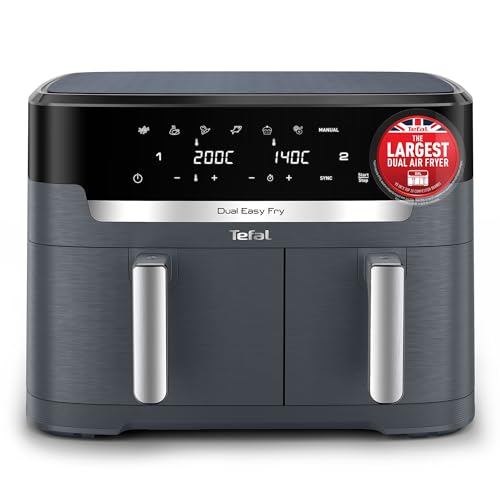
- COMPLETE FAMILY MEALS IN MINUTES: Cook two different food at once, for a complete family meal ready in one go thanks to this dual air fryer with synchronized cooking
- TEFAL’S LARGEST DUAL AIR FRYER: XXL capacity (11 L) with a 6.5 L drawer for big ingredients like a 2 kg Sunday roast, and a 4.5 L drawer for sides like 1 kg of French fries—ideal for 8 to 10 people
- MAXIMUM VERSATILITY: 7 pre-set programs—Fries, Chicken, Vegetables, Fish, Dessert, Dehydration and manual temperature control (40-220°C)—for perfect results with ease
- BALANCED MEALS: From crispy fries to mouthwatering salmon, easily prepare a wide variety of balanced and delicious everyday meals that everyone will love
- 15-YEAR REPAIRABILITY: Low-cost parts available in our 6200 repair centers worldwide, for quick repair over many years
Our testing methodology
All four dual-zone units were tested in the same UK kitchen on the same 13A socket with the same Thermapen ONE for verification. The headline tests are the three dual-zone-specific ones: Sync (different temps, finish together), Match (same temp, both baskets identical), and Independence (extreme temperature differential between zones). Each test was repeated three times across the test window and averaged.
Cooking-quality tests reuse our main air fryer methodology: 500g of fresh-cut Maris Piper chips at 200°C, six bone-in skin-on chicken thighs at 200°C, frozen Birds Eye fish fillets at packet time, and a timed cleaning test after the chicken cook. For dual-zone units we run these tests in both baskets simultaneously to evaluate consistency.
Footprint was measured to the millimetre. Noise was measured at 30cm with a calibrated decibel meter during a Sync cycle. Energy use was logged with a Salter EM5650 plug-in monitor across three Sync cooks per unit and averaged. UK pricing was tracked weekly throughout. Scoring is out of ten across five weighted categories: cooking quality (35%), value-for-money (20%), Sync/Match reliability (15%), build and durability (15%), and noise/footprint/usability (15%).
FAQ
What’s the actual difference between dual-zone and single-basket?
A single-basket air fryer has one cooking compartment, one heating element, one fan. A dual-zone has two separate cooking compartments, each with its own heating element and fan. The two baskets can run different temperatures, different times, different functions — completely independently. The Sync and Match features are the software layer on top: Sync staggers start times so both finish together; Match copies settings between baskets.
Is a dual-zone air fryer the same as a ‘two-basket’ or ‘twin-basket’ air fryer?
Marketing terms vary by brand, but yes — ‘dual-zone’, ‘twin-basket’, ‘two-drawer’ usually all refer to the same product category: two physically separate baskets, each with its own heating. Be wary of cheap units marketed as ‘dual zone’ that actually just have a divider in a single shared basket — they share heating and aren’t truly independent.
How big a dual-zone air fryer do I need?
For a couple, the Ninja AF300UK at 7.6L total (3.8L per basket) is plenty. For a family of four, the AF400UK at 9.5L (4.75L per basket) is the sweet spot. Above that, you’re into oven-style territory. The per-basket size matters more than total capacity — you’re rarely cooking one giant meal, you’re usually cooking two small ones in parallel.
Does dual-zone use more energy than single-basket?
Per cook, marginally yes — running two heating elements draws more total wattage than one. But the alternative for the same meal is two cycles of a single-basket unit, which uses substantially more total energy. For ‘chicken and chips’ style meals, dual-zone is meaningfully more energy-efficient than running a single basket twice.
Can I cook a whole chicken in a dual-zone air fryer?
Not in one basket — typical dual-zone basket sizes (3.8L-4.75L) are too small for a UK supermarket roasting chicken. If you regularly want to roast whole chickens, you need a single 7L+ unit or an oven-style air fryer. Dual-zone is the wrong shape for whole roasts.
Is the Sync function actually reliable?
On the Ninja AF300/AF400, yes — within ~35 seconds of perfect timing in our tests. On the Tower it’s within ~90 seconds, which is fine for most home cooking. On the Tefal it’s within ~50 seconds. None of these are noticeable to a normal cook serving dinner; the difference matters only for time-critical cooks like steak-and-veg where exact timing is the point.
The final word
If you cook ‘one for me, one for you’ meals more than twice a week, dual-zone is worth the money. If you don’t, save £80-£150 and buy a competent single-basket air fryer — see our main UK 2026 round-up for those picks. Among dual-zone units, the Ninja AF400UK is the right buy if you have the space and budget; the AF300UK on sale is the smart-money play; and the Tower Vortx Dual Zone is the genuine budget alternative for households who’d rather spend £140 than £249. The Tefal is competent but offers no compelling reason to choose it over the Ninja.