
| Our verdict at a glance Smeg KLF03 Kettle – around £160. Rating: 8.0/10 One-line verdict: a properly made stainless steel kettle in the best-looking body in the category, fast to boil and built to last – let down only by a slightly awkward handle balance and the absence of temperature control at a price where rivals include it. Buy it if the kettle is on permanent display, you want a metal body rather than plastic, and coordinating it with a matching toaster is part of the appeal. Skip it if you brew green tea or pour-over coffee and need variable temperature, you want the quietest possible boil, or you object on principle to paying a design premium on a simple appliance. |
A kettle is the most-used appliance in a British kitchen and one of the least interesting to write about. It boils water. The Smeg KLF03 is the kettle that made that a design question instead of a functional one, and it has been the default aspirational choice for the better part of a decade – the object that turns up in kitchen photography, in rental listings trying to look expensive, and on wedding lists where nobody has looked at the price. At around £160 it costs roughly five times what a perfectly competent kettle costs, and any honest assessment has to begin there.
Weighing up the options? See our round-up of the best kettles in the UK.
The useful question is not whether it boils water better than a £30 kettle, because it does not. It is whether what the extra money buys – stainless steel construction, a finish that survives years on a worktop, and a shape that coordinates with an entire range of matching appliances – is worth having. For a lot of buyers on the shortlist in best kettles UK 2026, it demonstrably is, and the KLF03 is also better engineered than its reputation as a lifestyle object suggests.
This review looks at how it is actually built, how quickly and quietly it boils, the two design details that genuinely irritate, and how it compares with the variable-temperature alternatives at the same money.
Where the KLF03 sits in the kettle market
At around £160 the KLF03 competes with three quite different propositions. There are the variable-temperature kettles from Sage, Bosch and Russell Hobbs at £80 to £130, which offer selectable temperatures between roughly 60°C and 100°C plus a keep-warm function, in plastic or plastic-and-steel bodies. There are the specialist gooseneck pour-over kettles at £110 to £200, which trade capacity for precision. And there is the Dualit Classic and the KitchenAid Artisan, which are the KLF03’s direct rivals on the same terms: metal-bodied, design-led, temperature control optional.
Against the variable-temperature group, the KLF03 loses on features and wins on materials. Against the pour-over kettles it is a completely different tool – 1.7L versus 1L, wide spout versus gooseneck. Against the KitchenAid and the Dualit it wins on coordination: the Smeg small-appliance range is broad and long-lived enough that a matching toaster, coffee machine, blender and even a stand mixer can be added over years without the colour going out of production.
That coordination is the honest core of the value proposition. Nobody buys a KLF03 to solve a boiling problem. They buy it because the kitchen is going to have a Smeg kettle and a Smeg toaster in the same colour, and that costs what it costs.
Design, materials and finish
The body is stainless steel with a thick powder-coat or enamel-effect finish depending on colour, and the difference between this and a painted plastic shell is obvious within seconds of picking it up. It weighs a little over 1.1kg empty, feels solid rather than hollow, and the finish resists the scuffing and yellowing that afflicts white plastic kettles after a couple of years near a hob.
The detailing is where the money shows. The chrome collar around the base, the chrome handle mount, the domed lid with its chrome button, the lever-style switch at the base of the handle – these are separate, properly finished components rather than mouldings pretending to be metal. The water gauge is a slim vertical window set flush into the body rather than a bulging plastic tube stuck on the side, which is the single detail that most clearly separates it from a mid-market kettle.
The colour range is extensive and Smeg supports it for long enough that a matching appliance bought two years later will still be the same shade. That is not a trivial thing: the whole reason to accept the premium is coordination, and a range that gets discontinued after eighteen months would undermine it entirely.
Two design criticisms are worth stating plainly. The first is handle balance. The handle is mounted high and set slightly back, and with a full 1.7L of water the kettle wants to tip forward as it is lifted, which means the wrist does more work than it should. It is manageable and it becomes habit, but a taller, more upright handle would be better. The second is the lid. It opens via a chrome button and springs up sharply, and filling through the lid opening is fine, but the opening is not wide enough to get a hand inside for descaling. Filling through the spout is awkward because of the shape.
Boiling performance and noise
The KLF03 uses a 3kW concealed element, which is the maximum practical for a UK 13A plug and means boil times are at the fast end of the category. A full 1.7L from cold takes a little over four minutes; a single mug’s worth from the minimum fill line takes well under a minute. There is nothing to criticise here – it is as fast as a kettle can be on a domestic circuit.
The concealed element is also the right decision for anyone in a hard-water area. Exposed-element kettles scale up on the element itself, which slows boiling and eventually kills them; a concealed flat plate scales on the base, where it can be descaled without wrestling a coil. In London and the South East this matters a great deal, and descaling every four to six weeks with citric acid or a proprietary solution should be treated as routine rather than optional.
Noise is average rather than good. The steel body does nothing to dampen the sound of a rolling boil, and the KLF03 is noticeably louder than the insulated, double-walled kettles that lead the Best Quiet Kettles UK 2026 shortlist. It builds to a proper roar in the last thirty seconds. In an open-plan kitchen where someone is watching television twelve feet away, that is a real consideration. In a closed kitchen it is a non-issue.
The 360-degree base is well executed, with a positive seat and enough clearance that the kettle drops on without hunting for the contact. The switch is a lever rather than a rocker and it has a satisfying, mechanical action – one of several places where the kettle feels more expensive than a comparison of specifications would suggest.
Pouring, capacity and everyday use
The spout is wide and short, and it pours cleanly at a moderate angle without dribbling down the outside – better than many kettles at this price, where a badly formed lip is a common failing. What it cannot do is pour slowly and precisely. This is a kettle for filling teapots, mugs, pans and hot water bottles, not for a controlled spiral over a coffee filter. Anyone doing pour-over coffee needs a gooseneck kettle, and no amount of careful wrist work makes a wide spout behave like one.
Capacity is 1.7L, which is the standard and sensible figure for a family kettle: roughly seven mugs, or a large teapot plus a mug. The minimum fill line is around 0.5L, which is higher than ideal for a single cup and means a little energy is wasted when only one drink is wanted. The removable limescale filter in the spout is easy to pull out and rinse, and it does its job.
The absence of temperature control is the functional gap. At £160 there are kettles that will hold water at 80°C for green tea or 94°C for filter coffee, and the KLF03 will only do 100°C. For anyone drinking mostly English tea and instant coffee this is genuinely irrelevant – boiling water is what is wanted. For anyone with a serious tea habit it is a real omission, and it is the reason Smeg offers the KLF04 and KLF05 variants, which add variable temperature in the same body for roughly £40 to £60 more.
Is the Smeg KLF03 worth the money?
On a purely functional reading, no, and there is no point pretending otherwise. A £35 kettle boils 1.7L in a similar time, and a £100 variable-temperature kettle does more. The KLF03’s specification sheet does not justify its price and was never going to.
The argument that does work is about materials, permanence and coordination. This is a stainless steel appliance with properly finished metal detailing in a category almost entirely given over to plastic, and it will look the same in eight years as it does in its first week – which is more than can be said for a white plastic kettle, or for a brushed steel one covered in fingerprints. Set against the fact that it sits in view every single day and gets used more than any other appliance in the house, the premium is easier to defend than the specification alone makes it look.
The 8.0 rating reflects that split. Build, finish, boil speed and the concealed element are all excellent. The handle balance is imperfect, the boil is loud, the minimum fill is high and the lack of temperature control is a genuine omission at this price. Bought as a beautifully made basic kettle that will last, it delivers. Bought expecting the feature set the price implies, it will disappoint.
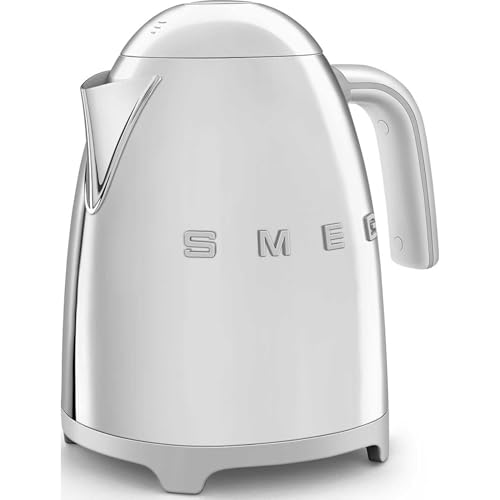
- ELEGANT SOFT OPENING: The kettles lid is soft opening when the central button is pressed for easy filling
- LIMESCALE FILTER: The kettle has an in-built stainless steel filter which filters out natural limescale. It's removable for cleaning too
- EXCELLENT HEAT CONDUCTION: The kettles enamelled stainless steel surface ensures excellent heat conduction and there is an automatic switch off at 100˚C for added piece of mind
- 360 SWIVEL BASE: The kettle can slot onto the base in any position and has a handy cable tidy
- SMEG GUARANTEE: This product comes with a 2 year guarantee when you register for free with SMEG where you’ll be able to return the appliance to be repaired or replaced if faulty
FAQ
What is the difference between the Smeg KLF03 and the KLF04?
The KLF03 is the standard model: 1.7L, 3kW, boil-only, with a chrome lid button and lever switch. The KLF04 shares the same body and capacity but adds variable temperature control, usually with selectable settings between roughly 50°C and 100°C plus a keep-warm function, and a digital or stepped selector in place of the simple switch. It costs around £40 to £60 more. If green tea, oolong or filter coffee are part of the routine, the KLF04 is the one to buy; otherwise the KLF03 does everything needed.
Is the Smeg KLF03 noisy?
It is average for a metal-bodied kettle, which means noticeably louder than an insulated double-walled quiet kettle. The single-skin stainless steel body does not dampen the sound of a rolling boil, and it becomes quite loud in the final thirty seconds of a full fill. In a separate kitchen this is unremarkable. In an open-plan room where someone is trying to watch or hear something, it is worth considering a quiet kettle instead.
Does it scale up badly in hard water areas?
It scales at the same rate as any kettle in a hard-water area, but it handles it better than most because the element is concealed under a flat stainless base. Scale forms on the plate rather than on an exposed coil, which means it can be dissolved with citric acid or a descaling solution without any risk of damaging the element. In London and the South East, descaling every four to six weeks keeps boil times and taste where they should be.
Can you use the KLF03 for pour-over coffee?
Not well. The spout is wide and short, designed for fast, clean pouring into mugs and teapots rather than for the slow, controlled stream that pour-over brewing requires. It also has no temperature control, so there is no way to hit the 92°C to 96°C window that filter coffee wants. A dedicated gooseneck kettle with variable temperature is the right tool for that job, and it can happily live alongside a KLF03 used for everything else.
Do Smeg kettles last?
The construction suggests they should, and the concealed element removes the most common cause of early kettle failure. The body is steel, the finish resists wear, and the mechanical switch and lid hardware are metal rather than sprung plastic. The usual caveats apply: a kettle is a sealed appliance, so a failed element or base means replacement rather than repair, and consistent descaling makes a large difference to how long it stays fast and quiet.
Does the kettle match the Smeg toaster exactly?
Yes – the colours are shared across the 50s Style range, so the KLF03 and the TSF01 or TSF02 toaster are designed to sit side by side in the same shade with the same chrome detailing. This is the main reason many people buy either one, and Smeg keeps the colours in production long enough that the second appliance can be bought some time after the first. The pairing is covered in more detail in the Smeg TSF01 toaster review.
The final word
The Smeg KLF03 is a genuinely well-made kettle that happens to be bought for the way it looks, and the good news is that the engineering underneath is not an afterthought. Stainless steel body, concealed element, fast boil, proper metal detailing, a finish that will still be smart in eight years – these are real advantages over the plastic mainstream, and they are the things that justify the spend.
The compromises are the loud boil, the high minimum fill, the slightly tipping handle and the absence of temperature control at a price where it should arguably be standard. If the last of those matters, spend the extra on the KLF04 rather than dropping down the range. If it does not, the KLF03 is a sound purchase for anyone who wants their most-used appliance to be an object rather than a utility.



