Our top picks at a glance Weighing up the options? See our round-up of the best kettles in the UK. Best overall temperature-control kettle: Fellow Stagg EKG — The gooseneck pour-over benchmark. To-the-degree control, a beautifully balanced spout for a slow controlled pour, a 60-minute hold mode and a build that feels worth the money. The one to buy if budget allows. Best budget pick: VICBINLY Electric Gooseneck Kettle — Around £42, it holds a set temperature accurately, pours cleanly enough for V60, and stays notably quiet while boiling. It is not as refined as the Stagg, but it does the core job for well under a third of the price. Best for tea drinkers: Sage the Smart Kettle — Not a gooseneck, so not ideal for pour-over, but its five preset tea temperatures, large capacity and fast boil make it the most convenient choice for a household that mainly drinks green, white, oolong and black tea. |
Boiling water is the enemy of good tea and good coffee. Pour 100°C water over delicate green or white tea and you scald it into bitterness; pour it over a light-roast pour-over and you drag out harsh, astringent flavours the roaster never intended. A temperature-control kettle lets you set the exact temperature the leaf or bean wants — typically 70–85°C for greens and whites, 90–96°C for coffee — and that single change does more for the cup than almost any other piece of kit.
This guide is for two overlapping UK audiences: tea drinkers who want the right temperature for each leaf at the press of a button, and pour-over coffee people who also need a gooseneck spout for a slow, controlled pour. They are not always the same kettle, and we tested with both in mind. If you have already upgraded your coffee setup from our best espresso machines under £500 UK 2026 guide, a variable kettle is the natural next step for the days you brew filter rather than pull a shot.
We judged each kettle on four things that matter day to day: temperature accuracy (does it actually hit and hold the number you set), pour control (the gooseneck spout’s flow rate and precision, which is everything for pour-over), hold and convenience features (keep-warm, presets, speed), and build and ease of living with it. Tea-first buyers can weight convenience and capacity; coffee-first buyers should weight the pour above all else.
Gooseneck or not? Match the kettle to the brew
The first decision is whether you need a gooseneck spout, and it comes down to coffee. For pour-over — V60, Kalita, Chemex — a gooseneck is close to essential: the narrow, curved spout lets you lay down a slow, precise stream exactly where you want it, controlling the flow that governs even extraction. A normal kettle dumps water too fast and too wide, channelling through the coffee bed and giving you a weak, uneven cup. If you brew pour-over, prioritise a gooseneck.
If you only make tea, a gooseneck is optional and sometimes a mild nuisance — slower to fill a big pot, and usually lower capacity. A wide-spout variable kettle with tea presets and a litre-plus capacity is more convenient for a household working through mugs of green, oolong and black tea. We have ranked the kettles below by overall capability, then flagged clearly which suits pour-over, tea, or both.
At a glance: the kettles we tested
Five temperature-control kettles, spanning premium pour-over precision to a genuine sub-£50 option — ranked by overall capability, with pour-over and tea-only picks called out where they differ.
1. Fellow Stagg EKG — Best overall (£150)
The Fellow Stagg EKG is the kettle that turned the gooseneck from a barista tool into a worktop object people actively want, and it remains the benchmark in 2026. Set your target on the dial and the LCD, and it heats to the degree and holds there; in our testing the spout temperature tracked the set point within about 1°C, the tightest of any kettle here. For pour-over that precision genuinely shows up in the cup.
The pour is what justifies the price. The counterweighted handle and the long, tapered gooseneck give the most controlled, predictable flow we tested — you can drop to a fine trickle for a delicate centre pour or open up for the bloom without the stream wandering. A 60-minute hold mode keeps water at temperature through a slow brew or a second cup, and a built-in stopwatch (on the EKG) helps you time your pour. It is a joy to use every morning.
The downsides are price and capacity. At £150 it is the most expensive kettle here, and the 0.9L usable capacity is fine for one or two brews but small for a tea-drinking household. The matte finishes also show fingerprints. None of that changes the conclusion: if you take pour-over seriously and the budget stretches, the Stagg EKG is the one to buy. Tea drinkers who do not brew coffee will find it overkill — look at the Sage instead.

2. TIMEMORE Fish Smart — Best for pour-over precision (£129)
The TIMEMORE Fish Smart is the kettle serious pour-over people reach for when they want Stagg-grade control without the Stagg price. TIMEMORE built its name on precision brewing gear, and it shows here: a STRIX temperature controller holds the water within about 1°C of target across a 40-100°C range, with a dual display showing both the actual and target temperature at once, and a hold mode that automatically reheats if the water drifts below your set point.
The patented fine gooseneck spout is built specifically for pulse-pouring technique, producing a thin, controllable stream that TIMEMORE pitches at coffee novices and specialists alike — and it delivers. It heats quickly too, reaching typical pour-over temperatures in well under four minutes. For a coffee-first buyer who wants maximum pour precision without paying Stagg prices, this is the strongest pick in the group.
Where it trails the Stagg is capacity and finish: at 600ml it holds noticeably less water than the Fellow’s 0.9L, which means more refills for a multi-cup brewing session, and the overall build feels a touch less premium. Buy the Fish Smart if pour-over precision is your priority and you want the best pour-to-price ratio here; choose the Stagg only if the extra capacity and design refinement matter enough to justify the extra £21.

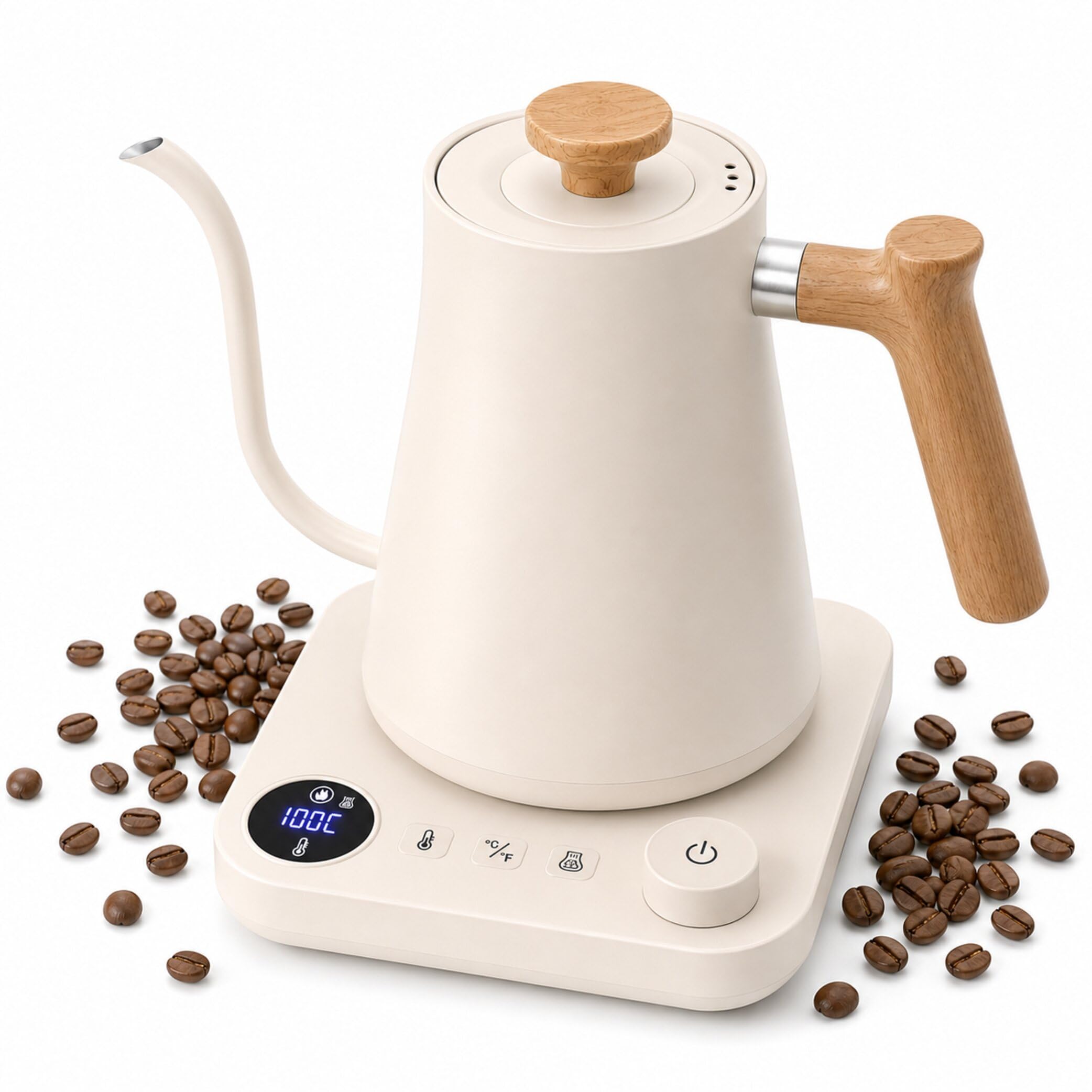
3. VICBINLY Electric Gooseneck Kettle — Best budget pick (£42)
The VICBINLY proves you do not have to spend three figures — or even two — to get into temperature-controlled pour-over. For around £42 it gives you adjustable temperature control via an NTC sensor, a genuinely quiet variable-frequency heating element, and a 0.9L gooseneck spout that pours cleanly enough for a perfectly good V60. For most people dipping a toe into pour-over, this is all the kettle they actually need.
It won’t match the Fellow or the TIMEMORE for the very finest low-flow control, but the pour is steady and predictable enough for a clean, even V60. Build quality is reasonable for the money — 304 stainless steel construction, an ergonomic handle, and a genuinely quiet boil that’s a pleasant surprise at this price. At 0.9L the capacity suits one or two brews at a time, and the same temperature control works just as well for tea.
The compromises are the ones you would expect at the price: the spout flow is a little less refined than the premium options, and the materials feel more functional than special. None of that stops it doing the core job well. Buy the VICBINLY if you want temperature-controlled pour-over and tea on a genuine budget and you are happy to trade a little pour finesse for spending well under a third of what the Stagg costs.

4. Sage the Smart Kettle — Best for tea drinkers (£90)
The Sage the Smart Kettle (BKE820) is not a gooseneck, so it is not the kettle for serious pour-over — but for a household that mainly drinks tea, it is the most convenient choice here. It offers five preset temperatures mapped to tea types (green at 75°C, white at 85°C, oolong at 95°C, and so on up to a full 100°C boil for black tea and French press), a generous 1.7L capacity, and a fast, powerful element that boils quicker than any gooseneck on this list.
For tea it is genuinely excellent: tap the leaf type, walk away, and come back to water at the right temperature, with a 20-minute keep-warm to hold it there. The large capacity means it fills a teapot and several mugs in one go, which the small-capacity gooseneck kettles simply cannot do. Accuracy at the presets was reliable in our checks, and the brushed-steel build feels solid and looks smart on the worktop.
The limitation is pouring coffee. The wide spout floods a V60 bed and gives you no flow control, so pour-over results were poor — exactly as expected from a non-gooseneck kettle. If you brew filter coffee, this is the wrong tool. But if your daily ritual is tea in various forms and coffee is, at most, a cafetiere job, the Sage Smart Kettle is the most practical and pleasant kettle in this round-up. Buy it for tea; look elsewhere for pour-over.

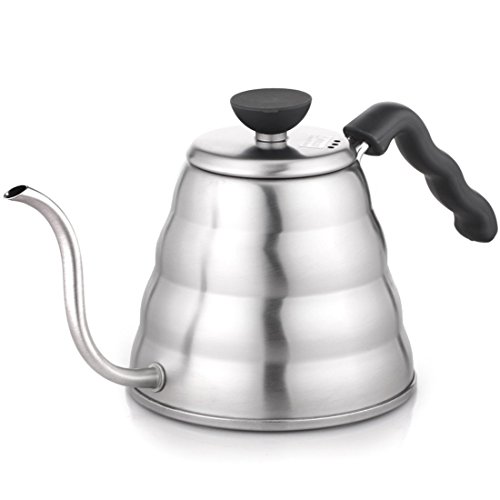
5. Hario V60 Buono — Capable runner-up (£58)
The Hario V60 Buono is the kettle a lot of pour-over enthusiasts learned on, and it still has a place. It is a stovetop (and electric-base, depending on version) gooseneck with a long, well-shaped spout that pours beautifully — the flow control is excellent and, on the cheaper stovetop version, it costs only around £58. For the pour itself, it is genuinely competitive with kettles costing far more.
It lands fifth for one decisive reason: the standard Buono has no temperature control. You boil it and either pour at 100°C (wrong for almost everything delicate) or let it cool and guess, or use a separate thermometer. In a round-up specifically about temperature-controlled kettles, that is a real handicap — you are buying a brilliant spout attached to a dumb kettle. There is a variable-temperature electric version, but it costs more and is less widely stocked in the UK.
Buy the Buono if you already own a thermometer or a brew scale with a temperature probe, you want a superb pour for very little money, and you are happy to manage temperature manually. For everyone who wants set-and-forget temperature control in one device, the VICBINLY at £42 is the smarter entry point, and the TIMEMORE or Stagg the better long-term tools.
Our testing methodology
All five kettles were tested with the same Brita-filtered water in the same kitchen, so starting temperature and mineral content stayed constant. We verified accuracy with a calibrated probe thermometer reading actual water temperature at the spout — not the kettle’s own display — at two targets: 80°C for green tea and 94°C for pour-over coffee, recording the deviation from the set point.
Pour control was assessed by brewing an identical 1:16 V60 (20g to 320g) with each gooseneck kettle, scoring the ease of a slow controlled stream and a precise centre pour. We timed one-litre boil-from-cold speed, monitored hold-mode stability across 30 minutes, and logged practical irritations such as dripping lids, persistent beeps and hot handles. The non-gooseneck Sage was scored for tea use only. Each kettle was used daily for the test period so that the verdicts reflect living with them, not a single bench session. We use Amazon Associates affiliate links throughout the site — see our editorial policy for details.
FAQ
What water temperature should I use for tea and coffee?
As a rule of thumb: green and white teas like 70–85°C, oolong around 85–95°C, and black tea, herbal infusions and pu-erh a full 90–100°C. For coffee, pour-over and filter generally sit between 90°C and 96°C, with lighter roasts wanting the hotter end and darker roasts a little cooler to avoid bitterness. A temperature-control kettle lets you match each of these precisely instead of scalding everything at 100°C.
Do I really need a gooseneck kettle for pour-over?
If you brew V60, Kalita or Chemex, a gooseneck makes a real difference. The narrow, curved spout lets you pour a slow, controlled stream exactly where you want it, which is what produces even extraction and a clean cup. A standard wide-spout kettle pours too fast and floods the coffee bed, causing channelling and an uneven, weaker brew. For cafetiere or tea, where you are just filling a vessel, a gooseneck is not necessary.
Are temperature-control kettles accurate enough to trust?
The good ones are. In our testing the better kettles held the set temperature within about 1–2°C at the spout, which is well within the range that matters for tea and coffee. Cheaper models drift a little more and some use banded presets rather than to-the-degree control, but all of them are far more accurate than guessing how long to let a boiled kettle cool. If precision is critical to you, the Fellow Stagg and TIMEMORE were the tightest here.
Is a hold or keep-warm function worth having?
Yes, especially for pour-over and for tea sessions where you brew more than one cup. A hold mode keeps the water at your set temperature for 30–60 minutes, so your second pour is as accurate as your first and you are not re-boiling and re-cooling. For a single quick cup it matters less, but it is one of the features that makes a temperature-control kettle pleasant to live with rather than just technically capable.
Can one kettle do both tea and pour-over well?
The closest all-rounders are the gooseneck variable kettles — the Fellow Stagg, TIMEMORE Fish Smart and VICBINLY all set tea temperatures and pour coffee from the same spout. The trade-off is capacity: gooseneck kettles are usually under one litre, which is small for a tea-drinking household. If you brew a lot of tea and only occasional filter coffee, a large variable kettle like the Sage plus a separate cheap gooseneck can actually be the better combination.
The final word
For anyone who takes pour-over seriously, the Fellow Stagg EKG at £150 is the kettle we would buy — the most precise pour, to-the-degree control, a proper hold mode and a build you will enjoy every morning. If that is more than you want to spend, the TIMEMORE Fish Smart at £129 gives you arguably the best spout in the test for well under the Stagg’s price, and the £42 VICBINLY does the essential job — accurate temperature and a clean pour — for genuine budget money.
Tea-first households should ignore the gooseneck question and buy the Sage the Smart Kettle, whose presets, capacity and speed make it the most convenient way to get the right temperature for every leaf. And if you already own a thermometer, the Hario Buono remains a wonderful pour for very little outlay. Whatever you choose, getting off the 100°C default is the single change that will most improve your tea and coffee — the kettle simply makes it effortless to repeat.