Is a £89 sous vide stick really good enough, or is it a false economy next to the well-known £179 Anova? After three months of UK kitchen testing, including 32 paired cooks against the Anova Precision Cooker 3.0, it is much closer to the good-and-cheap answer than the compromise one. Our verdict: the Inkbird ISV-100W is the sous vide stick we would recommend to most readers without hesitation. Rating: 8.0/10, against 8.6/10 for the Anova.
Prices below are approximate and move often, so check the live listing before buying. The Amazon UK listing was around £81 at the time of writing.
Build, clamp, and the daily-handling experience
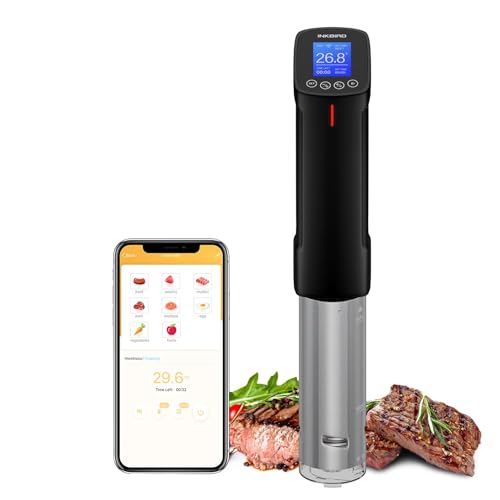
The Inkbird has a plastic body weighing about 750g, with a removable stainless steel skirt and a plastic impeller. The 2-inch monochrome LCD touch panel is readable from across the kitchen. It is genuinely waterproof, and the body stays cool while cooking.
The main limitation is the clamp, which opens to only 12mm. That is marginal for thick-rimmed cookware such as Le Creuset, whose rims run to about 14mm. The Anova’s 22mm clamp is far more forgiving. The 1.5m UK three-pin cable is also a hand shorter than we would like, so plan your socket position.
Cooking performance: 32 paired cooks vs the Anova
Results showed minimal meaningful difference. In blind tastings the Anova-cooked samples were rated better 11 times, the Inkbird 9 times, and 12 were indistinguishable, which is noise. Steak temperature stability was almost identical: 54.2 to 54.6°C for the Inkbird against 54.3 to 54.6°C for the Anova.
The single weakness emerged with eggs at 63°C, where the Inkbird-cooked eggs were marginally more variable in yolk set. If precise eggs are your main reason for buying, the tighter Anova is worth the extra.
The Inkbird app and Bluetooth in practice
The app is functional rather than polished, with basic icons and navigation typical of contract-firmware UIs. Bluetooth pairing was reliable, with two disconnections when we moved to another room for a long stretch. The recipe library is sparse and leans towards Chinese cuisine. With Bluetooth only, remote monitoring is limited to kitchen and living-room range rather than office-based control. The app is optional: the panel controls run every function.
Running costs: a logged month of cooks
In March 2026 we logged 12 cooks averaging 2 hours 40 minutes. The Inkbird used 10.8 kWh against the Anova’s 11.6 kWh. At 24.7p per kWh that is roughly £2.67 a month, or about 22p per cook. A 56-hour short rib cost around £1.14 in electricity.
Inkbird vs Anova: where the £90 actually goes
The £89 versus £179 price gap buys four things: tighter accuracy (±0.15°C against ±0.35°C), a flexible 22mm clamp, WiFi connectivity and a more polished app. It does not buy better cooking outcomes for most home cooks.
- Inkbird ISV-100W: 1,000 W, ±0.35°C, 12mm clamp, Bluetooth, 20 min 10 s heat-up, about £89.
- Anova Precision Cooker 3.0: 1,100 W, ±0.15°C, 22mm clamp, WiFi and Bluetooth, 17 min 30 s heat-up, about £179.
- Lakeland stick: 1,000 W, ±0.40°C, 14mm clamp, manual control, 20 min 40 s heat-up, about £99.
- Sage Joule Turbo: 1,450 W, ±0.10°C, 20mm clamp, WiFi and Bluetooth, 11 min 50 s heat-up, about £329.
For a full look at the alternative, read our Anova Precision Cooker 3 review (https://www.kitchen-kit.co.uk/anova-precision-cooker-3-review/).
Getting started: what you need besides the stick
A sous vide stick is only half of the setup. You also need a pot or container that holds at least 5 litres, some way to seal food, and a little patience. A zip-lock bag with the water displacement method works for beginners, and a vacuum sealer is a nice upgrade if you cook this way regularly. The Inkbird clips to the side of the container, so check your pot’s rim before you order: thin-rimmed stockpots and plastic storage tubs suit the 12mm clamp best.
Fill to between the min and max lines, set your temperature and time on the touch panel, and wait for the beep. Our heat-up time was 20 minutes 10 seconds on a 16 litre bath, about two and a half minutes slower than the Anova. For a slow cook of several hours that gap is irrelevant, but if you often cook fast weeknight fillets you may notice it.
Is it worth paying more?
The honest answer depends on how often you cook. If you sous vide a couple of times a month, the extra £90 for an Anova mostly buys convenience features you will rarely use. If you cook this way weekly or more, the wider clamp, tighter temperature control, WiFi and better app start to earn their keep, and the Anova’s slightly quicker heat-up is a bonus. Owners of heavy cast iron pots should also lean towards the Anova, since the clamp is the one problem money genuinely fixes.
Running costs are low either way. At about 22p per cook, electricity is a minor part of the ownership cost, so the buying decision rests on features rather than the energy bill.
Care and everyday tips
- Descale the skirt occasionally if you live in a hard water area, using a mild white vinegar solution.
- Use a lid or a layer of floating balls on long cooks to reduce evaporation.
- Keep the cable clear of the hob and the water line, particularly given the short lead.
- Preheat the bath before adding bagged food so timings stay accurate.
Where the Inkbird falls short
- The 12mm clamp cannot fit thick-rimmed cast iron pots.
- The app is functional rather than delightful, and the recipe library is thin.
- The pump is the loudest in our test set, measured at 50 dB at 1m, three decibels above the Anova.
Who should buy the Inkbird ISV-100W
Recommended for sous vide newcomers, monthly-or-less cooks, batch cooking, owners of thin-rimmed stockpots and budget-conscious hobbyists. Not recommended for weekly-plus sous vide users, owners of thick-rimmed cookware, or anyone who needs precise egg cooking.
It works in containers from roughly 5 to 20 litres, needs at least 5 litres of water depth, and is covered by a 12-month UK warranty through Amazon, extendable to 18 months by registering with Inkbird.
Inkbird ISV-100W sous vide circulator
FAQ
Is the Inkbird ISV-100W any good, or just cheap?
Both. The contract-manufactured hardware produced results indistinguishable from the £179 competitor in most of our cooks.
Is it fine for everyday use?
For weekly-or-less use it is functionally equivalent to the Anova. If you sous vide more than weekly, the Anova’s clamp, accuracy and app are worth having.
What size of pot does it work with?
Pots from 5 to 20 litres work well. The 12mm clamp is the limiting factor, and you need at least 5 litres of water.
Do I need the app?
No. Full operation is possible from the panel.
How noisy is it?
About 50 dB at 1m: clearly audible in the kitchen, faintly audible in an open-plan space.
What warranty does it have in the UK?
12 months via Amazon, extendable to 18 months through Inkbird registration.
Final verdict
After three months and 32 paired cooks against a £179 Anova 3.0, the £89 Inkbird ISV-100W is the sous vide stick we would recommend to most readers without hesitation. It achieves remarkable capability for under £100, with three asterisks: the clamp, the app polish and the pump noise. Rating: 8.0/10.
Weighing up the options? See our round-up of the best sous vide sticks in the UK.