
The Ninja AF400 Max XL is, in effect, an AF300 that has been to the gym. It keeps the same two-drawer dual-zone layout and the same six cooking programmes, but stretches total capacity from 7.6 litres to 9.5 litres. That extra room typically costs around £60 more, depending on the retailer and the week. After six weeks in a UK kitchen, our conclusion is simple: yes, the AF400 cooks more food. No, most UK kitchens do not actually need it.
This review looks at what the extra capacity really buys you, how the sync modes behave, how loud it is, and, most importantly, whether you have the worktop to live with it. Prices below are approximate and move often, so check the live listing before you buy.
Our verdict at a glance
- Best for households of five or more, weekly batch cooks and anyone who wants to roast a whole chicken: Ninja AF400UK.
- Best for most families of four or fewer: the Ninja AF300UK. It covers around 95% of cooking scenarios, takes up less space and costs less.
- Not worth it if your worktop is already crowded. The footprint is the single biggest reason we hold back a blanket recommendation.
The capacity case: 1.9L extra is a bigger deal than it sounds
On paper, 9.5 litres against 7.6 litres is a 25% uplift. In practice it is the difference between cooking for four adults in one batch and having to cook in two rounds. Each drawer measures roughly 22 × 19 cm, around 16% larger than the AF300 drawer at 21 × 18 cm, so a full tray of chips, a big batch of chicken thighs or a family-sized side of vegetables fits without overcrowding.
The headline trick is the whole chicken. With the centre divider removed, a 1.8 kg supermarket chicken fits in the AF400 as a single large cavity. The AF300 simply cannot do this. If Sunday roast for a full table is part of your routine, that alone may justify the upgrade.
Sync and Match: identical to the AF300
The two smart modes work exactly as they do on the smaller model. Sync finishes two different foods at the same moment even if their cooking times differ, and Match copies the settings from one drawer to the other for a big single batch. Across our six-week test, Sync accuracy averaged 32 seconds, which in real terms means the chips and the fish are ready together.
The one difference is preheat: because the drawers are larger, preheating takes roughly 10% longer. It is not a deal-breaker, but it is worth knowing if you are used to a quick blast for a small snack.
Cooking results: the whole-chicken win
Our whole-chicken test was the standout. A 1.8 kg bird roasted at 180°C for 50 minutes came out with crisp skin, evenly cooked thigh-to-breast meat and a finished internal temperature of 78°C in the breast and 82°C in the thigh. Always confirm with a probe thermometer rather than trusting the clock, as ovens and air fryers vary.
For everyday batches (chicken thighs, chips, fish fingers) the results were genuinely indistinguishable from the AF300. The one small downside appears with tiny portions: a single handful of nuggets in a big drawer can come out slightly less crisp because there is more air volume around the food. For very small meals, the smaller machine is the better fit.
Noise: the AF400’s quiet surprise
We expected the bigger machine to be louder. It was not. We measured 58 dB at 30 cm and 50 dB at 2 m for the AF400, against 64 dB at 30 cm and 56 dB at 2 m for the AF300. The larger fan blades turn more slowly and produce a lower-frequency hum that is easier to talk over. In an open-plan kitchen-diner, that is a genuine plus.
The footprint problem: this is the deal-breaker
The AF400 sits on 41 × 36 cm of worktop, around 14% more than the AF300 at 39 × 34 cm. Pull a drawer out to load it and the depth stretches to about 41 × 56 cm. It also needs breathing room behind for ventilation. This is a serious worktop commitment, and it is the single biggest reason we do not recommend the AF400 to households who do not actively need the bigger drawers.
Before ordering, measure the space, check the clearance under wall cabinets and think about where the drawers will open. If it will live in a cupboard and come out for special occasions, a machine this size is a chore to lift in and out.
It is also worth being honest about who this machine is not for. If you mostly cook for one or two, reheat leftovers or make the odd portion of chips, the AF400 will feel like overkill and will sit hogging space. Extra capacity only pays off when you regularly fill it, so think about your busiest cooking night rather than your average one.
Cleaning, accessories and warranty
Both drawers and crisper plates are dishwasher safe, and ours went through more than 25 cycles with no coating wear or damage. Accessories are not interchangeable with the AF300, so if you are upgrading, do not expect your old crisper plates or silicone liners to fit. Ninja UK provides a 2-year limited warranty as standard.
AF300 vs AF400: definitive guidance
Buy the AF400 if:
- Your household is five or more people.
- You regularly feed four or more guests on weeknights.
- You want to roast whole chickens in the air fryer.
- You have generous worktop space to spare.
- You batch-cook proteins every week.
Buy the AF300 instead if:
- You are a family of four or fewer.
- You entertain less than monthly.
- Your worktop is already crowded, as most UK ones are.
- You would rather keep the £60 or so difference.
For related reading, see our other reviews and guides on Kitchen Kit, including the best sous vide sticks for UK kitchens and the Tower Vortx 5L review.
Ninja Foodi MAX Dual Zone AF400UK 9.5L
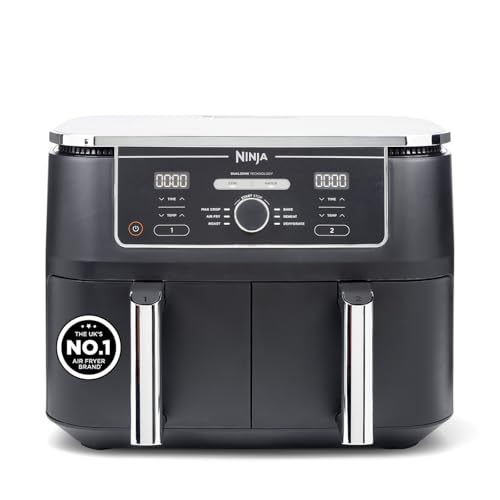

The AF400UK is the machine to buy if you cook for five or more, want the whole-chicken option and have the worktop to spare. It has two 4.75 litre drawers, a 2,470W element and six programmes: Air Fry, Max Crisp, Roast, Bake, Reheat and Dehydrate. Check the listing carefully: Amazon also sells an exclusive copper/black bundle and a newer variant, so make sure you are ordering the version you intend.
Ninja Foodi Dual Zone AF300UK 7.6L
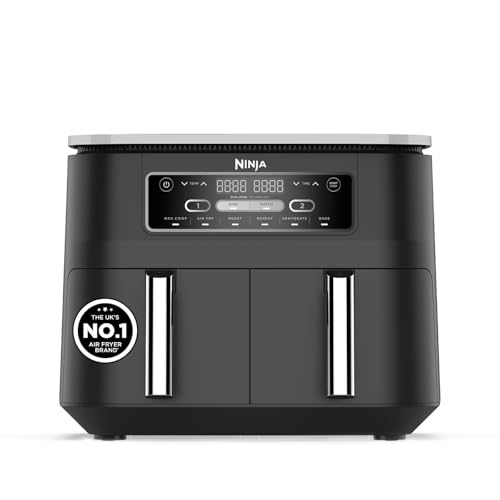
The AF300UK is the practical choice for most UK families. The same Sync and Match modes, the same programmes, results we could not tell apart at family-of-four sizes, a smaller footprint and a lower price. If you are on the fence, this is the one we would start with.
Frequently asked questions
Q: Is the AF400 worth £60 more than the AF300?
A: For households of five or more and meal-prep cooks: yes, comfortably. For everyone else: no. The AF300 does the same job with a smaller footprint and money left in your wallet.
Q: Does the AF400 fit a UK roasting chicken?
A: Yes. A 1.8 kg supermarket chicken fits with the divider removed and roasts well at 180°C for about 50 minutes.
Q: How does the AF400 compare to the Ninja Foodi Max?
A: The Foodi Max is a single-basket 6.7L unit with multi-cook functions, while the AF400 gives you dual-zone capability and far more cooking area.
Q: Can I use AF300 accessories in the AF400?
A: No. Crisper plates, drawers and silicone liners are not interchangeable between the two models.
Q: What’s the AF400’s warranty in the UK?
A: Ninja UK provides a 2-year limited warranty as standard.
Q: Is the AF400 dishwasher safe?
A: Yes. Both drawers and crisper plates are dishwasher safe, and ours came through 25+ cycles with no coating wear or damage.
Final verdict
The Ninja AF400 is a well-made, surprisingly quiet air fryer that genuinely does more than the AF300, but only if you will use that extra capacity. For larger households and Sunday-roast cooks it is a strong buy. For the typical UK family of four, the AF300 delivers 95% of the cooking at around £60 less and with a much friendlier footprint. Check the live listings for current prices and pick the one that matches your worktop, not just your appetite.
Weighing up the options? See our round-up of the best air fryers in the UK.



