We’re here to help you
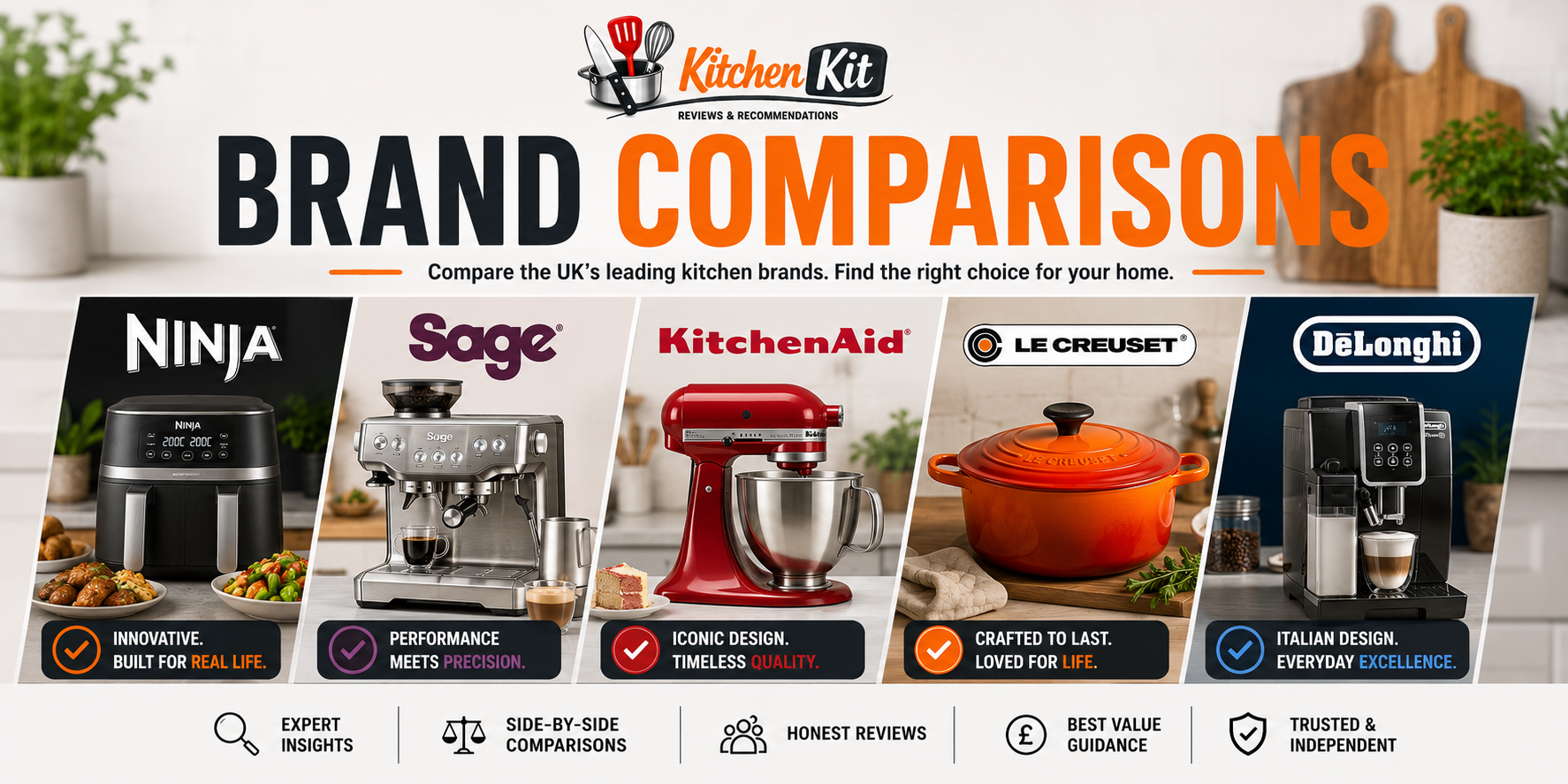
The kitchen-appliance aisle is full of brands shouting for your attention, but only a handful consistently deserve it. We’ve spent the last twelve months cooking, brewing and baking through kit from dozens of manufacturers — what follows is the honest shortlist.
This isn’t a generic round-up. We’ve focused on the six brands that matter most to UK home cooks — the ones we’d actually recommend to a friend furnishing a new kitchen, weighed against a small London flat (induction hob, 13A sockets, limited counter space) and a household budget that has to stretch.
Each brand earns its spot for a different reason. Some are best for one specific category and quietly forgettable elsewhere; others have remarkable range. We’ll tell you which is which.

The kitchen brand that arguably rewrote the rulebook for British home cooking in the 2020s. Ninja exploded into UK kitchens on the back of one product — the dual-zone air fryer — and used that beachhead to build an empire of multi-cookers, blenders, ice cream makers and grills. Owned by SharkNinja (the same parent behind the Shark vacuum brand), Ninja’s strategy is consistent: pick a cooking method, engineer it better than the competition at a similar price, and put a confident black-and-copper appliance on the worktop. They market hard, sponsor television, and update product lines aggressively — three new air fryer models a year is not unusual. The result is a brand that home cooks recognise instantly and trust by default. For a UK home co
Founded in 1995 in Massachusetts, USA, originally as Euro-Pro under entrepreneur Mark Rosenzweig. The Ninja brand launched in the early 2000s, initially focused on blenders, before pivoting decisively to multi-cookers and air fryers. The parent company, SharkNinja Operating LLC, went public on the New York Stock Exchange in 2023 and now reports annual revenues exceeding $4 billion globally.
The Foodi Dual Zone Air Fryer is the brand’s defining product — six-litre and eight-litre versions dominate UK sales charts. Beyond air frying, the Foodi multi-cooker (pressure cook, slow cook, air fry, steam in one pot), the Creami ice-cream maker, the Woodfire outdoor grill, and the Speedi rapid cooker are the standout lines. The Blender Duo also has a strong UK following.
SharkNinja’s global headquarters are in Needham, Massachusetts, USA, with a major UK and Ireland operations base in Leeds, West Yorkshire — meaning UK customer service and warranty processing happens domestically rather than across the Atlantic. The company has additional offices in China, Germany and Japan, and operates manufacturing through partner facilities primarily in China and Vietnam.
Ninja enjoys an unusually strong reputation among British home cooks, regularly topping Which? Best Buy lists for air fryers and multi-cookers. Trustpilot scores hover around 4.4/5 on tens of thousands of reviews.
Mid-market — what we’d call premium for the category, but not premium overall. A Foodi Dual Zone air fryer typically retails between £199 and £299, undercutting Sage and Smeg appliances meaningfully while sitting comfortably above budget brands like Tower and Russell Hobbs. Ninja rarely discounts deeply but participates fully in Amazon UK Prime Day and Black Friday events, where 20–30% off is the standard.
Air fryers, multi-cookers, blenders, food processors, coffee makers, hot/cold drink makers (Thirsti), outdoor grills (Woodfire), ice cream makers (Creami), and increasingly cookware — the NeverStick pan range launched into the UK in 2024. Notably absent: stand mixers, dishwashers, large appliances. Ninja deliberately stays in the countertop space where its engineering and marketing edge is sharpest.
The Breville company was founded in Sydney, Australia, in 1932 by Bill O’Brien and Harry Norville (the brand name is a portmanteau of their surnames). Originally a manufacturer of car radios, Breville pivoted to small kitchen appliances in the 1960s and is widely credited with inventing the toasted sandwich maker. The Sage brand name was adopted for UK and European markets in 2011.
The Barista Express is the runaway icon — the espresso machine that created an entire category of prosumer home espresso. Beyond it, the Smart Oven Pro (with element-IQ heat-element control), the Super Q blender, the Bambino Plus (entry-level espresso), and the Smoking Gun (food smoker) are the brand’s standout products. The Oracle Touch is the flagship, fully-automatic top-of-range coffee machine.
Breville Group Limited is headquartered in Alexandria, Sydney, Australia, where the company is listed on the Australian Securities Exchange (ASX:BRG). The European operation, which oversees the Sage brand, is based in Botley, Oxfordshire. Manufacturing is largely handled by partners in China, with quality control and product development split between Australia and the UK.
Sage commands one of the strongest reputations in UK premium kitchen kit, particularly among coffee enthusiasts. The Barista Express alone has thousands of five-star Amazon reviews. The brand is praised for engineering quality, longevity, and customer service responsiveness. Criticism, where it exists, focuses on price and on out-of-warranty repair costs — Sage machines are well-built but not cheap to fix when they do fail.
Premium. Entry-level Sage products like the Bambino espresso machine start around £350, while mid-range items such as the Barista Express and Smart Oven Pro sit in the £600–£900 range. The flagship Oracle Touch retails north of £2,500. Sage rarely discounts but participates in Black Friday and offers a structured refurbished programme through John Lewis and direct, where 20–30% savings are realistically achievable.
Espresso machines, coffee grinders, ovens, blenders, food processors, kettles, toasters, slow cookers, and a small but premium cookware line. Notably, Sage does not make air fryers, stand mixers, or any large appliances. The portfolio is deliberately focused on countertop appliances where engineering depth justifies the premium price tag — every product earns its shelf space.

Sage is the brand for British home cooks who’ve outgrown beginner kit but aren’t ready to pour cement and install a commercial espresso machine in their kitchen. The Sage Barista Express has, almost single-handedly, taught a generation of British coffee drinkers what real espresso tastes like at home — and the brand has applied the same engineering depth to ovens, blenders and food processors. Sold in the rest of the world as Breville (the Australian original), Sage trades under a different name in the UK and Europe due to a long-running trademark conflict with the unrelated UK kitchenware brand. The products are identical; only the badge changes. Sage products sit somewhere between mass-market and professional — properly engineered, built from real materials, and packed with thoughtful features that reward users who learn the appliance rather than just press one button.
De’Longhi is the brand for British home cooks who want excellent coffee every morning without learning to be a barista. The Italian company has spent decades perfecting bean-to-cup technology — the kind of machine that grinds whole beans, doses them, tamps them, brews espresso, and steams milk for a cappuccino at the press of one button — and now dominates the European bean-to-cup market. Beyond coffee, De’Longhi makes kettles, toasters, slow cookers, multi-cookers, and even portable air conditioners and oil-filled radiators (a less-glamorous but lucrative slice of their business). For the UK kitchen-gear shopper, however, De’Longhi is overwhelmingly a coffee brand. The Magnifica Evo and the higher-end Eletta Explore are the workhorse machines that have replaced the daily Costa run for hundreds of thousands of British households — and at a fraction of the long-term cost.
De’Longhi was founded in 1902 in Treviso, north-east Italy, originally as a small industrial parts workshop run by the De’Longhi family. The company entered consumer appliances in the 1950s, initially making portable heaters, before expanding decisively into coffee machines in the 1980s. De’Longhi is now publicly listed on the Borsa Italiana (DLG) and reports global revenues exceeding three billion euros annually.
The Magnifica Evo is the bestselling bean-to-cup machine in Europe and the brand’s defining product. Beyond it, the Eletta Explore (premium bean-to-cup with cold-foam capability), the Dedica (slim manual espresso machine), the La Specialista range, and the Dinamica Plus are the most prominent lines. Outside coffee, the Multifry air fryer-cookers and the iconic Pinguino portable air conditioners round out the brand’s recognised products.
De’Longhi Group is headquartered in Treviso, in the Veneto region of north-east Italy. The company maintains research and development facilities in Italy and Germany, and operates manufacturing plants across Italy, Romania and China. The UK and Ireland operation runs through De’Longhi UK Limited, headquartered in Wokingham, Berkshire, with UK-based customer service and warranty processing handled domestically.
De’Longhi has a strong reputation for everyday reliability and accessible pricing in the bean-to-cup category. Trustpilot scores sit around 4.0/5, with the lower scores typically tied to engineer call-outs on out-of-warranty machines rather than the products themselves. Praised attributes: simplicity, replacement parts availability, and a mature ecosystem of descalers and cleaners. Criticism focuses on customer service consistency.
Premium-mid. The entry-level Magnifica Start sits around £349, the bestselling Magnifica Evo retails between £499 and £649, and the flagship Maestosa exceeds £2,500. The slim Dedica espresso machine starts at £199, undercutting Sage’s equivalent offerings. De’Longhi runs strong promotional discounts, particularly through Currys and Amazon UK around Black Friday — 25–35% off is realistic on mid-range bean-to-cup models.
Bean-to-cup coffee machines, manual and automatic espresso machines, coffee grinders, kettles, toasters, slow cookers, multi-cookers, deep fryers and Multifry air fryer-cookers. Outside the kitchen: portable air conditioners (Pinguino), oil-filled radiators, dehumidifiers and electric heaters — De’Longhi remains a major player in domestic climate appliances. The brand does not make stand mixers, blenders, or food processors.
Le Creuset was founded in 1925 in the small French town of Fresnoy-le-Grand, in Picardy, by Belgian industrialists Armand Desaegher and Octave Aubecq. The first product — a Volcanic orange enamelled cast iron casserole — is still produced today, in the same foundry, using the same casting and enamelling processes that have been carefully refined over a hundred-year history.
The Signature 24cm round casserole in Volcanic orange is the brand’s icon, often considered the single most photographed piece of cookware in the world. Beyond it, the Signature oval casseroles, the Toughened Non-Stick frying pan range, the cast iron skillet, and the stoneware mugs and oven dishes round out the most popular lines. The traditional kettle range is also a strong UK seller.
Le Creuset’s global headquarters and primary manufacturing site remain in Fresnoy-le-Grand, France, where every piece of cast iron is still cast and enamelled. The UK and Ireland operation is based in Andover, Hampshire, and operates over a dozen factory outlet stores across the country. The brand has remained privately owned since the 1980s under a Belgian holding company.
Le Creuset commands one of the strongest reputations in the entire homeware sector, with cult-level loyalty among UK home cooks. Trustpilot scores are consistently above 4.5/5 across thousands of reviews, with longevity, customer service, and the genuinely-honoured lifetime guarantee most praised. Criticism focuses on weight (a 24cm casserole approaches 5kg empty) and on the steep price point.
Luxury / heirloom. A 24cm Signature cast iron casserole retails between £225 and £305 depending on colour. Stoneware items start around £18 (mugs) and rise to £80 plus (oven dishes). Le Creuset rarely discounts directly, but their factory outlets (Bicester Village, Cheshire Oaks, Swindon) offer 30%-plus off seconds and discontinued colours. Amazon Warehouse occasionally lists genuine Le Creuset returns at significant savings.
Enamelled cast iron (casseroles, skillets, grill pans), toughened non-stick aluminium cookware, stainless steel cookware, stoneware (mugs, ramekins, oven dishes, tagines), kettles, mini cocottes, tableware, accessories such as silicone tools and oven gloves, and a small but growing range of textiles. Notably absent: small electric appliances, knives, and gadgets. The brand stays focused on cookware and tableware.

Le Creuset is the most identifiable cookware brand on the planet. The vivid enamelled cast iron — Volcanic orange, Marseille blue, Cerise red — is recognisable from the doorway of any kitchen that owns a piece. But Le Creuset’s reputation isn’t built on colour; it’s built on the fact that a properly cared-for Le Creuset casserole genuinely outlasts the cook. A 24cm Signature casserole bought in 1985 still works in 2026, still holds its enamel, and on eBay still sells for 60–70% of its original price. The brand has expanded carefully from its core French foundry into stoneware, stainless steel, kettles and tableware, but cast iron remains the heartbeat. Le Creuset is not cheap — a 24cm casserole retails north of £200 — but it’s the rare kitchen brand where the lifetime guarantee is genuinely the rule, not the exception.

KitchenAid is less an appliance brand and more a kitchen institution. The Artisan stand mixer, instantly recognisable in its dozens of colour finishes, has been the centrepiece of serious home baking for nearly a century — and a 30-year-old Artisan still works, still has parts available, and still commands a healthy resale price. Owned by American giant Whirlpool Corporation, KitchenAid has spent decades extending the Artisan halo into food processors, hand mixers, kettles, toasters, blenders and, more recently, larger appliances like dishwashers and ovens. The brand’s strength sits in two categories — stand mixers and food processors — where it genuinely sets the standard. Outside those, KitchenAid is competent rather than exceptional, and its products often command a premium driven more by brand heritage and design than by engineering advantage. For UK bakers, however, an Artisan in the corner of the kitchen is close to non-negotiable.
KitchenAid was founded in 1919 in Troy, Ohio, USA, originally as a division of the Hobart Manufacturing Company to commercialise a planetary-action stand mixer engineer Herbert Johnston had developed for industrial bakeries. The first home model launched in 1919 as the Model H. Whirlpool acquired the KitchenAid brand in 1986 and continues to manufacture the Artisan in Greenville, Ohio.
The Artisan stand mixer is the undisputed signature product, with the 4.8-litre tilt-head version the best seller in the UK. Beyond it, the K400 blender, the 9-cup Food Processor, the Cordless Variable Speed Hand Blender, and the Artisan Kettle and Toaster duo are the most prominent lines. The Pro Line series targets serious home bakers with bowl-lift mechanics and larger 6.9-litre capacity.
KitchenAid is headquartered in Benton Harbor, Michigan, USA — the same campus as parent company Whirlpool Corporation. The iconic Artisan stand mixer is still manufactured at the historic Greenville, Ohio plant in the United States. The UK and Ireland operation runs through Whirlpool UK Appliances Limited, headquartered in Peterborough, Cambridgeshire, which handles UK warranty and customer service.
KitchenAid enjoys near-cult status among UK home bakers. The Artisan is consistently cited as a buy-once-cry-once purchase that lasts decades. Trustpilot and Which? scores are strong, with longevity the most-praised attribute. Criticism focuses on price (an Artisan costs significantly more than equivalent-power Kenwood or Smeg models) and on the patchy quality of KitchenAid’s smaller, lifestyle-oriented appliances.
Premium. The Artisan stand mixer typically retails between £499 and £699 depending on colour and finish — special editions can exceed £800. Smaller KitchenAid items (kettles, toasters) sit in the £100–£200 range, often two to three times the price of equivalent Russell Hobbs alternatives. KitchenAid runs structured sales around Black Friday and the January sales, with John Lewis and Amazon UK typically offering 20% off.
Stand mixers, food processors, hand mixers and immersion blenders, kettles, toasters, coffee machines, and increasingly large appliances — wall ovens, dishwashers, hobs and refrigerators, primarily for the US market though some lines reach the UK. The accessory ecosystem for the Artisan stand mixer is extensive: pasta rollers, ice cream bowls, meat grinders, sausage stuffers, and vegetable spiralisers.